 PhysicsBowl
Not every PhysicsBowl candidate sits in a school hall. AAPT’s published rules accommodate homeschooled students, library-based sittings and test-prep centres, but each route carries its own proctor-source requirement, email-verification path and award-category limitation. Candidates in Asia and the Middle East (regions 15–21, including China) register through ASEEDER rather than directly via AAPT, so the routing described here applies to direct AAPT registration; see our ASEEDER registration guide if that is your pathway. This article separates the non-school routes so a candidate can confirm eligibility before registration closes.
The Universal Proctoring Rule: No Family, No Exceptions
Every PhysicsBowl sitting, regardless of venue, must be proctored. AAPT’s rules exclude parents, relatives, close friends and acquaintances of the student from serving as proctors. This prohibition is absolute; it does not relax because a student is homeschooled, travelling, or sitting in a private study room. The rule exists to preserve the integrity of a 40-question, 45-minute timed examination whose scores feed into regional rankings.
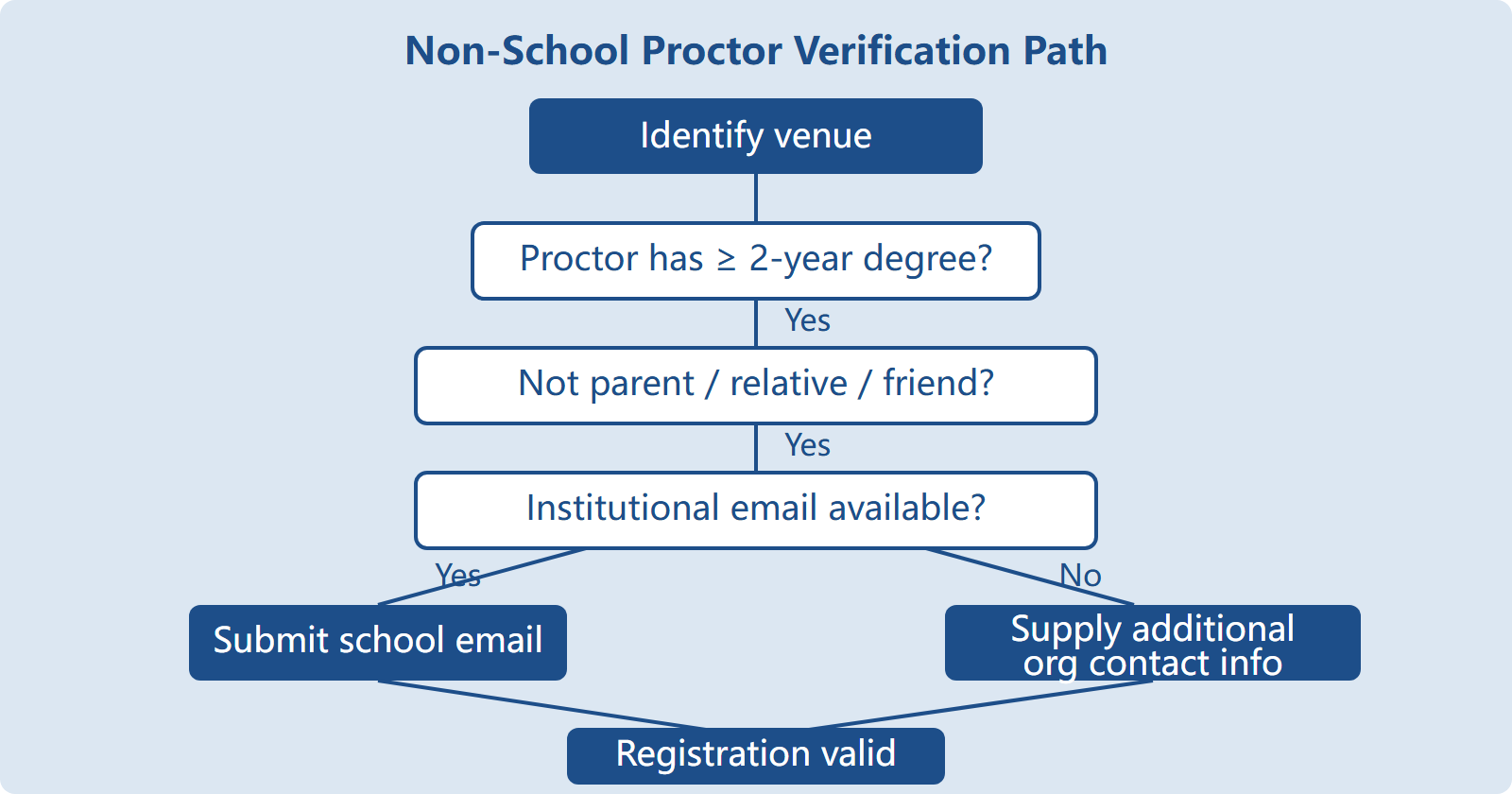
The proctor must hold at least a two-year degree. That degree need not be in physics or any STEM field; a librarian with an associate’s degree in library science satisfies the credential threshold. What matters is that the proctor can observe the testing process and ensure no unauthorised materials or communication occur. For candidates accustomed to self-study, this is the single hardest constraint to arrange, because the most convenient adult in the room—a parent—is categorically excluded.
AAPT expects and prefers that competitors sit the exam at their local school, but acknowledges that students may take it elsewhere if needed. That elsewhere is where the remaining rules become operationally important.
Homeschooled Candidates: Sourcing an Acceptable Proctor
AAPT directs homeschooled students to contact community colleges, universities, or libraries to ask whether they offer proctoring services. The parent or guardian may register the child for the exam—registration and proctoring are separate functions—but the registration form must include information for an alternative proctor. A parent filling in their own name in the proctor field will not satisfy the requirement.
Practically, this means a homeschooled candidate should begin outreach well before the registration deadline. AAPT names community colleges, universities and libraries as places to ask about proctoring services; the specific department or arrangement will vary by institution, so candidates should confirm details directly with the venue. The proctor must be able to observe the student for the full 45 minutes. AAPT’s published guidance for library sittings requires that staff can observe the test to ensure its integrity; candidates using any non-school venue should confirm with the venue and with AAPT what oversight arrangements will satisfy the requirement before registration.
If a library agrees to proctor, AAPT’s guidance specifies a public library setting where staff can observe the test. Whether a particular room or arrangement within a library system qualifies is something the candidate should confirm with both the library and AAPT before committing. The library itself does not need to specialise in physics or standardised testing; it needs the institutional standing to provide an official contact point for verification.
Email and Identity Verification: What Counts and What Does Not
AAPT uses the proctor’s email address as a primary identity check. The stated preference is an official school email address, ideally one associated with a school district or an accredited private school. Personal email addresses—Gmail, Outlook, Yahoo, or any free provider—are explicitly not acceptable.
For non-school venues this creates a concrete problem. A community-college proctor can supply a .edu address. A public-library proctor can supply a municipal or library-system domain. A test-prep centre must supply its organisational email and, critically, must acknowledge its status as a testing centre and provide a web address for verification purposes.
If no official school email is available—say, a small tutoring collective without an institutional domain—AAPT requires additional contact information for the organisation so it can verify both the proctor’s identity and the organisation’s legitimacy. The registration will not proceed on a personal inbox alone. Candidates should confirm the proctor’s institutional email before filling in the registration form, not after.
Test-Prep Centres and Educational Services: A Separate Region, Limited Awards
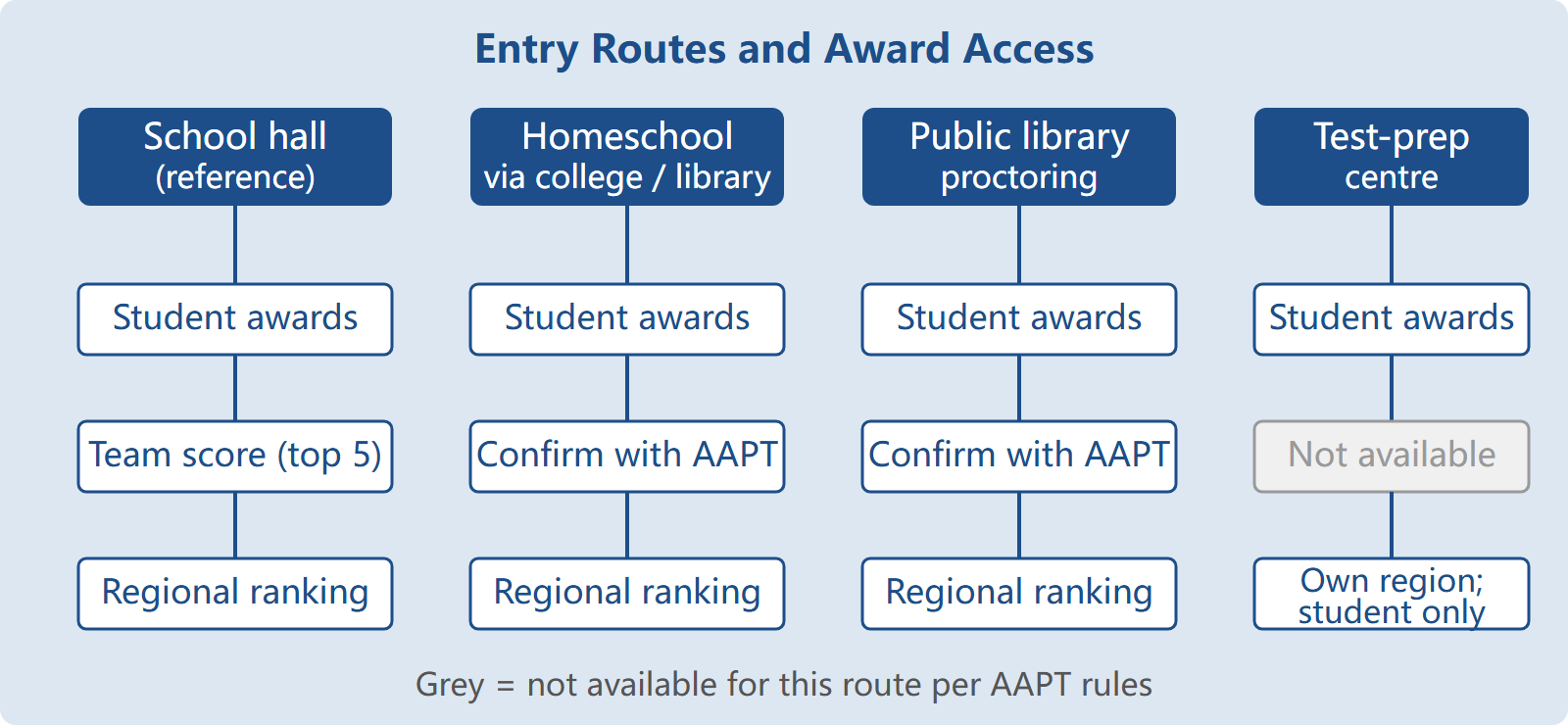
AAPT places Test Prep Centers and Educational Services in their own competitive region. They do not compete against school teams in the standard 15 domestic regions or the seven Asia-and-Middle-East regions (regions 15 through 21). More importantly, they are eligible for student award categories only. This means individual students can earn recognition based on their personal score, but the centre cannot field a five-student team whose top-five sum determines a school-team ranking.
For a student entering through a test-prep centre, the practical consequence is clear: there is no team-score pathway. The student’s result stands or falls on individual performance. This is worth understanding before registration, because some families assume a centre entry carries the same team-recognition structure as a school entry. It does not.
AAPT is explicit that it holds no affiliation with, does not endorse and does not recommend any test centres, schools or other proctoring locations. It does not facilitate or arrange test centres, teachers or proctors, and it does not maintain a shareable listing of participating centres. Families must locate and vet a proctoring venue entirely on their own.
Comparing the Four Non-Standard Routes
| Route | Acceptable Proctor Source | Email / Verification | Award Eligibility | Team Score? |
|---|---|---|---|---|
| Homeschool via community college or university | Testing-office staff with ≥ 2-year degree | Institutional (.edu or equivalent) email | Student + regional (as individual) | Not specified for non-school routes; ask AAPT which category applies |
| Homeschool via public library | Library staff who can observe the sitting | Library / municipal domain email | Student + regional (as individual) | Not specified for non-school routes; ask AAPT which category applies |
| Test-prep centre / educational service | Centre staff; must acknowledge testing-centre status and supply web address | Organisation email + website URL for verification | Student award categories only | No |
| Standard school hall (reference) | School teacher or appointed staff | Official school / district email | Student + team + regional | Yes – top five scores summed |
The table is illustrative of the structural differences AAPT outlines; specific regional placement depends on the address and organisation type entered at registration. Note that AAPT explicitly restricts test-prep centres to student awards but does not individually confirm team-score or regional-ranking eligibility for homeschooled candidates; the homeschool entries above reflect the general scoring structure described for school teams, applied by inference. Candidates should verify with AAPT (programs@aapt.org) before relying on team-score access.
Decision Checklist Before You Commit
Before submitting a registration, a non-school candidate should confirm five items in sequence:
1. Venue confirmed. You have a physical location—a college testing room, a public library study area, or a test-prep centre classroom—where the proctor can observe you for 45 uninterrupted minutes.
2. Proctor identified and eligible. The proctor holds at least a two-year degree, is not your parent, relative, close friend or acquaintance, and is willing to be named on the registration form.
3. Email path verified. The proctor can supply an institutional email address. If not, you have gathered the additional organisational contact information AAPT requires.
4. Award category understood. If you are entering through a test-prep centre, you know that only student-level awards are available. If you are homeschooled or using a library venue, AAPT’s published materials do not specify a team-score pathway for non-school entries; contact AAPT’s Programs department to confirm which award categories apply to your situation.
5. Registration timeline respected. For the 2026 contest the deadline was 23 February (extended to 25 February). Registration for 2027 opens in December. Non-school candidates need extra lead time to secure a proctor, so beginning outreach in December or early January is prudent.
What AAPT Will Not Do for You
A common misconception among families new to the contest is that AAPT can recommend or assign a proctoring location. The organisation is explicit: it does not facilitate or arrange test centres, teachers, or proctors. It does not maintain a shareable listing of centres that have participated or will participate. If a test-prep centre advertises itself as “AAPT-approved” or “AAPT-recommended,” that claim has no basis in AAPT’s published position.
This non-endorsement stance means the burden of due diligence falls entirely on the family. You must verify the proctor’s credentials, confirm the venue can support a 45-minute observed sitting, and ensure the email or organisational contact information will pass AAPT’s verification. For candidates in the Asia and Middle East regions (15 through 21), registration routes through ASEEDER rather than directly through AAPT, adding a further layer of coordination that families should confirm early. Our earlier piece on PhysicsBowl registration from China via ASEEDER covers that pathway in detail.
Frequently Asked Questions
Can my parent proctor my PhysicsBowl exam if I am homeschooled?
No. AAPT explicitly states that parents, relatives, or close friends and acquaintances of students are not acceptable proctors, and it repeats this prohibition specifically for homeschooled students. A parent may register the child but must supply an alternative proctor at a community college, university, or library.
Will a personal Gmail address be accepted for my proctor’s contact information?
No. AAPT requires official school or institutional email addresses for proctor verification. Personal email addresses are not acceptable. If an institutional address is unavailable, you must provide additional organisational contact information so AAPT can verify the proctor’s identity and the organisation’s legitimacy.
If I enter PhysicsBowl through a test-prep centre, can my centre submit a team score?
No. Test Prep Centers and Educational Services compete in their own region and are eligible for student award categories only. The top-five team-score mechanism that applies to school entries is not available to test-prep centres.
For candidates whose school has never hosted the contest and who are considering whether to ask their school to run it instead of seeking an external venue, our guide on what hosting PhysicsBowl involves for a first-time school lays out the practical steps. And if you are uncertain how your regional placement affects ranking, the breakdown in PhysicsBowl regions and the top-five team score explains the competitive structure. The proctoring expectations for a standard school sitting are covered in who can invigilate your PhysicsBowl paper.
This article is published by an independent educational site and is not affiliated with, endorsed by, or sponsored by AAPT or the PhysicsBowl organising committee. All procedural statements are drawn from AAPT’s publicly available PhysicsBowl programme page as of September 2026. Candidates should verify current requirements directly with AAPT before registration.