 PhysicsBowl
 gives every student an equation sheet and a constants sheet, and only those formulas and constants may be used. The 2026 sheets cover the core relations from kinematics to early modern physics, plus five moments of inertia. But when we checked them against AAPT's 2026 answers, several solutions relied on relations the sheet does not print — among them series and parallel resistance, and rotational kinetic energy.
What the paper and AAPT's conventions say about the sheets
Three statements frame everything else. The instruction page of the 2025 and 2026 papers says only the formulas and constants provided with the contest may be used, and the question pages repeat that g is 10.0 m/s² for every question. AAPT's exam conventions page says the equation sheet carries many of the basic equations but is not, and is not meant to be, an exhaustive list of what a question may use. The same page says some constants are provided, that the constants on the sheet are the values used in building the exam, and that a value students are not expected to know — its example is the resistivity of copper — may still be asked about qualitatively, as a comparison rather than a number.
The sheets also change. AAPT notes that the equation sheet has changed over time, with many changes in 2008 and 2009, and that the constants sheet has changed in the past couple of years. Alongside the current season's sheets it produces an annotated equation sheet that explains what each line represents; that version is a study aid, not what you receive in the room. The sheet that counts is the one that comes with your paper, and nothing for 2027 has been published yet.
What does the 2026 equation sheet print, and what did the answers need anyway?
The 2026 equation sheet runs to two pages. The first moves from constant-acceleration kinematics through forces, gravitation, momentum and rotation, energy, springs and pendulums, fluids, heat and the ideal gas law, waves and the Doppler effect, refraction, interference and thin lenses, and on to electrostatics, capacitors, simple circuits and magnetism, ending with motional emf. The second page adds mass–energy, photon energy and momentum, the photoelectric equation, radiated heat, relativistic momentum and energy, and five moments of inertia: a hoop, a solid disk or cylinder, a solid sphere, and a thin rod about its centre and about its end.
To see how far that goes in practice, we read AAPT's 2026 answers and solutions against the sheet, question by question, and recorded every solution that used a relation the sheet does not print. Question numbers below are booklet numbers: questions 11 to 40 were sat by both divisions, while 46 and 50 were Division II only.
| Topic | Printed on the 2026 sheet (our summary) | Used in a 2026 solution but not printed |
|---|---|---|
| Linear mechanics | Kinematics equations, ΣF = ma, the friction limit, weight and gravitation, p = mv, a = v²/r | Centre of mass (Q24). Centripetal force as mv²/r (Q36), which you can rebuild from ΣF = ma and a = v²/r |
| Rotation | v = rω, a = rα, torque, Στ = Iα, five moments of inertia | Rotational kinetic energy ½Iω² (Q15, Q40). Angular momentum L = Iω and its conservation (Q30, Q40) |
| Energy and gravitation | Kinetic energy, mgΔy, work, spring energy, power, Hooke's law | Gravitational potential energy in its universal-gravitation form (Q23). KE = p²/2m (Q50), which you can rebuild from ½mv² and p = mv |
| Circuits | V = RI, P = IV, Q = CV, energy stored in a capacitor | Resistors in series and in parallel (Q46). Parallel branches and total current, reasoned qualitatively (Q32) |
| Heat and radiation | Ideal gas law, first law of thermodynamics, Q = mcΔT, latent heat, ΔS = Q/T, radiated heat | Wien's displacement law (Q13) |
| Waves | v = fλ, the Doppler effect | Wave speed on a string, set by tension and linear mass density, reasoned qualitatively (Q26) |
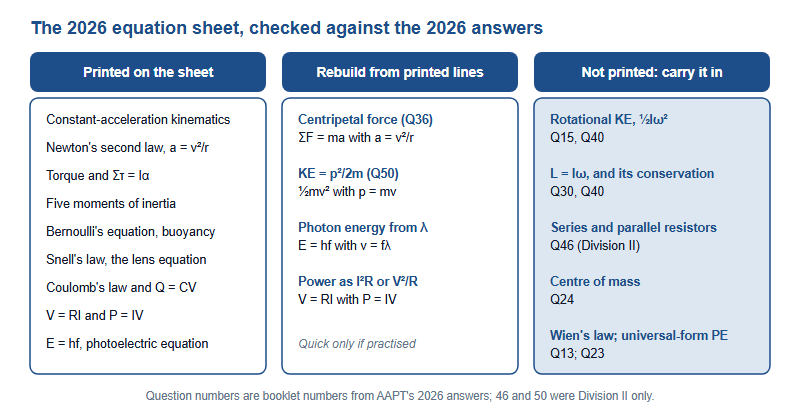
Two details stand out. Question 40, which AAPT's statistics name as the hardest Division I question of 2026, needed both rotational kinetic energy and the conservation of angular momentum, and neither is on the sheet. And question 15, in the block both divisions sit, paired a moment of inertia that the sheet supplies with a kinetic energy formula that it does not. In both cases the sheet carried part of the problem; the rest was recall.
Read the right-hand column of the table as a list of what you carry into the room in your head. None of it is exotic — it is standard first-course and second-course physics — but it shows that a sheet being provided and a sheet being enough are two different statements.
The constants sheet rounds on purpose
The 2026 constants sheet opens with an instruction worth taking literally: use its values, because other values may give answers that do not exactly match any option, in which case you choose the option closest to your own result. Its values are rounded to two or three significant figures, and a few sit noticeably away from the figures in a university data book.
| Quantity | 2026 constants sheet | More precise value | The sheet differs by about |
|---|---|---|---|
| Acceleration due to gravity, g | 10 m/s² | 9.81 m/s² | 2% high |
| Gravitational constant, G | 6.7 × 10⁻¹¹ N·m²/kg² | 6.674 × 10⁻¹¹ N·m²/kg² | 0.4% high |
| Radius of the Earth | 6.4 × 10⁶ m | 6.371 × 10⁶ m (mean) | 0.5% high |
| Rest mass of the proton | 1.7 × 10⁻²⁷ kg | 1.673 × 10⁻²⁷ kg | 1.6% high |
| Atomic mass unit | 1.7 × 10⁻²⁷ kg | 1.661 × 10⁻²⁷ kg | 2.4% high |
| Planck's constant, h | 6.6 × 10⁻³⁴ J·s | 6.626 × 10⁻³⁴ J·s | 0.4% low |
A difference of half a percent rarely changes which option is closest, but differences compound. A result that depends on the square of the Earth's radius roughly doubles that error, and a calculation that combines g with the proton mass stacks two of them. The practical cost is usually time rather than marks: a value that lands between two options sends you back through the arithmetic, hunting for a mistake that is not there. Two further details are worth knowing. The sheet gives the proton mass and the atomic mass unit the same rounded value, and it lists the latent and specific heats of water in both kilocalories and joules, so a stem written in kilocalories should not stall a student trained only in SI units. And when a question supplies its own value — the 2026 alpha-particle question gave the particle's mass in the stem — use the value in the question.
The conventions AAPT writes questions around
AAPT's conventions page lists the working assumptions behind the questions, and says it tries to make implicit assumptions clear in the stem of each question. Five of those assumptions change how a question should be read.
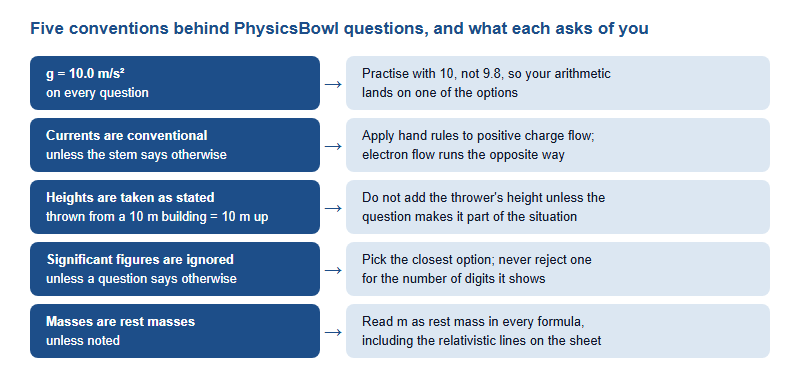
The convention on current is the one with a history. AAPT's FAQ recalls a question that used the word current and confused students taught both conventional and electron current, and it says challenges to questions are accepted — but only after the official solutions are published, roughly a week after the contest officially closes. The 2026 answer key shows that corrections do happen: it lists two answers for each of questions 23 and 44, and records a slip in one of the options of question 49. If you sit through the China route and believe a question was genuinely ambiguous, raise it through your teacher and the channel that entered you once the solutions are out, rather than on the day.
How to prepare with the real sheets
- Learn the sheet before you need it. Know what is printed and what is not, so that in the paper you never search for a relation that was never there. A glance for a line you rarely use — a Doppler sign convention, Bernoulli's equation — is cheap; hunting for a line that does not exist is not.
- Practise with the current sheet, even on older papers. The sheet has changed over the years, and the habit you want is the one built around the version you will actually receive.
- Build your own not-printed list. After each past paper, go through the solutions and note every relation used that the sheet does not print. Within a few papers the list stops growing, and that list is what your recall practice should cover.
- Do practice arithmetic with sheet constants. It keeps your answers landing on the options and removes the near-miss hesitation described above.
- Check what comes with your sitting. The sheets described here are the ones AAPT published for 2026. For a China-route sitting, arrangements are set by that route, so look over the sheets the moment you receive your paper.
Our past-paper pack includes papers with their answers, and worked solutions for some years; what you receive follows what our teachers send, and the past papers page explains how to ask for it. The format, divisions and scoring are summarised on our rules page, and how an entry from China is arranged is set out on the registration page.
Common questions
Is there a formula sheet in the PhysicsBowl?
Yes. An equation sheet and a constants sheet come with the paper, and only those may be used. The equation sheet is not exhaustive.
What value of g does the PhysicsBowl use?
Every question uses g = 10 m/s², and the constants sheet asks you to use its values so that your answers match the options.
Is series and parallel resistance on the equation sheet?
Not on the 2026 sheet, although a 2026 Division II question needed both. Learn resistor combinations by heart.
Does the PhysicsBowl count significant figures?
AAPT says significant figures are not considered unless a question says otherwise, so choose the option closest to your value.
Contest details change from season to season; confirm current details on aapt.org before acting on anything here. Corrections are issued within 7 working days.