 PhysicsBowl
In Physics Bowl Division 2, rolling motion questions often trap students who apply sliding-block logic. The key is not just the algebra, but verifying the no-slip constraint (v = ωR) and understanding that static friction does no work in ideal rolling. This tutorial walks through checking these conditions to avoid common energy conservation errors.
Why rolling is not sliding
For a sliding block on a frictionless surface, all gravitational potential energy lost becomes translational kinetic energy. For a rolling object, the total kinetic energy is the sum of translational and rotational parts:
K_total = ½mv² + ½Iω²
Here m is the mass, v is the velocity of the centre of mass, I is the moment of inertia about the centre of mass, and ω is the angular velocity. If you omit ½Iω², your calculated speed will be too high. The object cannot move as fast as a frictionless sliding block because part of the energy budget goes into rotation.
This also explains why shape matters. Two objects with the same mass and radius can roll down the same incline at different speeds if their moments of inertia differ. A solid sphere, with I = 2/5 MR², stores less rotational energy for a given v than a hollow cylinder, with I = MR². The solid sphere therefore reaches the bottom first. That ranking is a useful sanity check when reviewing multiple-choice options. For a broader treatment of energy accounting, see Physics Bowl Energy Graphs: Connect Potential Energy With Force and Motion.
Static friction in pure rolling: Ideal Assumptions
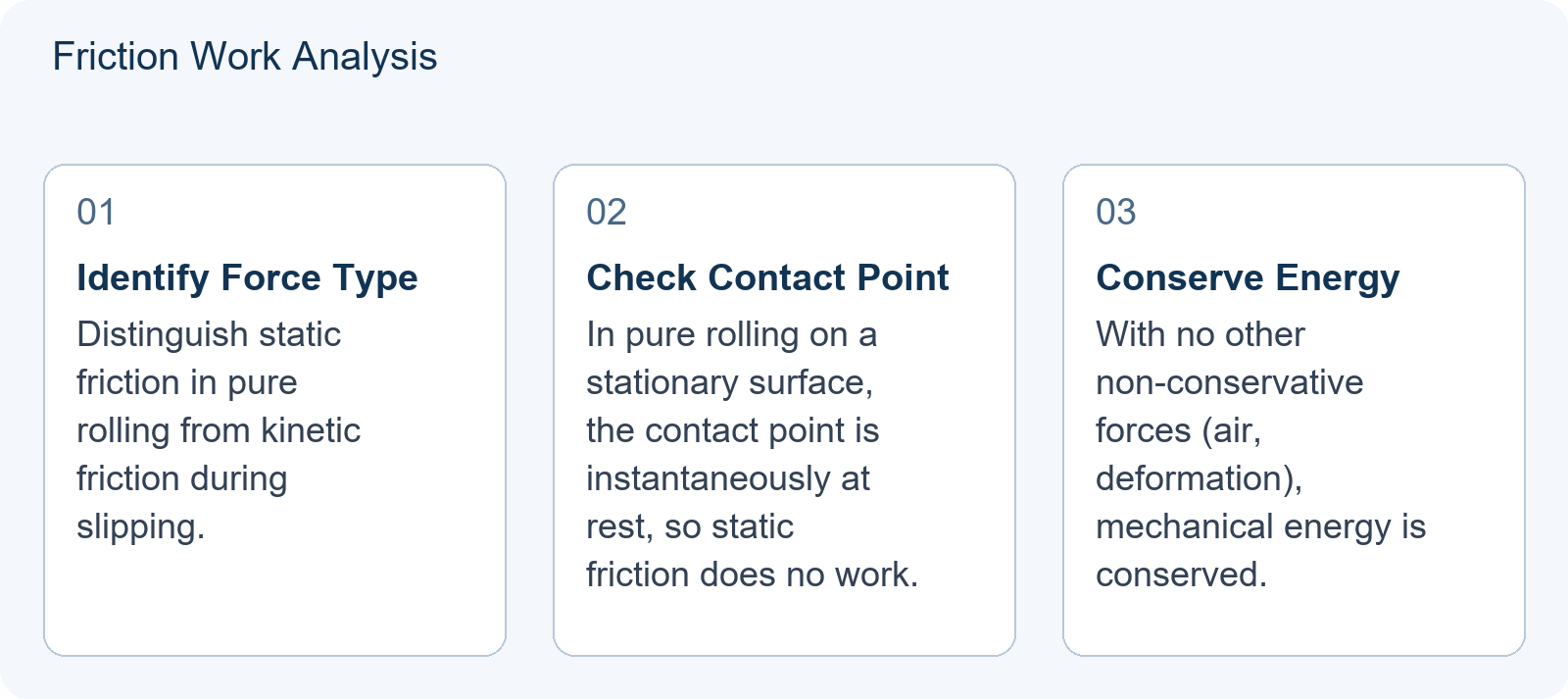
A persistent misconception is that friction always removes energy. In ideal rigid rolling on a stationary surface, the relevant friction is static friction. Static friction prevents slipping; it does not necessarily dissipate mechanical energy. The work done by a force depends on the movement of the point where the force is applied. In pure rolling on a fixed ground, the contact point is instantaneously at rest relative to the ground. The displacement of that contact point over an infinitesimal time interval is zero, so static friction does zero work on the object.
Under these specific conditions—rigid body, stationary surface, no deformation, and no rolling resistance—mechanical energy is conserved. If no air resistance or other non-conservative force acts, you can use:
E_initial = E_final
mgh_i + ½mv_i² + ½Iω_i² = mgh_f + ½mv_f² + ½Iω_f²
If the object starts from rest, the initial kinetic terms vanish. If it rolls down a vertical height h, the decrease in gravitational potential energy equals the increase in total kinetic energy. Static friction changes the distribution between translation and rotation, but the total mechanical energy remains the same.
Crucial Caveat: Rolling without slipping alone is insufficient to guarantee energy conservation in all scenarios. For example, if a wheel rolls on a moving belt, the contact point is not at rest relative to the ground frame, and static friction may do work. Additionally, real-world effects like tire deformation (rolling resistance) or air drag introduce non-conservative forces. Never assume kinetic friction is the only possible energy loss; check for external work sources.
Diagnostic 1: Verify the no-slip condition
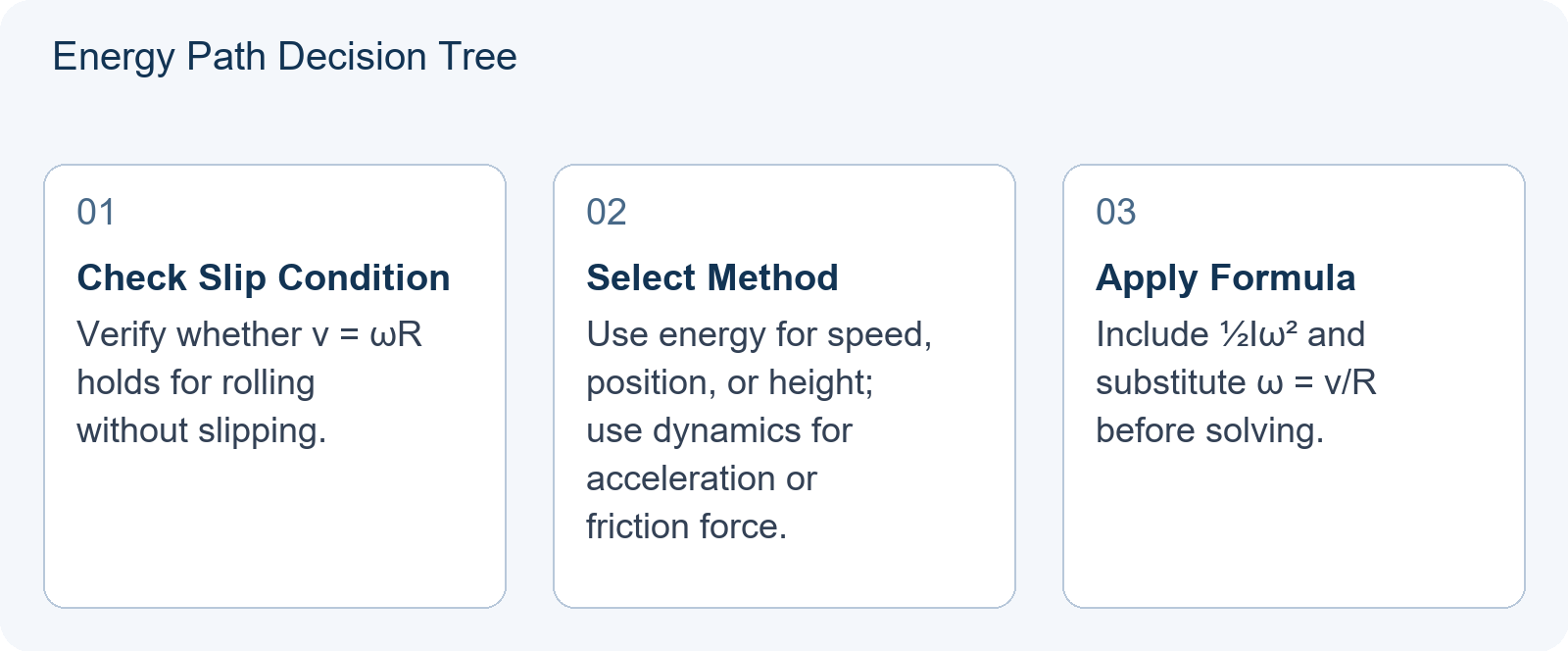
Before using any energy shortcut, confirm that the problem states or implies rolling without slipping. This condition links linear and angular variables through the geometrical constraint:
v = ωR
where R is the radius of the object. If this relation holds, you can substitute ω = v/R into the energy equation and solve for v directly. If the problem says the object is slipping, or if it gives v and ω that do not satisfy v = ωR, then you cannot use that substitution. In cases with kinetic friction, mechanical energy is not conserved because kinetic friction can do negative net work. If the surface is frictionless and the object is not rolling, translation and rotation may be independent, and you must use the information the problem provides rather than imposing v = ωR.
This diagnostic is also a system-choice habit. The rolling constraint defines which object variables are linked. The same discipline of choosing the system before applying a conservation law is developed in Physics Bowl Momentum: Choose the System Before Applying Conservation.
Diagnostic 2: Choose energy or dynamics
Once rolling without slipping is confirmed, you usually have two paths: energy conservation or dynamics through force and torque equations. The question’s target determines the better method.
Use energy conservation when the question asks for speed, position, or height after a change in elevation. It is usually faster because it avoids solving for acceleration and friction separately. The equation only needs the moment of inertia, the rolling constraint, and the initial and final states.
Use dynamics when the question asks for acceleration, the magnitude of the static friction force, or the minimum coefficient of static friction required to prevent slipping. Energy methods cannot easily isolate the friction force because static friction does no work in the ideal rolling case. For a solid cylinder rolling down an incline, for example, write mg sin θ − f_s = ma for translation and f_s R = Iα for rotation. With a = αR, you can solve for both acceleration and f_s. If the question asks whether the cylinder slips, you then compare f_s with μ_s mg cos θ.
Mixing methods without checking the target is a common time sink. If you only need speed, energy is usually enough. If you need force or acceleration, go to dynamics.
Teaching illustration: solid sphere on an incline
This is a teaching illustration, not an official Physics Bowl problem. Assumes ideal rigid rolling on a stationary surface.
A solid sphere of mass M and radius R rolls without slipping from rest down an incline of vertical height H. What is its speed at the bottom?
Step 1: Identify the moment of inertia. For a solid sphere about its centre, I = 2/5 MR².
Step 2: Apply energy conservation. Initial gravitational potential energy equals final total kinetic energy:
MgH = ½Mv² + ½Iω²
Step 3: Use the rolling constraint. Since v = ωR, we have ω = v/R. Substitute:
MgH = ½Mv² + ½(2/5 MR²)(v/R)²
MgH = ½Mv² + 1/5 Mv²
MgH = 7/10 Mv²
Step 4: Solve for v:
v = √(10/7 gH)
Compare this with a frictionless sliding block, for which v = √(2gH). The coefficient in v² is 10/7 for the rolling sphere instead of 2 for sliding. The rolling sphere is slower because some of the energy becomes rotational kinetic energy. If you instead used a sliding-block result, you would overestimate the speed. You can also sanity-check this result with limiting cases. As I tends to zero, the object behaves more like a point mass and the rolling formula approaches the sliding formula. The methods in Physics Bowl Limiting Cases: Checking Whether a Formula Makes Physical Sense are useful for that kind of check.
Common pitfalls in multiple-choice practice
1. Ignoring rotational kinetic energy. An answer option such as v = √(2gH) is correct only for a frictionless sliding block. If the object rolls without slipping, that option is a distractor.
2. Using the wrong moment of inertia. A hollow cylinder has I = MR², a solid disk or cylinder has I = ½MR², and a solid sphere has I = 2/5MR². Always confirm whether the axis passes through the centre of mass and whether the object is hollow or solid.
3. Subtracting a friction loss term when static friction does no work. If the object rolls without slipping on a stationary surface, do not insert a μmgd energy loss. Only include work by kinetic friction when the problem explicitly involves slipping.
4. Confusing centre-of-mass speed with the speed of a point on the rim. In rolling without slipping, the centre of mass moves at v, but the top of the wheel moves at 2v relative to the ground, and the contact point is instantaneously at rest. Use the centre-of-mass speed in the translational kinetic energy term.
5. Applying v = ωR when the object slips. If the problem gives v and ω that are inconsistent with v = ωR, do not force the rolling constraint. Use the given kinematics and account for kinetic friction if it acts.
What curriculum changes signal
The AP Physics 1 course framework now adds connections between rotational and translational motion. The supplied source notes for Physics Bowl D2 also list rotation, electromagnetic induction, relativity, and quantum basics as additional or more emphasized content. These signals do not mean every rolling question is new, but they do mean the translation-plus-rotation idea is a framework connection you should be able to apply, not merely a formula you memorise.
In practice, that means examiners can place rolling inside a broader mechanics scenario: a rolling object connected to a hanging mass, a rolling object on a moving cart, or a collision followed by rolling. The common thread is that you must identify the constraint before writing conservation equations. If you treat the rolling object as a sliding particle, you lose the rotational term. If you treat static friction as an energy loss, you subtract energy that should still be in the system.
Checklist for rolling-motion questions
When you meet a rolling object in a Physics Bowl practice paper, pause before writing equations. Ask:
- Is the object rolling without slipping? Check for a statement such as rolls without slipping, or for the relation v = ωR.
- Is mechanical energy conserved? Check for kinetic friction, air resistance, rolling resistance, or external work (e.g., moving belts). Static friction in pure rolling on a stationary surface does no work.
- What shape is it? Identify I for a solid sphere, solid cylinder or disk, hollow cylinder, or other body.
- What is the question asking? Speed or height usually points to energy. Acceleration or friction force points to dynamics.
- Does the answer make physical sense? A rolling object should be slower than the same object sliding frictionlessly down the same height. A larger I for the same mass and radius should mean slower arrival.
With those checks, rolling-motion questions become less about memorising special cases and more about correctly linking translation, rotation, and the no-slip constraint. That is the skill the Physics Bowl rolling-motion topic rewards.
Frequently Asked Questions
Does static friction ever do work in rolling motion?
In pure rolling without slipping on a stationary surface, static friction does no work because the point of contact is instantaneously at rest. However, if the surface itself is moving (like a conveyor belt), static friction can do work. Kinetic friction does work whenever slipping occurs.
When should I use torque instead of energy conservation?
Use torque and Newton’s laws when you need acceleration, the magnitude of the friction force, or the minimum coefficient of static friction. Energy conservation is best for speeds, positions, or heights, provided no non-conservative work is done.
How do I know which moment of inertia to use?
Identify the shape and whether it is solid or hollow. Common values are solid sphere 2/5 MR², solid cylinder or disk ½MR², and hollow cylinder or ring MR². Always check that the axis is through the centre of mass.