 PhysicsBowl
Many families preparing for international physics competitions notice that Physics Bowl and the British Physics Olympiad (BPhO) cover broadly overlapping syllabus material. According to Hanlin’s 2027 Physics Bowl preparation guide, both test kinematics, dynamics, electromagnetism, waves, thermodynamics, and modern physics at a level comparable to first-year university general physics or advanced high school curricula. However, treating them as interchangeable because of this overlap is a critical preparation error. The fundamental difference lies not only in what you know, but in how you must demonstrate it. Physics Bowl rewards rapid, accurate multiple-choice selection under strict time pressure, while BPhO demands structured, written proof where partial reasoning can earn points even if the final answer contains errors.
The Shared Knowledge Base: Why One Study Plan Covers Much of Both Competitions
As Hanlin’s teaching notes confirm, Physics Bowl covers topics that broadly overlap with AP/IB physics knowledge points and is close in difficulty and scope to BPhO. This means a student who masters rotational dynamics, fluid mechanics, electric potential, and simple harmonic motion for one contest has built much of the necessary conceptual foundation for the other. Recent curriculum changes reinforce this synergy. The updated AP Physics 1 framework now includes fluids and explicit connections between rotational and translational motion, while IB Physics has shifted to five broad themes emphasizing model application over rote formula recall. These shifts align with both contests’ goals: testing whether students can deploy physical models in unfamiliar contexts.
For families, this shared base simplifies logistics. You do not need two entirely separate content courses. Instead, you need one rigorous physics curriculum followed by format-specific training. A student aiming for both should ensure their core study covers the full breadth of D2-level Physics Bowl topics, which include relativistic effects, quantum basics, and complex circuit analysis—areas also present in BPhO Section 2. The key insight from Hanlin’s teaching observations is that content mastery is a prerequisite, not the finish line. The real differentiator is response style adaptation.
Physics Bowl Mechanics: Speed, Selection, and Machine Grading
Physics Bowl is a timed multiple-choice exam. Division 1 students answer 40 questions in 45 minutes; Division 2 students answer 40 questions (numbered 11–50) in the same 45 minutes. This yields an average of 67.5 seconds per question, though individual questions vary significantly in difficulty and required computation. The official AAPT guidelines emphasize that answers are machine-graded for paper-based tests, requiring precise technique: complete filling, no stray marks, and strict adherence to question numbering ranges. However, administration differs by region—China online test-takers follow ASEEDER procedures, which may differ from paper-based international protocols.
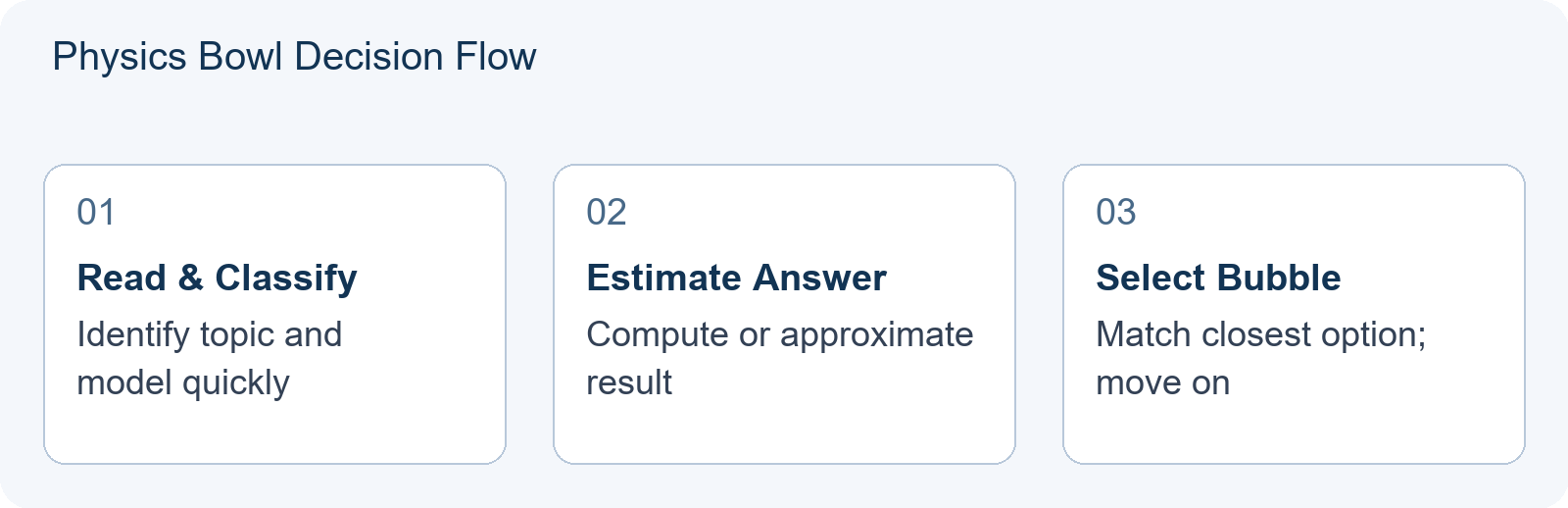
This format demands a specific cognitive skill set: rapid diagnostic ability. Students must quickly classify each problem, select the appropriate model, estimate the magnitude, and eliminate implausible options. Pacing is critical. As noted in our PhysicsBowl Pacing: What 40 Questions in 45 Minutes Actually Demands, the last questions on the paper often carry significant weight in tie-break scenarios, so abandoning them due to early time mismanagement can be costly. Preparation must therefore focus on pattern recognition and mental arithmetic shortcuts rather than exhaustive derivation. A correct response can be both quick and reasoned—the two are not mutually exclusive.
BPhO Mechanics: Proof, Partial Credit, and Strategic Selection
BPhO Round 1 operates under entirely different rules. According to the October 9, 2026 operator report, the 2026 BPhO Round 1 duration was reduced from 2 hours 45 minutes to 2 hours without lowering difficulty, intensifying the need for efficient written communication. The exam consists of proof-based problems in two sections. Section 1 contains short-answer questions with varying point values; candidates choose which questions to answer up to a specified point total. Section 2 offers long-form problems split into sub-parts; candidates choose a subset to attempt.
Critically, BPhO assessment rewards demonstrated reasoning. The official guidance states that solutions must show proof processes—merely writing an answer without justification typically receives no credit. Conversely, partial correct reasoning can earn partial marks even when the final answer is wrong, though the exact allocation depends on the specific rubric for each question. A blank submission yields no marks, while a rough but relevant attempt may capture some credit depending on what valid steps it contains. This transforms the strategic landscape: in Physics Bowl, guessing is rational when uncertain; in BPhO, attempting structured reasoning is generally preferable to leaving blanks, though quality of exposition matters significantly.
Teaching Illustration: Same Problem, Two Response Styles
Note: The following is a constructed teaching illustration for pedagogical purposes, not an actual past-paper question.
Scenario: A block of mass m slides down a frictionless incline of angle θ (measured from the horizontal) and length L along the plane, starting from rest. Find its speed at the bottom.
Physics Bowl Response Style: The student recognizes energy conservation applies. They compute that the vertical drop is h = L sin θ, then v = √(2gL sin θ). They scan options, identify the matching expression, and select it. No written justification is required or rewarded. If they mistakenly used cos θ instead of sin θ, they receive zero credit. Speed and accuracy dominate, but the underlying reasoning can be both rapid and physically sound.
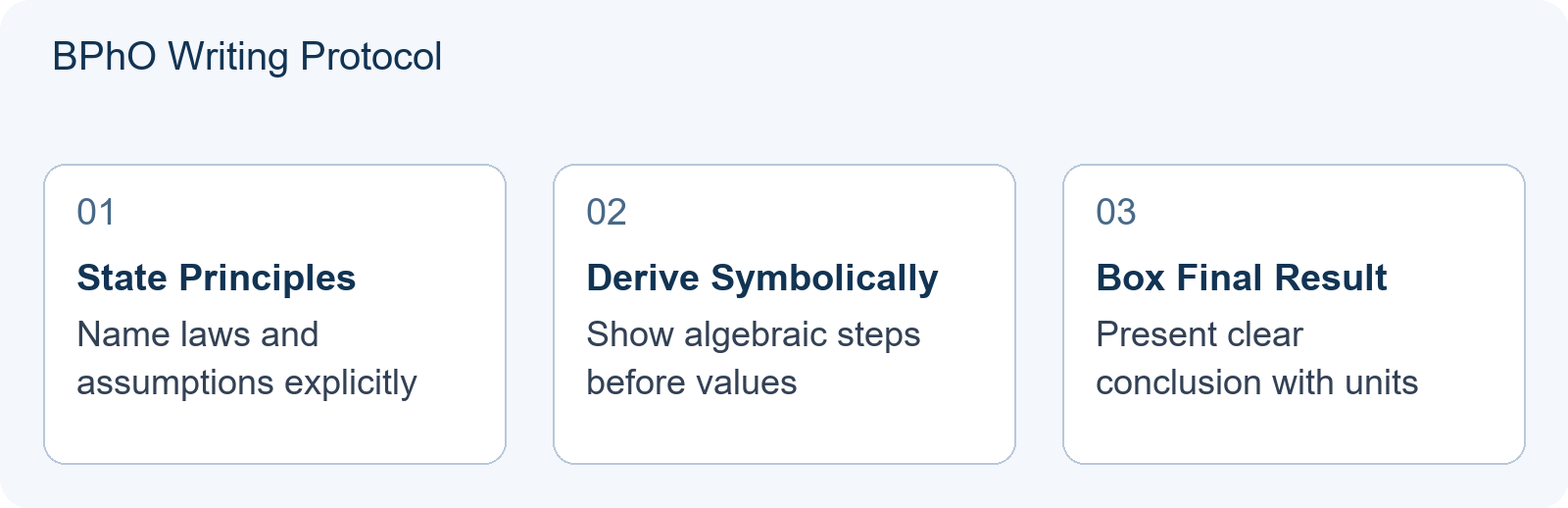
BPhO Response Style: The student writes: “By conservation of mechanical energy, initial gravitational potential energy converts to kinetic energy, as the normal force does no work and the surface is frictionless.” They define height h = L sin θ (with θ measured from horizontal and L the distance along the plane). They derive mgh = ½mv² symbolically, substitute, and present the final boxed result. Even with a minor algebraic slip in isolating v, they may earn substantial marks for correct setup and principle identification. Structure and explicit justification dominate.
Contrasting Case: Where Cross-Training Fails Without Adaptation
A common failure mode occurs when students apply Physics Bowl habits to BPhO. Consider a BPhO Section 2 problem involving coupled oscillators. A student trained primarily in multiple-choice may jump directly to a known formula for period T = 2π√(m/keff), plug in numbers, and stop. In BPhO, this yields minimal marks because no derivation of keff is shown, no free-body diagrams justify the restoring force proportionality, and no discussion addresses assumptions like small-angle approximation.
Conversely, applying BPhO-style thoroughness to Physics Bowl causes time collapse. A student who spends three minutes deriving every step of a simple kinematics problem will leave multiple questions unanswered. Since Physics Bowl has no partial credit, those blanks score zero regardless of correctness elsewhere. Thus, unadapted cross-training actively harms performance in both contests. Effective preparation requires deliberate switching between modes: timed drills for speed and accuracy; untimed writing exercises for clarity and completeness.
Diagnostic Application: Assessing Your Current Response Readiness
To determine which format needs more attention, try this self-assessment using authentic-style materials. First, take a Physics Bowl Division 2 section under strict 45-minute conditions. Record your raw score and note how many questions you skipped versus guessed. Second, select one BPhO Round 1 Section 1 problem and spend 10 minutes writing a full solution, including diagram, stated principles, symbolic manipulation, and boxed answer. Have a teacher or tutor grade it against BPhO marking criteria.
If your Physics Bowl score is strong but you left several questions due to time, your bottleneck is pacing—not knowledge. If your BPhO solution earned limited marks despite arriving at a correct numerical answer, your bottleneck is exposition. These diagnostics reveal whether your next learning task should be timed simulation practice or structured proof-writing workshops. Importantly, neither diagnosis suggests changing your physics content; it signals a need for format-specific rehearsal. Performance gaps typically have multiple contributing factors, not a single cause.
What the Diagnostic Means for Next Steps and Feedback
Students showing Physics Bowl timing deficits should shift from passive review to active drill cycles. Use past papers not just for checking answers, but for building reflexes: categorize each question type, assign target times, and track completion rates. Feedback should focus on decision-making efficiency—why did you spend excessive time on a particular question? Could elimination have resolved it faster?
Students struggling with BPhO exposition need guided rewriting exercises. Take a previously attempted problem and revise it to maximize mark capture: add missing justifications, clarify variable definitions, improve logical flow. Feedback should highlight where reasoning was implicit rather than explicit. Remember, BPhO assessors cannot award marks for thoughts you didn’t write down. Practising this discipline turns partial understanding into partial credit—and eventually full credit.
Practical Preparation Pathway for Families
Families seeking balanced preparation should structure study around dual-mode practice. Begin with unified content mastery covering all overlapping topics. Then allocate weekly sessions alternately: one focused on timed Physics Bowl simulations with post-mortem analysis of pacing decisions; another dedicated to BPhO-style written solutions graded against official rubrics. Leverage resources wisely: use Physics Bowl Past Papers: Choosing a Practice Set and Checking Answer Coverage for speed calibration and BPhO historical questions for proof refinement. For students unsure which division fits their background, our Physics Bowl Division I or Division II: Which One Your Course History Actually Puts You In maps course history to eligibility.
Avoid assuming success in one predicts success in the other. Each contest tests distinct skills atop shared knowledge. With targeted adaptation, students can excel in both formats simultaneously.
Frequently Asked Questions
Can I prepare for both Physics Bowl and BPhO with the same course?
Yes, for content. Both exams test similar physics knowledge broadly, though not identically. However, you must separately practise multiple-choice speed for Physics Bowl and written proof structure for BPhO.
Does getting a good Physics Bowl score guarantee BPhO success?
No. Physics Bowl rewards quick selection; BPhO rewards detailed explanation. A fast solver may fail BPhO by omitting justifications, while a thorough writer may run out of time in Physics Bowl. Performance gaps have multiple causes.
Is partial credit available in Physics Bowl?
No. Physics Bowl uses machine-graded multiple choice with binary scoring. BPhO may award partial marks for incomplete but logically sound written solutions, depending on the specific rubric.