 PhysicsBowl
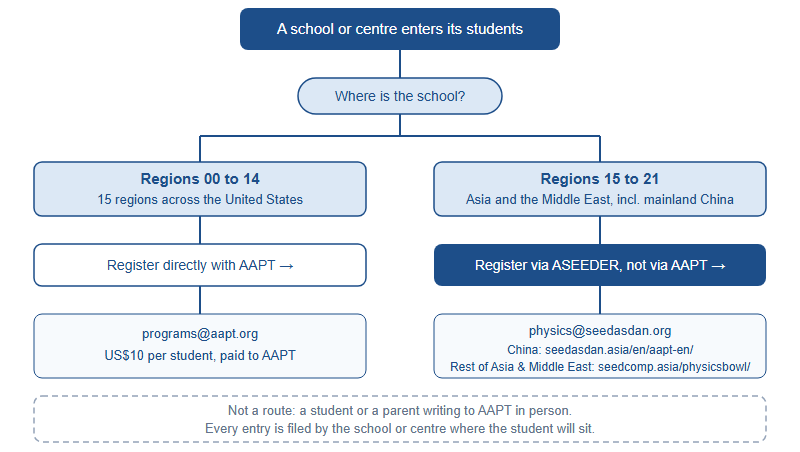
If you are organising a PhysicsBowl entry for a student in mainland China, two facts decide everything else. The entry is made by a school or a centre, never by a student or a parent. And mainland China sits inside AAPT's regions 15 to 21, where AAPT's own instruction is that schools register via ASEEDER rather than with AAPT. Writing to AAPT first is the most common way to lose two weeks before a late-February deadline.
Entries come from a school or a centre, never from a student
AAPT describes the contest as “a 40-question, 45-minute timed, multiple-choice test under their school's supervision.” That last phrase is the entire registration model compressed into five words. There is no individual sign-up. A student cannot enter themselves, and a parent cannot enter a child. The unit AAPT and its regional partners deal with is an institution: it submits the roster, books the room, supplies the proctor, and pays.
This reframes the first task. It is not finding a form. It is finding the person inside the school who will own the entry — usually the head of physics, sometimes an exams officer or the university-counselling office. If the school has never run PhysicsBowl before, someone there has to agree to run it before any paperwork becomes relevant. That internal yes, not the registration itself, is where most first-time entries stall.
One format point is worth nailing down early, because Chinese-language summaries of this contest do not always agree with AAPT. The paper is 40 questions in 45 minutes, and that format is the same for every student in both divisions. If a summary you are reading gives a different question count, or describes the two divisions as answering different portions of one longer paper, then it does not match AAPT's own published description — and you should treat its dates and its fees with the same suspicion.
The region split: where you sit decides who you write to
PhysicsBowl is organised into regions, and the region a school belongs to determines which body handles its entry. AAPT states that “Each Division has 15 regions that have been established across the country” — those are the United States regions, numbered 00 through 14, and schools in them register directly with AAPT. Specialised mathematics and science schools compete in their own region rather than against the general high schools around them.
Then comes the sentence that matters for every reader of this site. AAPT writes: “We have established seven regions specifically for countries in Asia and the Middle East, which includes China, Vietnam, Thailand, Indonesia, Malaysia, Singapore, Mongolia, Kazakhstan, Japan, Korea, India, Pakistan, Dubai, Saudi Arabia, and Qatar, these are regions 15 through 21. Schools in these countries will register via ASEEDER.”
Read that as an instruction, not a suggestion. It is not a choice between two doors. A school in Shanghai, Shenzhen or Beijing does not have the option of registering with AAPT directly and then competing in a United States region; its region is already assigned by geography. Correspondence sent to AAPT's programs office from a school in regions 15 to 21 will at best be redirected — and redirection costs days you may not have in February.
| If the school is… | AAPT regions | Entry is filed with | First contact | Fee position |
|---|---|---|---|---|
| In the United States (general high school) | 00 – 14 | AAPT directly | programs@aapt.org | US$10 per student, paid to AAPT |
| A specialised maths or science school | Its own region | As for its country | As above | As above |
| In mainland China | 15 – 21 | ASEEDER — not AAPT | physics@seedasdan.org seedasdan.asia/en/aapt-en/ |
Not published by AAPT; confirm at registration |
| Elsewhere in Asia or the Middle East | 15 – 21 | ASEEDER — not AAPT | physics@seedasdan.org seedcomp.asia/physicsbowl/ |
Not published by AAPT; confirm at registration |
| A test prep centre or educational service | Its own separate region | Files under its own identity | — | Student award categories only; no school team award |
Our registration page keeps the current contact details and the season status in one place. If your school has not done this before and would rather not open the correspondence cold, we can arrange the entry through the official channel on the school's behalf — the student still sits at their own school, under their own school's proctor, in their own school's region.
What the school actually needs to have ready
Most of the delay in a first-time entry is not the registration form. It is assembling six things that nobody thought to assemble in January.
A named owner. One member of staff whose job this is. Entries that are “being looked into” by three people at once are the ones that miss the deadline.
A division decision for each student. AAPT's rule is plain: “Division I is for first-year physics students and Division II is for second-year physics students.” The decision turns on how much of the syllabus a student has actually met, not on ambition. Our Division I or Division II self-assessment works through it question by question; the honest version of that decision is made with a timed past paper on the desk, not from memory.
A headcount, with five in mind. AAPT states that “School Team scores are determined by the sum of the scores of the top five students competing.” That makes five the working minimum if the school wants a team result at all. A school entering three strong students has entered three individuals; the team category is simply not in play for it. Schools that care about the team line usually enter comfortably more than five, so that one absence on the day does not collapse the total.
A proctor who qualifies. Covered in full below, and worth settling before you promise anyone a sitting.
A room and a date inside the window. The exam window is not a menu of official national dates. It is a span within which the school picks its own slot around its own timetable.
A confirmed fee. AAPT publishes US$10 per student for its own direct route. It does not publish what the ASEEDER route costs, so that number has to come from ASEEDER at the point of registration — not from a forum post or a screenshot of a previous year. As for the paper itself: an equation sheet is supplied with it, but per the published rules that sheet is not exhaustive, and gravity questions are set with g = 10 m/s². Both points, and what they mean for preparation, are set out on our rules page.
Proctoring, and the identity mistake that costs the team award
AAPT is unambiguous here: “The PhysicsBowl exam MUST be proctored. Parents, relatives, or close friends and acquaintances of students are not acceptable proctors.” Per the published rules, a proctor needs at least a two-year degree, and it does not have to be in physics.
In practice this rules out the arrangement families most often propose. There is no version of PhysicsBowl in which a student sits the paper at home while a parent watches, and none in which a private tutor who knows the family socially supervises it. Every legitimate route ends in the same place: a room at a school, a fixed 45 minutes, and someone unconnected to the student in charge of it.
| Proposed proctor | Acceptable? | Why |
|---|---|---|
| A physics teacher who does not teach that student | Yes | Staff member, not personally connected to the student |
| A teacher of another subject, or a librarian | Yes | The degree does not need to be in physics |
| An exams officer or school administrator | Yes | Standard invigilation role; the degree requirement still applies |
| The student's parent | No | AAPT excludes parents outright |
| An aunt, uncle, cousin or sibling | No | AAPT excludes relatives |
| A family friend, or a tutor known to the family socially | No | AAPT excludes close friends and acquaintances |
There is a second, quieter trap in the same area, and it concerns the identity under which the entry is filed rather than who watches the room. AAPT states that “Test Prep Centers and Educational Services will compete in their own region, and will be eligible for the student award categories only.” Filing an entry under a training centre's name therefore moves the student out of the school's region and into a separate one, and the school team award — that top-five sum — goes with them. A family that routes a child through a centre for convenience can forfeit the result their school was counting on, without ever being told that is what happened.
This is why our own position is narrow and worth stating plainly. We are an independent guide that also arranges entries through the official channel. We are not a test centre, we do not host sittings, and we do not proctor. Students sit at their own school, supervised by their own school, and any entry we help with is filed for the school, in the school's region. If anyone offers you a seat at their own venue, ask which region that entry will land in before you accept.
The shape of a season — and what is genuinely unknown about 2027
The 2026 season gives you a shape to plan against. Registration closed on February 23, 2026, extended to February 25 at 11:59pm EST, and the exam was given between March 18 and April 3, 2026. So: a late-February cut-off, roughly three weeks of gap, then a window of about two and a half weeks inside which each school chose its own sitting date.
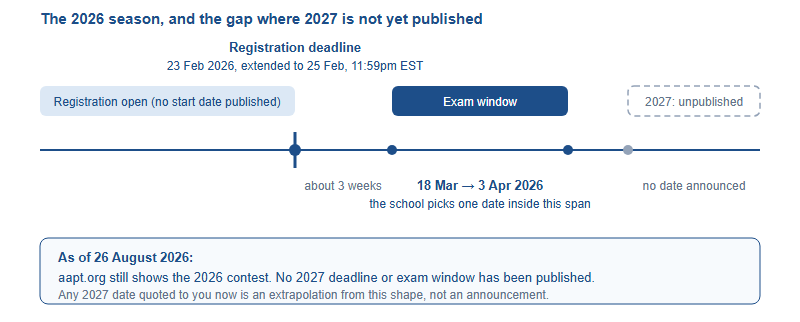
That last point deserves to be stated without softening. As of 26 August 2026, AAPT's PhysicsBowl page still describes the 2026 contest, and carries no 2027 deadline and no 2027 exam window. Anyone giving you a specific 2027 date today is projecting last season forward. When it is announced it will appear on AAPT's own PhysicsBowl page, and the regional version for the Asia and Middle East route will follow on ASEEDER's pages.
The useful response to that is not to wait. Almost everything on the list above is date-independent: naming the staff owner, settling each student's division, identifying a proctor who qualifies, getting the fee confirmed, and starting timed past papers. Do that work in the autumn and the announcement costs you a week of admin. Leave it until the announcement and it costs you a term, because the same February fortnight that contains the deadline also tends to contain mock exams, the Lunar New Year break, and a physics department with no spare capacity.
Common questions
Can a student register for the PhysicsBowl themselves?
No. The entry is made by a school or a centre. A student cannot enter directly, and neither can a parent acting alone.
Should a school in mainland China write to AAPT to register?
No. Schools in regions 15 to 21, which include China, register via ASEEDER. Write to physics@seedasdan.org instead.
Can a parent proctor the exam?
No. AAPT states that parents, relatives, or close friends and acquaintances of students are not acceptable proctors.
When is the 2027 PhysicsBowl?
AAPT has not published 2027 dates. The 2026 exam ran between 18 March and 3 April; check aapt.org for the new season.
Independent guide operated by Hanlin Education for China-based international-school students and their teachers. Registration routes, deadlines and fees change between seasons — confirm current details on aapt.org, and on ASEEDER's pages for the Asia and Middle East route, before acting on anything here. Corrections are issued within 7 working days of being reported.