 PhysicsBowl
If your school has never entered PhysicsBowl, the decision in front of it is smaller than it sounds. AAPT describes the contest as a 40-question, 45-minute, timed multiple-choice test taken under the school’s supervision. Your school does not write the paper and does not become a test centre. It supplies a room, a slot in the timetable, and a proctor who is not a candidate’s parent, relative or close friend.
What a host school is actually agreeing to
Most first-time refusals come from a misunderstanding of scale. A teacher hears “international physics competition” and pictures a multi-day event, an invigilation team, marking, and a results ceremony. The reality is a single 45-minute sitting inside a normal school week.
Three sentences from AAPT’s own description do most of the work when you are explaining this. The paper is 40 questions in 45 minutes, multiple choice, and timed. It is taken under the school’s supervision. A proctor is mandatory, and that proctor may not be a parent, relative or close friend of a student sitting the paper. Everything else — writing the questions, setting the divisions, defining the regions, scoring — belongs to AAPT, not to the school and not to whoever arranges the entry.
It is worth separating the three parties explicitly, because a school that cannot see the boundary tends to assume it is being asked to own the whole thing.
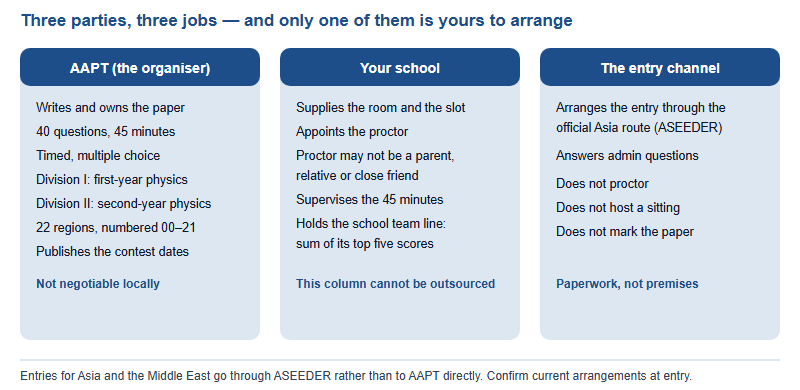
If your school wants the wider picture before the conversation starts, send them the contest overview rather than a marketing page. Schools respond better to a description of the paper than to a description of the prize.
Why the sitting has to happen at your own school
This is the part students most often try to shortcut, and it is worth understanding the mechanics rather than the slogan. AAPT’s rules state that “Test Prep Centers and Educational Services will compete in their own region, and will be eligible for the student award categories only.” In plain terms: entries that come in through a coaching institution rather than a school are placed in a separate competitive region and the school team category is not open to them.
That single rule explains our own position. We arrange entries through the official channel; we do not run a sitting, and we are not a test centre. Students sit the paper at their own school under their school’s supervision, which is exactly the arrangement AAPT’s format describes. It also means the school team line stays available to your school, and that line matters more than most students realise: a school team score is the sum of its top five students, so the fifth-best physicist in your year group is carrying part of the school’s result whether or not anyone tells them so.
The practical consequence is unglamorous. There is no version of this where you enter privately, sit the paper somewhere convenient, and still count towards your school. If you want the school line, you need the school room.
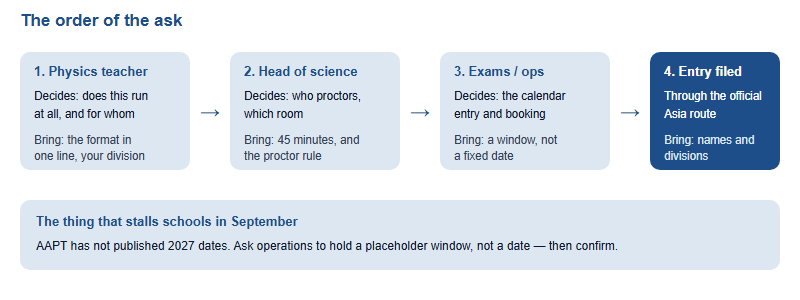
The ask ladder: who decides what, and in what order
Students lose seasons by asking the wrong person first. The most common failure is emailing the head of school with an enthusiastic paragraph about an American physics competition, receiving a polite “please go through your physics teacher”, and losing three weeks to the round trip.
Ask in the order below. Each person is deciding something different, and each one needs a different thing from you.
| Who | What they actually decide | What they need from you |
|---|---|---|
| Your physics teacher | Whether this runs at all, and which students would be put forward | The format in one line, your own division (first-year or second-year physics), and evidence you will prepare rather than turn up |
| Head of science / department | Who supervises, which room, whether it clashes with departmental assessments | Duration, supervision requirement, and confirmation that the department is not being asked to write or mark anything |
| Exams officer or academic operations | The calendar entry, the room booking, and any external-entry approval the school requires | A window rather than a fixed date, because AAPT has not published the 2027 dates |
| Whoever signs external entries | Sign-off on the school’s participation and on candidate details | A clean list of names and divisions, and the route the entry travels |
What to put in the one-page brief
Whatever you send should fit on one screen and should contain no adjectives. A physics teacher deciding in a five-minute gap between lessons wants facts they can check, not enthusiasm they have to discount.
- The paper. 40 questions, 45 minutes, timed, multiple choice, sat under the school’s supervision.
- The divisions. Division I is for first-year physics students; Division II is for second-year physics students. Say which one you are in and why, based on your course history.
- The supervision requirement. A proctor is mandatory and may not be a parent, relative or close friend of a candidate. This is a rule the school needs to hear from you before it hears it from a form.
- The route. Entries for Asia and the Middle East go through ASEEDER rather than direct to AAPT. If you want to hand the school something on this point, how registration works covers the route in full.
- The school-level upside. A school team score is the sum of its top five students, so the entry is a departmental result, not a private hobby.
- The date, honestly stated. AAPT has not published the 2027 dates. Say so. A student who invents a date to sound organised will be found out the moment the department checks.
Then stop. A brief that runs to two pages reads as a project the department has to manage; a brief that runs to six lines reads as a request the department can approve.
The timing problem this season, stated plainly
Two facts are in tension right now, and you should present both rather than pick the convenient one.
First, from AAPT: the 2027 dates are not published. Its pages still describe the 2026 contest. No one — including us — should be telling your school when the paper falls next spring, and this site does not publish a date before the organiser does.
Second, from the China organising channel: for the new season it says online seats are discontinued, leaving in-person sittings only, and its assisted registration is already open. That is channel-level information rather than an AAPT publication, so treat it as a planning signal and confirm the position at entry.
Read together, those two facts create the awkward shape of September. The arrangement that has to be secured earliest — a room, a supervisor and a slot inside your school — is the one whose date is least certain. That is not a reason to wait. It is a reason to make the ask now in the form of a placeholder: a held window, a named supervisor, and a decision in principle that the department will host once the date is confirmed. An in-person sitting still means a school sitting under school supervision, which is precisely what AAPT’s rules already describe, so the offline-only signal changes your logistics, not your route.
Five ways a first-time entry falls apart
| Failure | What it looks like | The fix |
|---|---|---|
| Asking upwards first | An email to a senior leader who redirects you to the physics teacher | Start with the teacher, and let them escalate with departmental weight behind it |
| Overselling | A brief full of prestige claims and no format details | Lead with 40 questions and 45 minutes; the school can evaluate that |
| Inventing a date | A confident spring date that the department later cannot verify | Ask for a window and say the organiser has not published dates |
| Proctor chosen too late | A parent volunteers a week out, which the rules do not permit | Settle the proctor at the head-of-science stage, before names are filed |
| Going alone | One student, no team line, no departmental interest | Bring at least five candidates so the school team score is live |
One further note on the fifth row, because students underrate it. A single-candidate entry asks a department to arrange supervision for one person. A five-candidate entry asks the same department to arrange supervision for a school result. The administrative cost is nearly identical and the institutional interest is completely different, which is why the students who succeed in getting a first sitting approved are usually the ones who arrive with classmates rather than alone.
Frequently asked questions
Can I sit PhysicsBowl if my school will not take part?
Our route is a sitting at your own school under its supervision, so a school has to agree first. Confirm any other arrangement at entry.
Who is allowed to supervise the room?
A proctor is mandatory, and AAPT’s rules state the proctor may not be a parent, relative or close friend of a student sitting the paper.
When is the 2027 contest?
AAPT has not published 2027 dates. Ask your school to hold a placeholder window rather than a fixed date, and confirm on aapt.org.
Does hosting mean the school has to mark the papers?
No. The school supplies the room and the supervision; the paper and its scoring belong to AAPT. Confirm handling details at entry.
Written for China-based international-school students. Confirm current details on aapt.org. Corrections issued within 7 working days.