 PhysicsBowl
The Real Problem: Axes Can Help or Hurt
Every Physics Bowl competitor learns to decompose vectors into components. Yet the harder problems do not ask whether you can decompose—they ask whether you decompose wisely. Choosing axes that align with the actual motion or the unknown force often turns a three-equation slog into a one-step substitution. Choose poorly, and you bury the answer under unnecessary algebra.
This article works through two teaching illustrations. The first shows the standard approach succeeding. The second shows a common mistake—sticking with horizontal-vertical axes on an inclined-plane problem—and how a quick rotation of axes fixes it. By the end, you should be able to decide before writing any equations which axes will make the algebra disappear.
Teaching Illustration 1: Projectile on Level Ground
A block slides off a horizontal table with speed v and falls to the floor. You need the horizontal distance traveled before impact.
Why horizontal-vertical axes win here: Gravity points straight down; the initial velocity points straight sideways. No force has a component in the unwanted direction. The kinematic equations separate cleanly:
- Horizontal: constant velocity, x = vt
- Vertical: constant acceleration, y = ½gt²
Solve the vertical equation for t, substitute into the horizontal equation, done. No trigonometry needed after the initial setup. This is the textbook case where standard axes are also the simplest axes.
Teaching Illustration 2: Block on a Frictionless Incline
Now place the same block on a frictionless ramp inclined at angle θ to the horizontal. Find its acceleration down the slope.
The Tempting Mistake: Horizontal-Vertical Axes
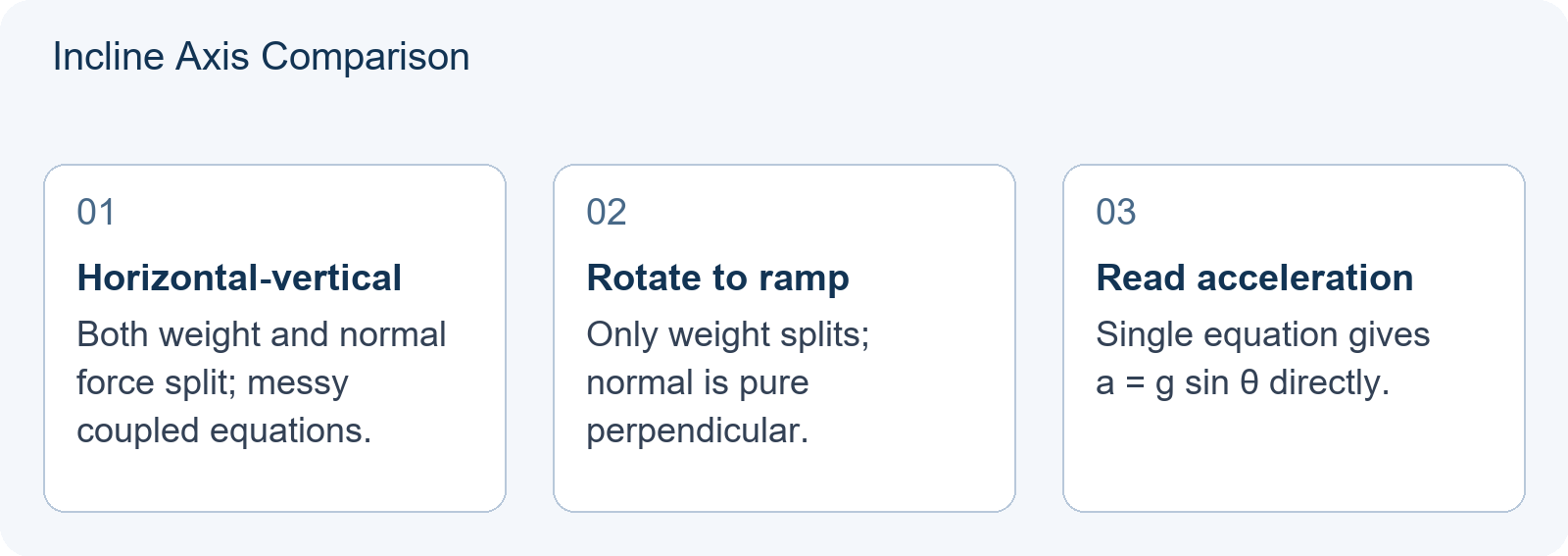
A student chooses standard horizontal-vertical axes. The weight mg must be decomposed into components. The normal force N also has both horizontal and vertical components. The equations become coupled:
- Horizontal: mg sin θ cos θ − N sin θ = max
- Vertical: N cos θ − mg cos² θ = may
These are correct but messy. The student must also enforce the constraint that acceleration is along the ramp, adding ay = a sin θ and ax = a cos θ. Three equations, multiple trig identities, many opportunities for sign errors.
The Better Choice: Axes Parallel and Perpendicular to the Ramp
Rotate the axes so x’ points down the ramp and y’ is perpendicular to it. Now the normal force N lies entirely along y’, and only one force needs decomposition: the weight splits into mg sin θ (down the ramp) and mg cos θ (into the ramp).
The equations collapse to:
- x’: mg sin θ = ma → a = g sin θ
- y’: N − mg cos θ = 0
Two lines. No simultaneous equations. The answer emerges immediately.
Diagnostic: When to Rotate Your Axes
| Situation | Best Axis Orientation | Why |
|---|---|---|
| Projectile on flat ground | Horizontal / Vertical | Gravity and initial velocity already align |
| Block on inclined plane | Parallel / Perpendicular to surface | Normal force becomes single-component; acceleration constraint is built in |
| Pendulum bob at angle | Radial / Tangential | Tension is radial; only gravity needs decomposition |
| Conical pendulum | Horizontal / Vertical | Centripetal acceleration is horizontal; vertical equilibrium is obvious |
Building the Decision Habit
Before writing ΣF = ma, ask two questions:
- Which direction is the acceleration? Align one axis with it if possible.
- Which unknown force points in a special direction? Align an axis perpendicular to it so it appears in only one equation.
If both questions point to the same axis choice, that is your answer. If they conflict, prefer aligning with the acceleration; the constraint equations are usually simpler than handling an awkward force decomposition.
Practice Sequence for Physics Bowl
Try this progression with past problems:
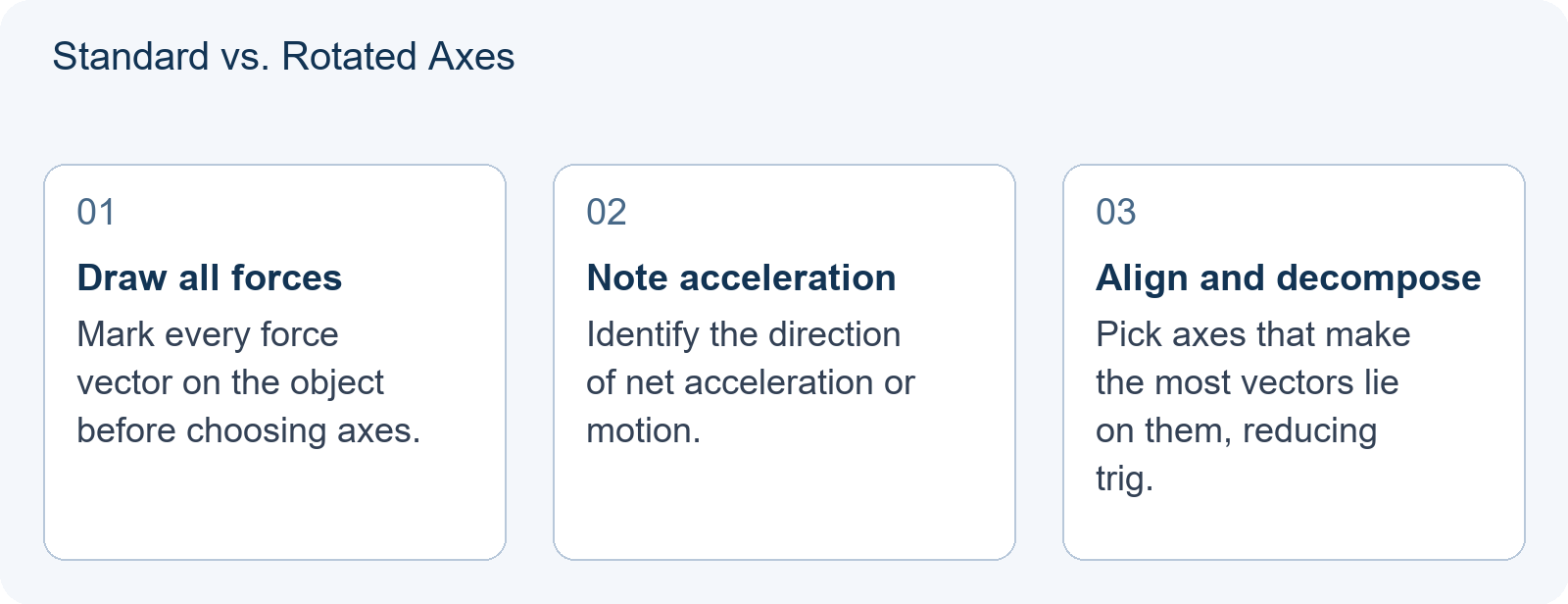
- Sketch the situation without axes.
- Mark the acceleration direction and all force directions.
- Draw two candidate axis systems: standard and rotated.
- Count how many forces need decomposition in each.
- Choose the system with fewer decompositions, especially if it eliminates an unknown from an equation.
For guidance on selecting which past papers to practice with, see Physics Bowl Past Papers: Choosing a Practice Set and Checking Answer Coverage. To understand how your course background determines which division you should enter, read Physics Bowl Division I or Division II: Which One Your Course History Actually Puts You In. For planning your registration timeline and test route, refer to Physics Bowl 2027 Registration: Planning Your Test Route and Preparation Timeline.
What You Should Be Able to Do Next
After working through these illustrations, you should be able to: (1) identify within 10 seconds whether a problem benefits from rotated axes; (2) draw the rotated system correctly without confusing sine and cosine; (3) write the force equations in the new system with fewer than two unknowns per equation when possible. This skill directly supports the timed, high-pressure environment of Physics Bowl where algebraic efficiency separates top scores from good scores.
Frequently Asked Questions
Does rotating axes ever make a problem harder?
Yes. If the problem asks for horizontal range or involves multiple objects with different acceleration directions, a common axis system may be clearer. The skill is matching the axis choice to what the question actually asks.
How do I avoid mixing up sine and cosine after rotating?
Draw the angle θ between the weight vector and the new perpendicular axis. The component adjacent to θ is cosine; the opposite is sine. Check limiting cases: when θ = 0, acceleration down the ramp should be zero, so a = g sin θ passes this test.
Is this technique allowed in Physics Bowl Division 1?
Absolutely. The competition permits any mathematically valid method. Division 1 problems often involve inclined planes where this technique saves time, making it especially valuable given the competition’s time constraints.