 PhysicsBowl
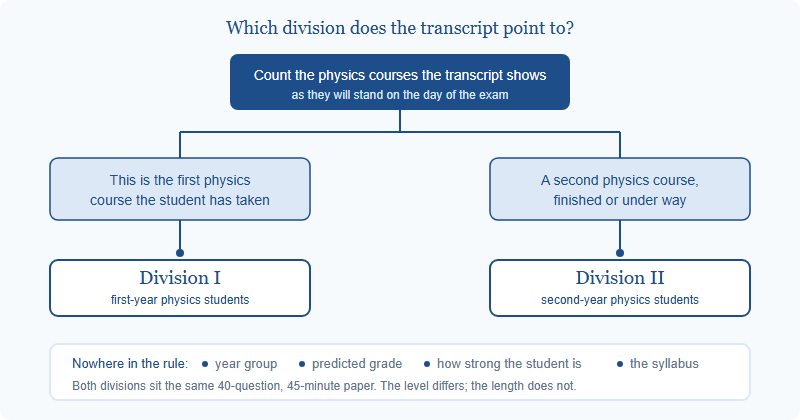
Division I is for first-year physics students and Division II is for second-year physics students. That is the entire rule AAPT publishes, and it turns on how much physics you have studied — not how strong you are, and not which year group you sit in. For a student at an international school in China, the hard part is deciding which of IGCSE, AS, AP or IB DP counts as year one.
What AAPT's rule actually says — and what it leaves out
AAPT's program page carries one sentence on eligibility: “Division I is for first-year physics students and Division II is for second-year physics students.” Read it closely, because almost every mistake made at registration comes from reading something into it that is not there.
It contains no grade level. A Year 10 student who has already finished a physics course and a Year 12 student in their first are not distinguished by age anywhere in the rule. It contains no score threshold and no mention of ability. It names no syllabus — IGCSE, A-Level, AP and IB are not mentioned, because the contest is American and the rule was written for a system in which “first-year physics” is unambiguous. And it says nothing about the paper being longer or shorter: every entrant sits, in AAPT's words, “a 40-question, 45-minute timed, multiple-choice test under their school's supervision.”
So the division is not a difficulty dial you turn up because a student is good. It is a statement about where that student sits in the physics curriculum, and it is the level of the paper that changes, not its length. The call is made once, by the school or centre submitting the entry — never by a student directly — and it is fixed before anybody sees the paper. AAPT's published page does not describe any way to change division after entries close, so treat it as final and speak to the channel that registered you if you believe there is a genuine error to correct. Our own Division I or II page walks the same decision from the student's side.
Your course history, path by path
The working test is therefore: how many physics courses does this student's transcript show, taught across a school year, with physics as the named subject, as of exam day? That phrasing is our own reading rather than AAPT's wording — AAPT does not define what counts as a course — but it is the reading that survives contact with a sceptical question later, because it points at a document instead of at an opinion.
Applied to the paths that actually walk through a China-based international school:
| Course history on exam day | What the rule points to | The point of doubt |
|---|---|---|
| First physics course of any kind, currently under way (AP Physics 1, DP1 Physics, or AS Physics with no prior physics) | Division I | None. This is the clean case the rule was written for. |
| AP Physics 1 completed; now in AP Physics 2 or AP Physics C | Division II | None. A clear second course. |
| IB DP2 Physics, having taken DP1 Physics | Division II | None. |
| IGCSE Physics completed as a standalone subject; now in AS or DP1 Physics | Reads as Division II — two physics courses appear on the transcript | AAPT does not say whether a pre-16 course counts. The entering school makes the call and should record it. |
| IGCSE Combined or Coordinated Science; now in AS or DP1 Physics | Commonly treated as Division I, this being the first standalone physics course | Whether a science course containing physics is “a physics course” at all. Undefined by AAPT. |
| Physics studied in the Chinese national curriculum, then a switch to an international track | Prior physics exists, so the count is not one | The same question as above, plus the practical problem that the earlier study may not appear on the international transcript. |
| Started the first physics course late, or joined a class partway through the year | Division I | Nothing in the rule lets a student sit an easier paper for having covered less. The exam is set on topics from a typical high school physics course. |
| Repeating a physics year, covering first-year content a second time | A second year of physics appears on the transcript, which reads as Division II | Content covered points one way and the transcript the other. The school decides, and writes down why. |
| Physics only through self-study, an online course or a tutoring programme, with nothing on the transcript | Division I, on the count | Whether the school regards that preparation as a course. This is a judgement, not a rule. |
The cases the rule does not settle
Four questions come up every season, and AAPT's published page answers none of them. It is worth being blunt about that, because a confidently invented answer is worse than an acknowledged gap.
Does a pre-16 course count? IGCSE Physics is a physics course on any ordinary reading, but AAPT wrote its rule for a system that does not have IGCSE, and there is no published ruling either way.
Can a strong first-year student choose to sit Division II? This is the most-asked question and the one with the least published support behind it. AAPT states the two divisions in terms of course year and does not describe an opt-up anywhere on its program page. Our own rules page characterises Division II as open to a student who wants the harder paper, which is a fair description of practice but is not a sentence you will find on aapt.org. If a student intends to sit up, have it confirmed by the channel actually submitting the entry rather than assuming.
What about a student taking two physics courses at the same time? The count is genuinely ambiguous and the rule offers nothing to resolve it.
Who decides when the rule runs out? The school or centre entering the student, because that is the party making the declaration. Two practical consequences follow. First, be consistent across a cohort: a school that enters two students with identical transcripts into different divisions has no answer if it is ever asked why. Second, write the reasoning down at the time. A school that can say what it counted, and why, is in a far better position than one reconstructing the decision a year later.
There is also a strategic argument that cuts against pushing upward. Both papers allow roughly 67.5 seconds per question, and a harder paper a student cannot finish reports less about them than an easier one handled cleanly. Sitting up is a decision with a cost attached, not a free upgrade.
Two mistakes that cost more than the wrong division
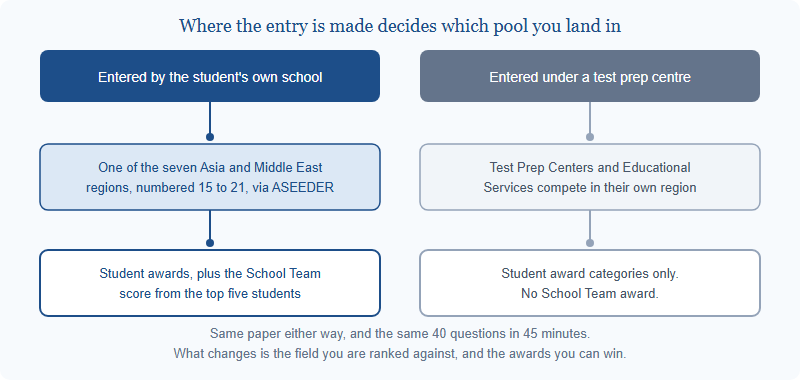
Entering under a test-prep identity. AAPT states that “Test Prep Centers and Educational Services will compete in their own region, and will be eligible for the student award categories only.” That is not a technicality. A student entered that way is ranked against a different field entirely, and the School Team award — which AAPT calculates as “the sum of the scores of the top five students competing” — goes off the table for their school. The normal arrangement is the one AAPT describes: students sit at their own school, under that school's supervision. AAPT is also explicit that “The PhysicsBowl exam MUST be proctored” and that “Parents, relatives, or close friends and acquaintances of students are not acceptable proctors” — so a parent invigilating at the kitchen table is not a sitting, whatever else it may be.
Planning around a 50-question paper. Chinese-language descriptions circulate claiming a 50-item paper on which Division I answers questions 1 to 40 and Division II answers 11 to 50. AAPT's own description is 40 questions in 45 minutes, for every student. If you have built a pacing plan around 50 items, the plan is wrong. The myth also does quiet damage to the division decision itself, because it implies the two divisions differ in which questions you face rather than in the level of the whole paper. Open any past paper and count: that settles it faster than any summary can. Two related points, per the published rules: an equation sheet comes with the paper but is not exhaustive, and gravity questions are set with g = 10 m/s².
What is published for the next season, and what is not
Known, because AAPT published it: the 2026 registration deadline was February 23, 2026, extended to February 25 at 11:59pm EST, and the 2026 exam was given between March 18 and April 3, 2026. That gives you a useful shape — a registration deadline in late February, and a testing window spanning roughly a fortnight in the second half of March.
Not known: anything about 2027. As of late August 2026, aapt.org still shows the 2026 contest and has published no 2027 dates at all. Do not build a schedule around a guessed date, and treat any Chinese-language source quoting one with suspicion. The real dates will appear on aapt.org/programs/physicsbowl/ when AAPT posts them.
Also worth fixing in mind before the season opens: entry is made by a school or a centre, never by a student directly. Schools in China and the other listed Asian and Middle Eastern countries register through ASEEDER, which covers regions 15 to 21 — China via seedasdan.asia/en/aapt-en/, the rest of Asia and the Middle East via seedcomp.asia/physicsbowl/, with physics@seedasdan.org as the contact address. On fees, AAPT publishes US$10 per student for the US route; it does not publish what the ASEEDER route charges, so ask ASEEDER rather than assuming the two match. We help schools and families get entries in through that official channel, and our registration page sets out the steps; we do not host sittings, proctor, or score anything.
None of which is a reason to wait. The division decision depends on a transcript, not on a calendar, so it can be settled now: pull the transcript, count the physics courses as they will stand next spring, write down the reading and the reasoning behind it, and put that in front of whoever will submit the entry. If the count is one, or clearly two, you are finished. If it falls into one of the ambiguous rows above, you now hold a documented position instead of a hurried guess in late February.
Common questions
Does Division II mean the student is better at physics?
No. AAPT sorts by course year: Division I is for first-year physics students and Division II is for second-year physics students.
Can a first-year student choose to sit Division II?
AAPT publishes no opt-up clause. The school or centre submitting the entry decides, so confirm it with whoever registers you.
Do the two divisions sit papers of different length?
No. Every entrant takes a 40-question, 45-minute multiple-choice paper, supervised at their own school. Only the level differs.
When is the next PhysicsBowl exam?
The 2026 exam ran from March 18 to April 3, 2026. AAPT has published no 2027 dates yet; they will appear on aapt.org.
Independent guide operated by Hanlin Education for China-based international-school students. Competition details change between seasons: confirm current rules, dates and eligibility on aapt.org before acting on anything here. Corrections are issued within 7 working days of notification.