 PhysicsBowl
Physics Bowl questions often present unfamiliar scenarios where you must select or derive the correct formula. A common preparation gap is not checking whether your chosen expression behaves sensibly under extreme conditions. This article focuses specifically on limiting cases—a reasoning technique that tests physical intuition by examining what happens when variables approach zero, infinity, or other boundary values.
Why Limiting Cases Matter for Physics Bowl
The American Association of Physics Teachers (AAPT) designs Physics Bowl to assess conceptual understanding, not just algebraic manipulation. Recent curriculum shifts in AP and IB Physics emphasize applying models to new contexts rather than memorizing formulas. When you face a Division 1 or Division 2 question involving mechanics, electromagnetism, or waves, verifying your answer through limiting cases can quickly eliminate incorrect options or reveal flawed assumptions.
This skill differs from broad topic review. For a general preparation framework, see our Physics Bowl Past Papers: Choosing a Practice Set and Checking Answer Coverage. Instead of cataloguing knowledge areas, we focus here on one specific verification method that catches errors before they cost points.
Worked Example 1: Pendulum Period at Small Angles
Consider a simple pendulum with length and mass . The standard small-angle period formula is:
A student might wonder if this formula remains valid as the amplitude increases. Let’s test it using limiting cases:
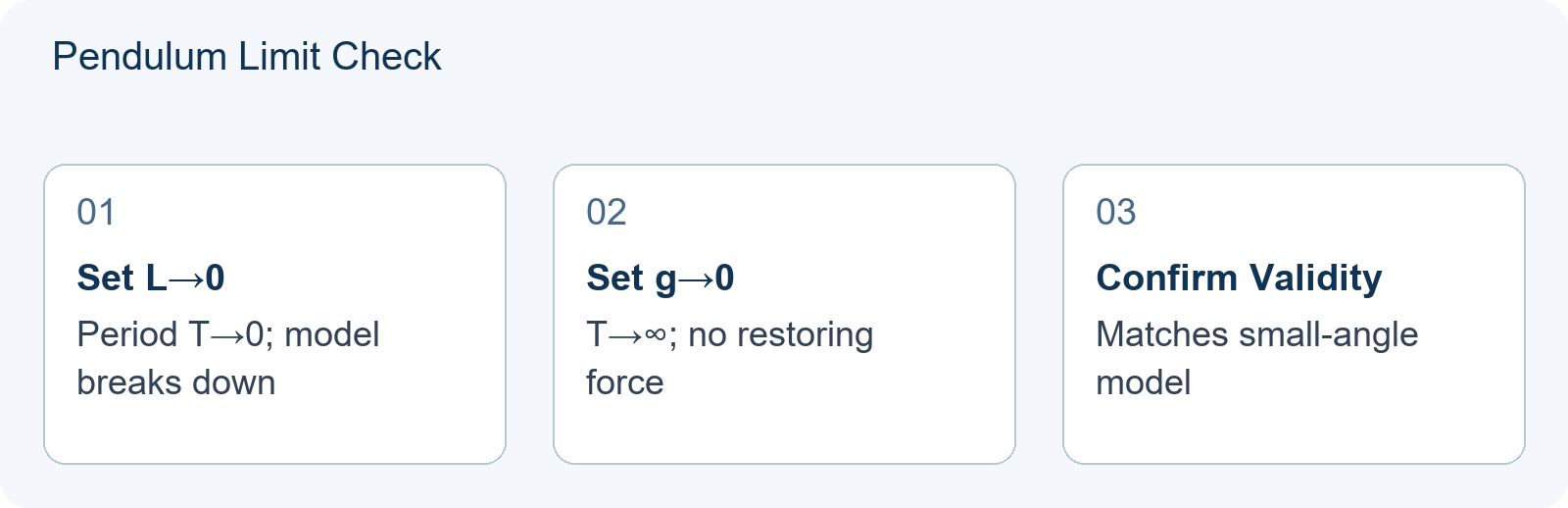
- Limit : If the pendulum length shrinks toward zero, the bob approaches the pivot point and the restoring torque vanishes. The formula gives , which indicates the model predicts increasingly rapid oscillation for very short lengths. At exactly zero length, however, the pendulum model itself breaks down—there is no oscillation at all. The limit correctly signals that the formula becomes invalid before reaching .
- Limit : In microgravity, there is no downward force to create a restoring effect. The pendulum would not swing back toward equilibrium. The formula gives , meaning the period becomes infinitely long—consistent with no oscillation occurring.
Both limits behave correctly, supporting confidence in the formula within its domain of validity (small angles). If a multiple-choice option included mass in the numerator under the square root, testing would show no change in , revealing that mass does not affect the period—a key insight many students miss.
Worked Example 2: Where the Shortcut Fails
Now consider electric potential energy between two charges and separated by distance :
A tempting shortcut is to assume this always describes stable configurations. Test the limit :
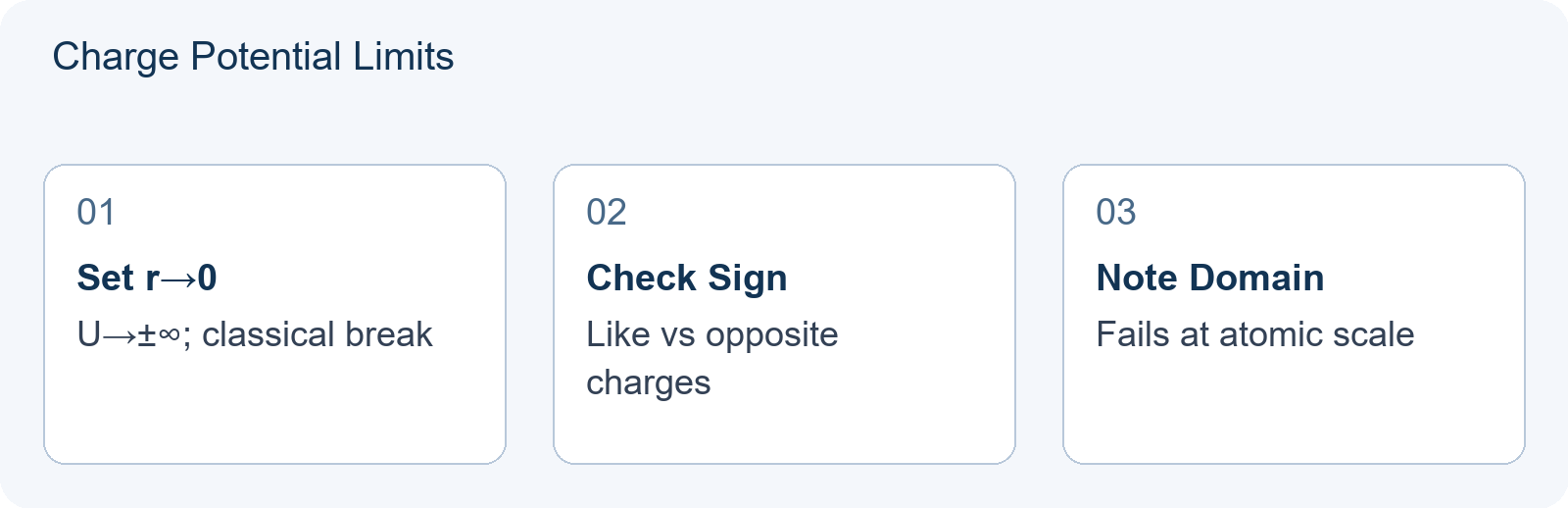
- As separation approaches zero, depending on charge signs.
- For like charges (), potential energy becomes large positive—meaning enormous work is required to bring them together. This makes sense physically because repulsion grows stronger.
- For opposite charges (), , suggesting infinite binding energy at contact.
However, real charges have finite size. At extremely small , quantum effects and charge distribution matter—the classical point-charge model breaks down. If a Physics Bowl question involves atomic-scale separations, blindly applying this formula without recognizing its domain limitation leads to error. The lesson: limiting cases confirm mathematical behavior but also expose where idealized models cease to apply.
Diagnostic Table: Common Mistakes Caught by Limiting Cases
| Mistake Pattern | What Limiting Case Reveals | Corrective Action |
|---|---|---|
| Including irrelevant variable in formula | Changing that variable produces no effect on result | Remove variable; check dimensional consistency |
| Wrong sign in exponent or denominator | Result diverges when it should converge (or vice versa) | Re-examine derivation step; test known boundary condition |
| Applying formula outside valid regime | Extreme value yields unphysical outcome (e.g., negative time) | Identify assumptions behind formula; restrict usage |
Targeted Practice Sequence
To build this skill systematically:
- Select five past-paper style problems from different topics (mechanics, E&M, waves).
- Solve each normally, then write down one limiting case per problem.
- Check whether your solution behaves plausibly in that limit.
- If not, trace back to identify the flawed assumption.
Pair this with broader strategy guidance from our Physics Bowl 2027 Registration: Planning Your Test Route and Preparation Timeline and the conceptual overview in Physics Bowl and the World of Biophysics: Where Life Meets Physical Law for comprehensive preparation.
Next Skill to Demonstrate
After practicing, you should be able to take any unfamiliar physics formula presented in a Physics Bowl context and immediately propose two meaningful limiting cases—one showing expected convergence and another exposing breakdown conditions. This demonstrates active modeling ability valued by admissions reviewers and aligns with current assessment trends emphasizing reasoning over recall.
Frequently Asked Questions
Do I need calculus to use limiting cases?
No. Most Physics Bowl limiting checks involve simple proportional reasoning—what happens when a quantity gets very small or very large—not derivatives.
How much time does this add during the exam?
With practice, checking one limit takes 10–15 seconds. It prevents costly rework and builds confidence in ambiguous choices.
Is this tested explicitly in Physics Bowl?
Not as a standalone question type, but many items reward students who recognize when formulas apply versus when they break down.