 PhysicsBowl
For students preparing for the PhysicsBowl Results: Where Proctors See Scores, When Students Hear, and Why a Score May Be Missing, one of the most frequent stumbling blocks in Division 1 and Division 2 electromagnetism questions is over-complicating circuit analysis. Many learners immediately reach for Kirchhoff’s laws or complex impedance calculations when they see a bridge-like structure. However, a significant portion of these problems can be solved instantly by recognizing circuit symmetry. This article focuses on the specific reasoning failure where students miss equal potential points, leading to unnecessary algebraic work and time pressure under the 45-minute exam constraint.
The Core Concept: Equipotential Nodes
In ideal circuits with symmetric resistance networks, certain nodes often share the same electric potential. If two points are at the same potential, no current flows through any component connecting them directly (like a central resistor in a Wheatstone bridge). Recognizing this allows you to “remove” that component from your mental model, collapsing a complex network into simple series-parallel combinations. This skill is particularly valuable given that Physics Bowl 2027 Registration: Planning Your Test Route and Preparation Timeline emphasizes efficient time management across 40 questions.
Teaching Illustration 1: The Balanced Bridge
The following is an original teaching illustration, not an official past-paper question or marking scheme.
Consider a standard diamond-shaped circuit with four resistors forming the sides and one resistor bridging the top and bottom vertices. Let the left-side resistors be and , and the right-side resistors be and . The central bridge resistor is also .
- Step 1: Identify the input voltage across the left and right vertices of the diamond.
- Step 2: Observe that the path from the positive terminal to the top vertex has total resistance , and continuing through the top branch to the negative terminal adds . The potential at the top vertex, by voltage division, is .
- Step 3: Apply the same logic to the bottom vertex. The path from positive terminal through to the bottom vertex, then through to the negative terminal. By identical voltage division: .
- Conclusion: Since , the top and bottom vertices are at the same potential. The central bridging resistor carries zero current. You can ignore it entirely. The total resistance becomes two parallel branches, each with resistance , giving:
Teaching Illustration 2: When Symmetry Actually Breaks
The following is an original teaching illustration, not an official past-paper question or marking scheme.
Now modify the circuit: keep , , but change to and . The central bridge remains .
- Analysis: Check the Wheatstone bridge balance condition: , while .
- Result: Since , the bridge is unbalanced. The potentials at top and bottom vertices differ: , while .
- Critical difference: . Current flows through the central resistor.
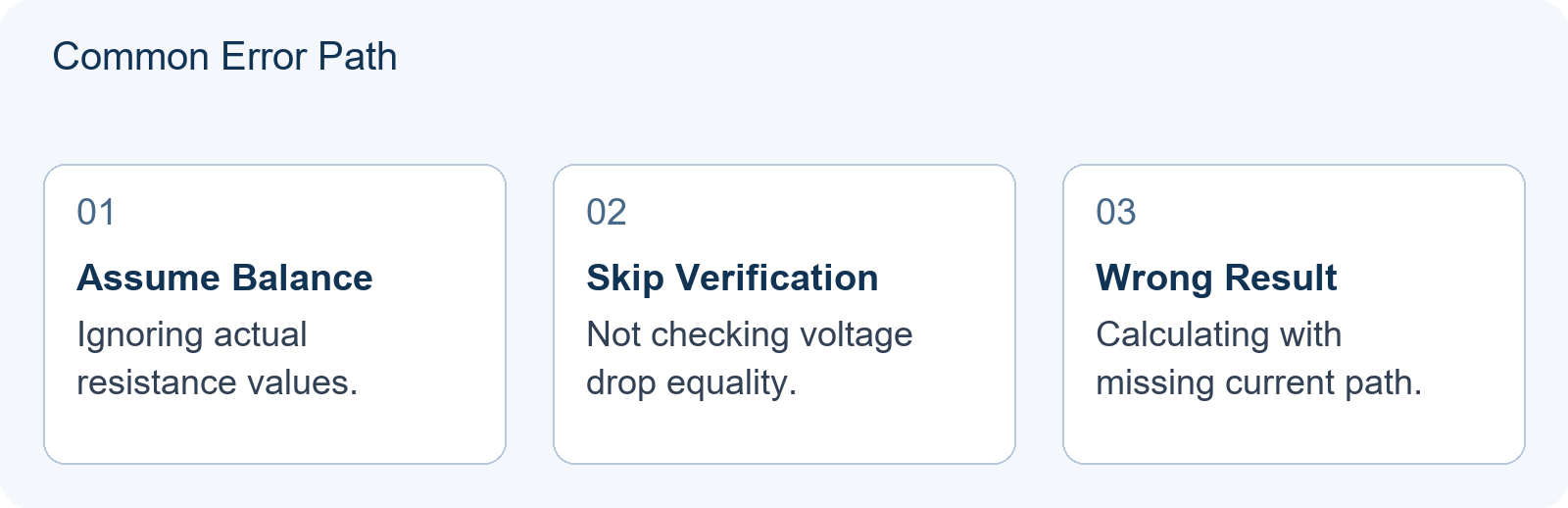
- Consequence: Attempting to remove the central resistor here leads to incorrect total resistance. The actual equivalent resistance requires full analysis (or the correct application of Y-Δ transformation).
Diagnostic Table: To Ignore or Not?
| Feature | Action | Reason |
|---|---|---|
| Identical paths from source to node | Check for equipotential | Symmetry suggests equal voltage drops |
| Central component connects equal-potential nodes | Remove from calculation | No current flows; simplifies circuit |
| Ratios of adjacent arms unequal | Use full analysis | Potentials differ; current flows through bridge |
| Time remaining under 5 minutes | Estimate or flag for review | Complex mesh analysis is risky under pressure |
Targeted Practice Sequence
To master this skill, follow this sequence during your preparation, aligned with the Physics Bowl 2027 Registration: Planning Your Test Route and Preparation Timeline:
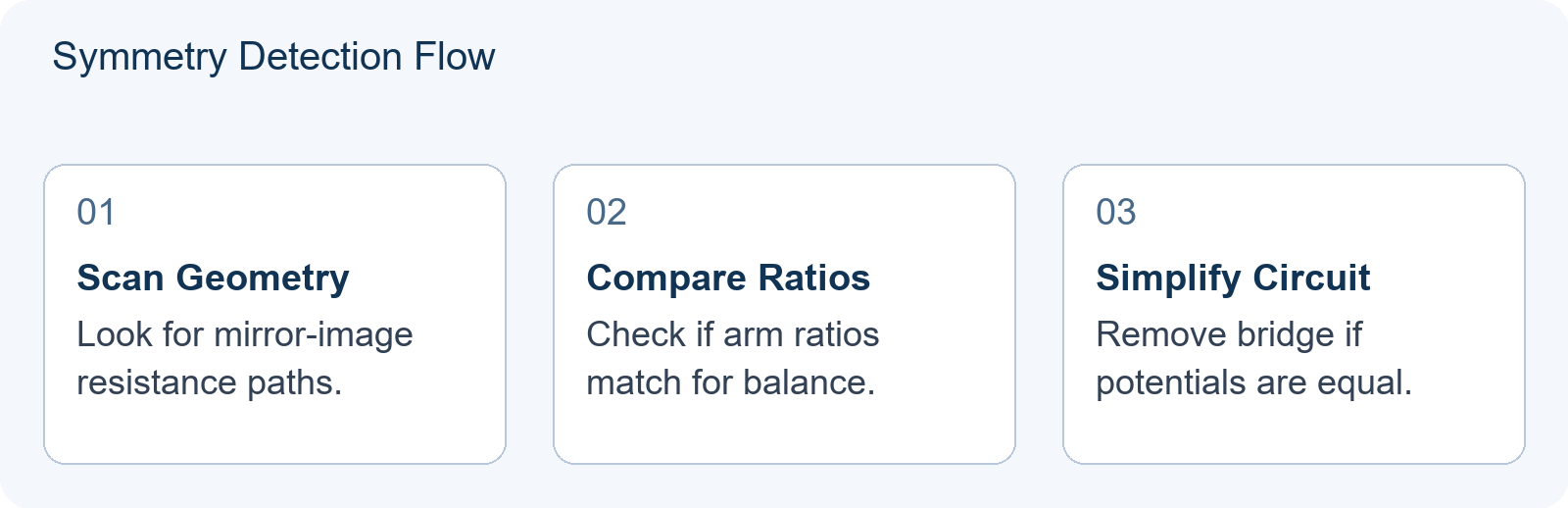
- Visual Scan: Before writing equations, look for geometric symmetry in the diagram. Does the circuit look like a mirror image?
- Potential Check: Mentally trace the voltage drop from the battery to key junctions. Are the paths identical in resistance?
- Redraw: If yes, redraw the circuit without the central component. Calculate equivalent resistance using simple series/parallel rules.
- Verify: If the answer seems too simple, double-check the ratio condition ().
This approach saves critical minutes in the exam window. For additional practice material, consult Physics Bowl Past Papers: Choosing a Practice Set and Checking Answer Coverage to find electromagnetism problems where symmetry shortcuts apply. Remember, the Physics Bowl tests conceptual understanding and quick modeling, not just brute-force calculation.
Next Steps for Learners
A student should be able to demonstrate this skill by solving three consecutive bridge-circuit problems in under five minutes, correctly identifying which ones allow for component removal. If you struggle with this, review basic voltage divider principles before attempting complex networks. For structured guidance on electromagnetic topics, consult your course materials or seek targeted tutoring that emphasizes pattern recognition over rote formula application.
Frequently Asked Questions
Does symmetry always mean I can remove the central resistor?
No. Only if the potentials at both ends of the central resistor are identical. This happens when the ratio of resistances in the upper arms equals the ratio in the lower arms (R1/R2 = R3/R4 for a standard Wheatstone bridge).
How does this help with the 45-minute time limit?
It reduces complex mesh analysis to simple series-parallel calculations, saving several minutes per problem and reducing cognitive load during the exam.
Is this tested in Division 1 or Division 2?
Both divisions test electromagnetism concepts. Division 1 may use simpler symmetries, while Division 2 might involve more complex networks requiring careful ratio checks.