 PhysicsBowl
When preparing for the Physics Bowl, students often memorize the law of conservation of momentum as p_initial = p_final. However, this equation is only valid under specific conditions. A frequent conceptual error in mechanics questions is failing to define the correct “system” before applying the conservation law. If your chosen system includes objects experiencing significant net external impulses (like friction from the ground over a sustained period), momentum is not conserved within that system. Conversely, if you exclude an object that exerts a force on your system, you are missing an external impulse.
This article addresses the precise decision-making process required to solve momentum problems efficiently. We will explore why system selection dictates whether conservation applies, provide a fully worked teaching illustration where the correct boundary choice simplifies the problem, and present a contrasting case where a superficially similar setup fails due to hidden external forces.
The Mechanism: Why System Boundaries Matter
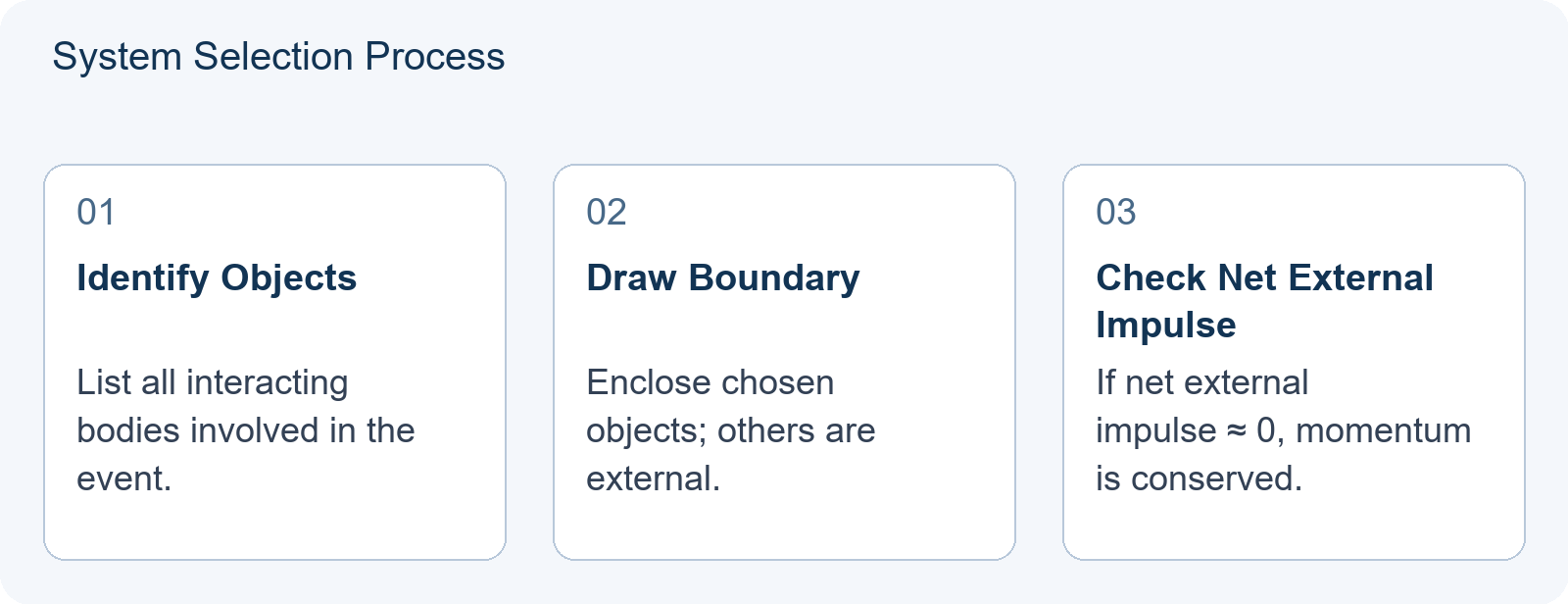
Momentum is a vector quantity defined as p = mv. The change in total momentum of a system is equal to the net external impulse acting on it: ΔP_system = J_external. Internal forces—forces between objects within the system—always occur in action-reaction pairs (Newton’s Third Law) and cancel out when summing over the entire system. Therefore, internal forces cannot change the total momentum of the system.
The critical step in solving any collision or explosion problem is drawing a dashed line around the objects you consider part of the “system.” If the net external impulse along the axis of motion is zero or negligible during the interaction time, momentum is conserved along that axis. If external impulses are present (e.g., sustained friction acting horizontally), you must either account for them explicitly or include the source of the force in your system.
For instance, in a car crash analysis, if you define the system as just the two cars, momentum is conserved during the brief collision because the impact forces are internal. However, if you include the Earth in the system, momentum is still conserved, but the calculation becomes impractical because the Earth’s velocity change is infinitesimal. In Physics Bowl multiple-choice questions, a common trap involves scenarios where friction is non-negligible over the time scale of interest, making the “two-object” system invalid for conservation unless you account for the impulse from the ground.
Worked Teaching Illustration: The Frictionless Cart Collision
Note: This is a hypothetical teaching illustration designed to demonstrate the concept, not an official contest question.
Scenario: A cart of mass m₁ = 2 kg moves right at v₁ = 4 m/s on a frictionless track. It collides elastically with a stationary cart of mass m₂ = 3 kg.
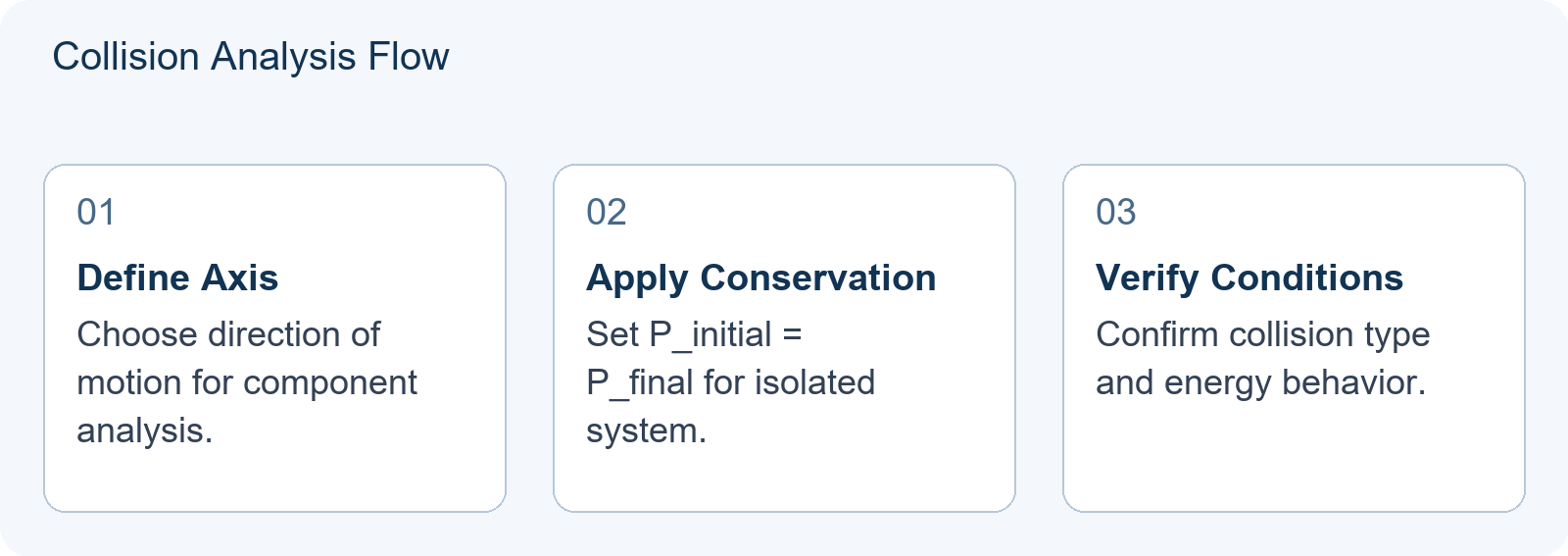
Step 1: Define the System. We choose the system to be {Cart 1 + Cart 2}. Since the track is frictionless and normal forces/gravity are vertical (perpendicular to motion), there are no external horizontal forces. Thus, horizontal momentum is conserved.
Step 2: Apply Conservation of Momentum.
P_initial = P_final
m₁v₁ + m₂v₂ = m₁v₁’ + m₂v₂’
(2)(4) + (3)(0) = 2v₁’ + 3v₂’
8 = 2v₁’ + 3v₂’ (Equation 1)
Step 3: Apply Conservation of Kinetic Energy (Elastic).
K_initial = K_final
½m₁v₁² + ½m₂v₂² = ½m₁v₁’² + ½m₂v₂’²
½(2)(16) + 0 = ½(2)v₁’² + ½(3)v₂’²
16 = v₁’² + 1.5v₂’² (Equation 2)
Step 4: Solve. From Eq 1, v₁’ = (8 – 3v₂’)/2 = 4 – 1.5v₂’. Substitute into Eq 2:
16 = (4 – 1.5v₂’)² + 1.5v₂’²
16 = 16 – 12v₂’ + 2.25v₂’² + 1.5v₂’²
0 = 3.75v₂’² – 12v₂’
0 = v₂'(3.75v₂’ – 12)
Solutions: v₂’ = 0 (no collision) or v₂’ = 12 / 3.75 = 3.2 m/s.
Then v₁’ = 4 – 1.5(3.2) = 4 – 4.8 = -0.8 m/s.
Check: Momentum: 2(-0.8) + 3(3.2) = -1.6 + 9.6 = 8. Correct. KE: ½(2)(0.64) + ½(3)(10.24) = 0.64 + 15.36 = 16. Correct.
Contrasting Case: When Conservation Fails Due to External Forces
Note: This is a hypothetical teaching illustration demonstrating a common pitfall, not an official contest question.
Scenario: Same carts (m₁=2kg, v₁=4m/s; m₂=3kg, v₂=0) collide on a rough surface with coefficient of kinetic friction μ_k = 0.2. The collision lasts Δt = 0.01 s.
The Error: Many students immediately apply P_i = P_f ignoring friction, calculating the same velocities as the frictionless case. Then they try to find stopping distances using work-energy theorem with these post-collision speeds.
Why it fails: During the collision, friction exerts an impulse. The maximum possible frictional impulse (upper bound, assuming both carts experience friction in the same direction) is J_friction ≤ μ_k(m₁+m₂)gΔt. With g ≈ 10 m/s², this gives J_friction ≤ 0.2(5)(10)(0.01) = 0.1 N·s, compared to the collision impulse of order Δp ≈ 8 kg·m/s. The fractional error is at most 0.1/8 = 1.25%. However, this is an upper bound—friction directions may switch during collision, and vector cancellation of external impulses is possible. More critically, after the collision, the carts slide with continuous friction acting. The system {Cart 1 + Cart 2} now experiences a sustained external force, so momentum is definitively not conserved during the sliding phase. Students who apply P_i = P_f through the entire process obtain physically impossible results.
Correct Approach: During the very brief collision, momentum conservation may be used as an approximation if the problem specifies negligible friction or very short Δt, but you must acknowledge the approximation. For the post-collision sliding, abandon momentum conservation entirely. Use the work-energy theorem or kinematic equations with a = -μ_k g to find stopping distances. The key skill is recognizing when the “conservation” phase ends: the moment external forces become sustained and non-negligible. Note also that without specifying whether the collision is elastic, inelastic, or perfectly inelastic, you cannot determine unique final velocities from momentum alone—additional information (restitution coefficient, energy data, or “stick together”) is required.
Diagnostic Application: Identifying the Valid System
Consider three hypothetical setups. Which allows for simple application of P_i = P_f?
- A: Two ice skaters push off each other on frictionless ice.
- B: A bullet embeds itself in a wooden block resting on a table with high friction.
- C: A rocket burns fuel in deep space (no gravity/friction).
Complete Analysis with Answers:
A: YES. System = {Skater 1 + Skater 2}. No external horizontal forces act on this system. The normal force and gravity are vertical, perpendicular to the horizontal motion. Momentum is conserved in the horizontal direction.
B: ONLY DURING COLLISION. During the very brief bullet-block collision, the frictional impulse from the table is small compared to the collision impulse, so momentum is approximately conserved for the system {bullet + block}. However, immediately after, as the block slides with continuous friction, momentum is not conserved. Students often err by applying conservation through the entire slide. The correct post-collision analysis uses work-energy with friction.
C: YES, WITH CORRECT SYSTEM. System = {Rocket + Exhaust Gas}. If you define the system as just the rocket, momentum is NOT conserved because the exhaust gas exerts an external force (thrust). You must include the expelled mass in the system to apply conservation laws correctly. The total momentum of {rocket + exhaust} remains constant at zero (if starting from rest).
Implications for Next Learning Tasks
If you struggle with defining systems, your next study task should not be more complex calculations, but rather free-body diagram exercises focusing on identifying external vs. internal forces. Review resources like the Physics Bowl Vector Components: Choosing Axes That Simplify the Forces article, as choosing the right coordinate system often reveals which forces are perpendicular to motion and thus do not affect momentum conservation along the axis of interest.
Furthermore, understanding the limits of conservation helps with energy problems. As noted in Physics Bowl Limiting Cases: Checking Whether a Formula Makes Physical Sense, checking if a formula yields sensible results (like negative mass or infinite velocity) can alert you to a misapplied conservation law. For instance, if you assume elastic collision in an inelastic scenario, your energy check will fail.
Finally, pacing matters. In the PhysicsBowl Pacing: What 40 Questions in 45 Minutes Actually Demands guide, speed comes from pattern recognition. Recognizing that “frictionless surface” implies momentum conservation allows you to skip deriving equations from Newton’s laws, saving valuable seconds.
Preparation Strategy and Resource Fit
To solidify this concept, practice problems should explicitly ask you to state the system before solving. Use past papers from the Physics Bowl Past Papers: Choosing a Practice Set and Checking Answer Coverage resource. Look for questions involving collisions on surfaces with varying friction coefficients. Compare your solution method against official solutions to see if they implicitly assumed a specific system boundary.
Remember that Physics Bowl questions are multiple-choice. Often, distractors are calculated based on incorrect system assumptions (e.g., conserving momentum when external forces are present, or vice versa). By consciously defining your system, you can identify which answer corresponds to the physically correct model.
For students aiming for higher difficulty levels, note that Division 2 questions may involve rotational momentum (angular momentum). The principle remains the same: angular momentum is conserved only if net external torque is zero. Defining the system to include all interacting bodies ensures torques are internal and cancel out.
Frequently Asked Questions
Does friction always prevent momentum conservation?
Not necessarily. During very short collisions, the impulse from friction may be small compared to the collision forces, allowing approximate conservation. However, during prolonged sliding, friction is a sustained external force, so momentum is not conserved. The key is comparing the time scale of the collision to the time scale of external force effects. Also, vertical forces like gravity and normal force cancel and do not affect horizontal momentum conservation.
How do I know if a collision is elastic?
The problem statement usually specifies ‘elastic’ or ‘perfectly elastic.’ If not specified, you cannot assume a unique outcome—additional information such as coefficient of restitution, energy data, or ‘stick together’ is needed. In Physics Bowl, look for keywords like ‘stick together’ (perfectly inelastic) or explicit ‘elastic.’ Always check if kinetic energy is conserved as a verification when elasticity is claimed.
Can I use momentum conservation for explosions?
Yes, provided the system includes all fragments and the initial momentum was zero (or known). Explosions convert chemical potential energy into kinetic energy, but total momentum remains conserved if no external forces act during the brief expansion. Define the system as {all fragments} to ensure all forces are internal. Do not double-count the original object separately from the fragments.