 PhysicsBowl
When two PhysicsBowl students finish on the same total, AAPT compares their answers from the last question of the paper backwards until one of them is ahead, so the final questions you answer can decide the order. Team ties are settled differently, in favour of the school with the higher-scoring top student. Perfect scores are not separated at all, and a wrong answer costs nothing beyond the mark itself.
Three rules for equal scores, all published by AAPT
The individual rule is printed on the instruction page of recent papers. A score is the number of correct answers, and nothing is deducted for an incorrect one. When scores tie, the entries are “compared from the end of the test forward until the tie is resolved.” The page then draws the conclusion itself: the last few questions may help decide the winner, so students should consider them carefully. AAPT's FAQ describes the same rule as a reward for answering the more difficult questions correctly.
AAPT does not describe the comparison step in more detail than that. The plain reading, and the one we coach to, works one question at a time from the back. If one student answered the last question correctly and the other did not, the first student ranks higher. If both did, or neither did, the comparison moves back one question and repeats until the two students differ.
Two further rules come from AAPT's 2026 results. Its results page says perfect scores of 40 are listed alphabetically, because there is no method for ranking them, while every other score is posted in tie-break order. And its 2026 team lists carry a note that a tied team total goes to the school with the highest-scoring student. A school team score is the sum of that school's five best scores in a division, so the team rule and the individual rule settle two different questions.
| Situation | What decides the order | Where AAPT says so |
|---|---|---|
| Two students on the same score | Answers compared from the end of the paper forward | Instruction page of the paper; the PhysicsBowl FAQ |
| Two or more perfect scores of 40 | Not separated; listed alphabetically in 2026 | The 2026 results page |
| Two schools on the same team total | The school with the highest-scoring individual student | A note on the 2026 team lists |
| A wrong answer set against a blank | Both score nothing for that question; nothing is deducted | Instruction page of the paper |
The last row settles a question our pacing guide left open. There is no deduction for an incorrect answer, so a guess can never score below a blank. Under this rule, the only thing a blank does is lock in the zero.
Why ties stopped being a footnote in 2026
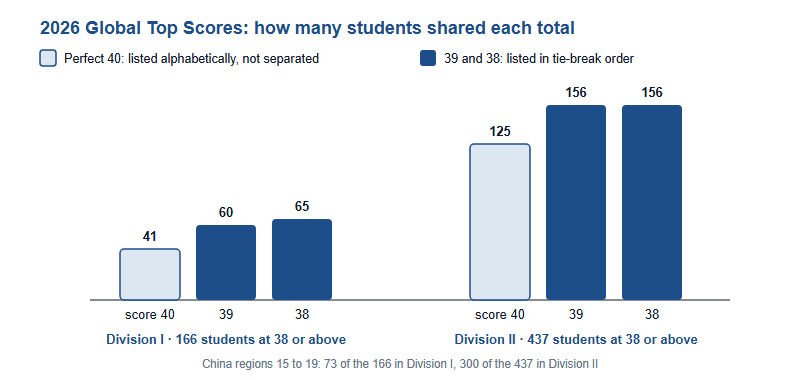
AAPT's 2026 results page explains that an unusually large number of students scored highly. Instead of a top-100 list, it recognised every student who scored 38, 39 or 40, in both divisions, on its Global Top Scores list — more than a hundred students per division. We counted that list. In Division I, 166 students scored 38 or more: 41 on a perfect 40, 60 on 39 and 65 on 38. In Division II the figure was 437: 125 on 40, 156 on 39 and 156 on 38.
The China share is large. By our count, 73 of the 166 Division I entries and 300 of the 437 Division II entries came from China's five regions, codes 15 to 19, including 78 of the 125 perfect scores in Division II. For a China-based candidate aiming at the very top of that list, the implication is simple. In Division II a total of 39 was shared by 156 students, and only the tie-break put them in order.
Keep the season in proportion. AAPT's statistics put the 2026 Division I average at 21.6 out of 40, with a standard deviation of 7.1, across 7,101 exams, and the Division II average at 25.5, with a standard deviation of 7.9, across 4,496 exams. Its FAQ says the contest is expected to average somewhere between 40 and 50 percent; 2026 came in above that, at roughly 54 and 64 percent, and the results letter says adjustments will be made to future exams. Crowding at the top was a feature of one season, not a promise about the next.
Where does your tie-break start? It depends on your division
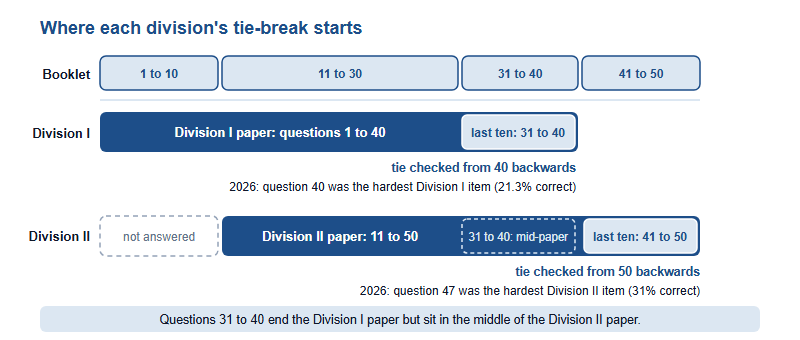
The end of the paper is not in the same place for everyone. In the combined booklet, Division I answers questions 1 to 40 and Division II answers questions 11 to 50. A Division I tie is therefore checked at question 40 first, then 39, then 38; a Division II tie is checked at question 50 first, then 49, then 48.
That produces an asymmetry most students never notice. Questions 31 to 40 are the final ten of the Division I paper, but for a Division II student they are the 21st to 30th questions — ordinary items in the middle of the paper. The ten questions that open a Division II tie-break, 41 to 50, are never seen by Division I at all. Two students in different divisions who both say they are working on the back of the paper are working on different questions.
AAPT's 2026 statistics show why this matters. The hardest Division I question that year, measured by the share of students who answered it correctly, was question 40, at 21.3 percent — the very first question a Division I tie is checked on. The hardest Division II question was question 47, at 31 percent, inside the ten questions that open a Division II tie-break. One season is not a pattern, but it shows the tie-break reaching into exactly the questions most of the field got wrong.
What the rule should change in the room, and what it should not
A tie-break only orders students who are already level, so it should never outrank a mark. With that fixed, the rule changes a handful of decisions. The habits below are our coaching advice, built on AAPT's published rule rather than on anything AAPT itself recommends.
| Moment in the paper | Habit | Why, under this rule |
|---|---|---|
| First pass | Work in order and keep moving; do not start from the back | Totals come from all 40 questions, and the tie-break only matters between equal totals |
| Approaching the last ten questions | Reach them with enough time to read each one | An unread question at the back is a certain zero, both for the total and for the tie-break |
| Final minutes, two questions left | If they look equally uncertain, spend the time on the later-numbered one | It is worth the same mark, and it is checked earlier if you tie |
| Last minute | Fill every remaining row in your division | Nothing is deducted for a wrong answer, so a blank is never better than a guess |
| Checking | Confirm that rows match question numbers, especially 31 to 40 or 41 to 50 | A shifted row at the end corrupts the very answers a tie is decided on |
The third row is the only place the rule should change what you choose, and even there it is a second-order effect. The first row matters more. A student who reorders the paper to protect the late questions risks losing marks in the middle that no tie-break can give back, because a tie-break only ever applies to a total that already matches someone else's. The end of the paper deserves care, not priority over everything before it.
Practising the back of the paper, and what applies in China
You can train for this with past papers. Score every timed paper twice: once out of 40, and once on the last five questions of your division — 36 to 40 for Division I, 46 to 50 for Division II. If your accuracy on those five sits well below your overall rate across several papers, practise late-paper questions as a separate set, at the pace the end of a real paper allows. Our past-paper pack includes papers with their answers, and worked solutions for some years; what you receive follows what our teachers send, and the past papers page explains how to ask for it. How scores, teams and awards fit together is summarised on our rules page.
China-based candidates should read AAPT's lists with one more fact in mind. AAPT's 2026 results letter says that students in regions 00 to 14 compete for AAPT's awards, while the contest for students in China is coordinated by ASDAN China, which was given the score information for regions 15 to 21. AAPT's 2026 file for those regions lists school team scores, and individual top scores appear on the global list described above. Award bands used in the China region, such as Super Gold, belong to the China-region organiser, and AAPT does not publish how those bands treat equal scores, so ask the channel that entered you. For reference, our own 2026 cohort record in those bands reads 39 Super Gold, 31 Gold, 42 Silver and 37 Bronze — per our own records, and not an official statistic. How an entry from China reaches the contest is set out on our registration page.
None of this depends on a date. AAPT has not published anything for 2027, and the individual rules described here are the ones printed on the 2025 and 2026 papers. Read the instruction page of the next paper before you rely on them.
Common questions
How are ties broken in the PhysicsBowl?
Equal individual scores are compared from the last question backwards until one student is ahead. Perfect scores of 40 are not separated.
Is there a penalty for wrong answers in the PhysicsBowl?
No. Your score is the number of correct answers, with no deduction for incorrect ones, so a guess never scores below a blank.
How are PhysicsBowl team ties decided?
On the 2026 team lists from AAPT, a tied team total went to the school with the highest-scoring individual student.
Which questions decide a Division II tie?
The Division II paper ends at question 50, so a tie is checked at 50 first, then 49, then 48, until one student is ahead.
Contest details change from season to season; confirm current details on aapt.org before acting on anything here. Corrections are issued within 7 working days.