 PhysicsBowl
The Physics Bowl is not a simple test of whether students have mastered high school physics knowledge. Rather, it is a comprehensive assessment of students’ breadth of knowledge, English reading ability, physical modeling skills, and competition problem-solving speed, all built on top of the school curriculum. Only by understanding the core differences between it and school exams can you develop a targeted preparation strategy.
I. Physics Bowl vs School Physics: Three Core Differences
Difference 1: Breadth of the Knowledge System and Switching Speed
School physics learning typically progresses chapter by chapter, and exam content is relatively focused. For example, after finishing the mechanics section, the exam will mainly test Newton’s laws, kinematics, work and energy, etc. The Physics Bowl, however, requires students to have a complete physics knowledge system and to switch quickly between different modules within 45 minutes. One question might just be a mechanics problem, and the next could involve electromagnetism, waves, thermodynamics, or even modern physics. This often leads to the dilemma of “knowing each chapter individually but being unable to solve integrated problems.”
Difference 2: Physics Thinking > Formula Calculation
A large number of Physics Bowl questions require students to make quick judgments rather than mechanically apply formulas. Typical scenarios include: analyzing motion patterns through graphs, using order-of-magnitude estimation to eliminate wrong options, and quickly building models based on physical phenomena. Pure formula calculation ability is far from sufficient.
Difference 3: English Reading Is a Hidden Barrier
Students not only need to understand physics concepts but also need to quickly identify professional vocabulary and the logical structure of the problem. In the high-pressure environment of completing 40 multiple-choice questions in 45 minutes, reading speed and information extraction ability directly affect the final score. Many students who “know how to solve the problems but cannot finish them” actually have their problems rooted in the English reading and comprehension stage.
II. Core Preparation Recommendations for the Physics Bowl
Knowledge Level:
During preparation, supplement your knowledge with topics beyond the AP Physics scope, while also paying attention to the latest developments in the field of physics (such as the Nobel Prize in Physics). Accumulate as much physics knowledge as possible.
Skill Level:
Completing 40 questions in 45 minutes is extremely time-pressured and reading-intensive. Improving reading ability, problem-solving speed, and accuracy is the key to preparation. A large amount of practice with past papers before the competition is essential.
III. Preparation Strategies by Curriculum
AP Curriculum
Grade 10: By the time the Physics Bowl takes place, students usually have just finished the mechanics portion of AP Physics 1. If you plan to participate in the March competition, you need to start preparing in December or during the winter break. During this time, you should complete all the topics covered in AP Physics 1 and AP Physics 2, especially electromagnetism, optics, and modern physics.
Grade 11: By the time of the competition, students have usually completed mechanics, electricity, optics, and some other topics, but modern physics may not have been covered yet. Participating in Division 1 is more advantageous and can yield very good results. If you want to participate in Division 2, you need to complete the modern physics chapters in advance.
A-Level Curriculum
Grade 10: Students generally have completed the mechanics, optics, and electromagnetism content of IGCSE Physics. However, IGCSE Physics covers topics at a relatively basic level, and there is still a gap compared to the Physics Bowl syllabus. It is recommended to complete AS Physics before aiming for an award.
Grade 11: If you have already completed AS Physics and started studying A2 Physics, you can continue to supplement the topics that are beyond the Physics Bowl syllabus. Learning the competition content in advance will help you achieve a higher award.
Chinese Domestic Curriculum
Core Problem: The in-school physics curriculum does not cover the Physics Bowl syllabus. The first step is to fill the knowledge gaps.
Language Barrier: The fully English exam is a significant obstacle for students from the domestic system. It is recommended to study AP Physics content outside of school. This will help you fill knowledge gaps while also adapting to the English expression of physics and improving your English reading level.
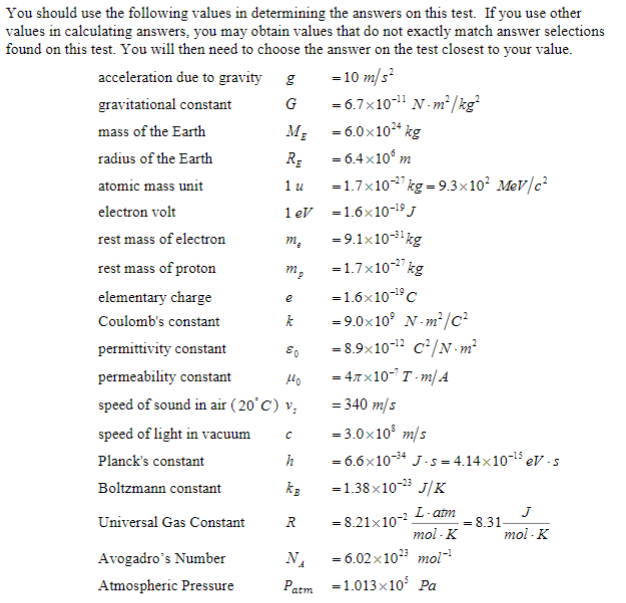
IV. Reference Constants
The following table lists common physical constants that may be useful for preparation and reference.
| Quantity | Symbol | Value |
|---|---|---|
| Acceleration due to gravity | g | = 10 m/s² |
| Gravitational constant | G | = 6.7 × 10⁻¹¹ N·m²/kg² |
| Mass of the Earth | Mₑ | = 6.0 × 10²⁴ kg |
| Radius of the Earth | Rₑ | = 6.4 × 10⁶ m |
| Atomic mass unit | 1 u | = 1.7 × 10⁻²⁷ kg = 9.3 × 10² MeV/c² |
| Electron volt | 1 eV | = 1.6 × 10⁻¹⁹ J |
| Rest mass of electron | mₑ | = 9.1 × 10⁻³¹ kg |
| Rest mass of proton | mₚ | = 1.7 × 10⁻²⁷ kg |
| Elementary charge | e | = 1.6 × 10⁻¹⁹ C |
| Coulomb’s constant | k | = 9.0 × 10⁹ N·m²/C² |
| Permittivity constant | ε₀ | = 8.9 × 10⁻¹² C²/(N·m²) |
| Permeability constant | μ₀ | = 4.7 × 10⁻⁷ T·m/A |
| Speed of sound in air (20°C) | vₛ | = 340 m/s |
| Speed of light in vacuum | c | = 3.0 × 10⁸ m/s |
| Planck’s constant | h | = 6.6 × 10⁻³⁴ J·s = 4.14 × 10⁻¹⁵ eV·s |
| Boltzmann constant | k_B | = 1.38 × 10⁻²³ J/K |
| Universal Gas Constant | R | = 8.21 × 10⁻² L·atm/(mol·K) = 8.31 J/(mol·K) |
| Avogadro’s Number | N_A | = 6.02 × 10²³ mol⁻¹ |
| Atmospheric Pressure | P_atm | = 1.013 × 10⁵ Pa |