 PhysicsBowl
If you are preparing for Physics Bowl Division 1, note that Fluids have moved from AP Physics 2 to AP Physics 1 Unit 8. Since D1 still tests fluid mechanics, this shift creates a gap for students who haven’t taken the new AP Physics 1 unit yet. This guide helps you bridge that gap with targeted practice.
The Syllabus Move: Fluids Leaves AP Physics 2, Enters AP Physics 1
As of October 2026, the AP Physics framework revision is the most relevant curriculum signal for Physics Bowl Fluids preparation. The supplied curriculum note says AP Physics 1 has expanded from seven to eight units, and Fluids becomes Unit 8. Pressure, buoyancy, and Bernoulli’s equation are now required content in AP Physics 1. The same note says Fluids are no longer part of AP Physics 2; AP Physics 2 has moved toward a fuller treatment of waves, split optics units, more comprehensive circuits, and modern-physics connections such as blackbody radiation and Compton scattering.
This is not just a course-label change. For a D1 candidate, the AP sequence now determines when fluids first appear. A student in AP Physics 1 may meet hydrostatic pressure and buoyancy before contest practice. A student in AP Physics 2 may not meet fluids in that course at all. That difference is exactly why a separate D1 fluids plan is useful. What PhysicsBowl Assumes You Already Know: A Topic Map from IGCSE, A-Level, IB and AP to the Contest Paper helps place fluids in the wider preparation sequence.
What Physics Bowl D1 Already Expects in Fluids
Physics Bowl D1 is not a separate AP exam. The supplied 2027 Physics Bowl preparation note lists D1 mechanics as including measurement basics, kinematics, Newton’s laws, momentum, impulse, kinetic energy, energy conversion, circular motion, and fluid mechanics. So fluids are already inside the D1 mechanics scope. D1 candidates answer questions 1–40 in 45 minutes. The note describes D1 as suitable for students such as IB Grade 10 and A-Level G2 students, with basic algebra and trigonometry rather than deep calculus derivations.
For preparation, that means the goal is not to build a university fluid-dynamics course. It is to become fast and accurate with the fluid models that can appear inside a timed mechanics section. In practice, the core D1 fluid topics to drill are hydrostatic pressure, buoyant force, floating and sinking conditions, continuity, and basic Bernoulli reasoning. The contest may use wording or combinations that a direct AP problem does not, so recognition speed matters as much as formula recall.
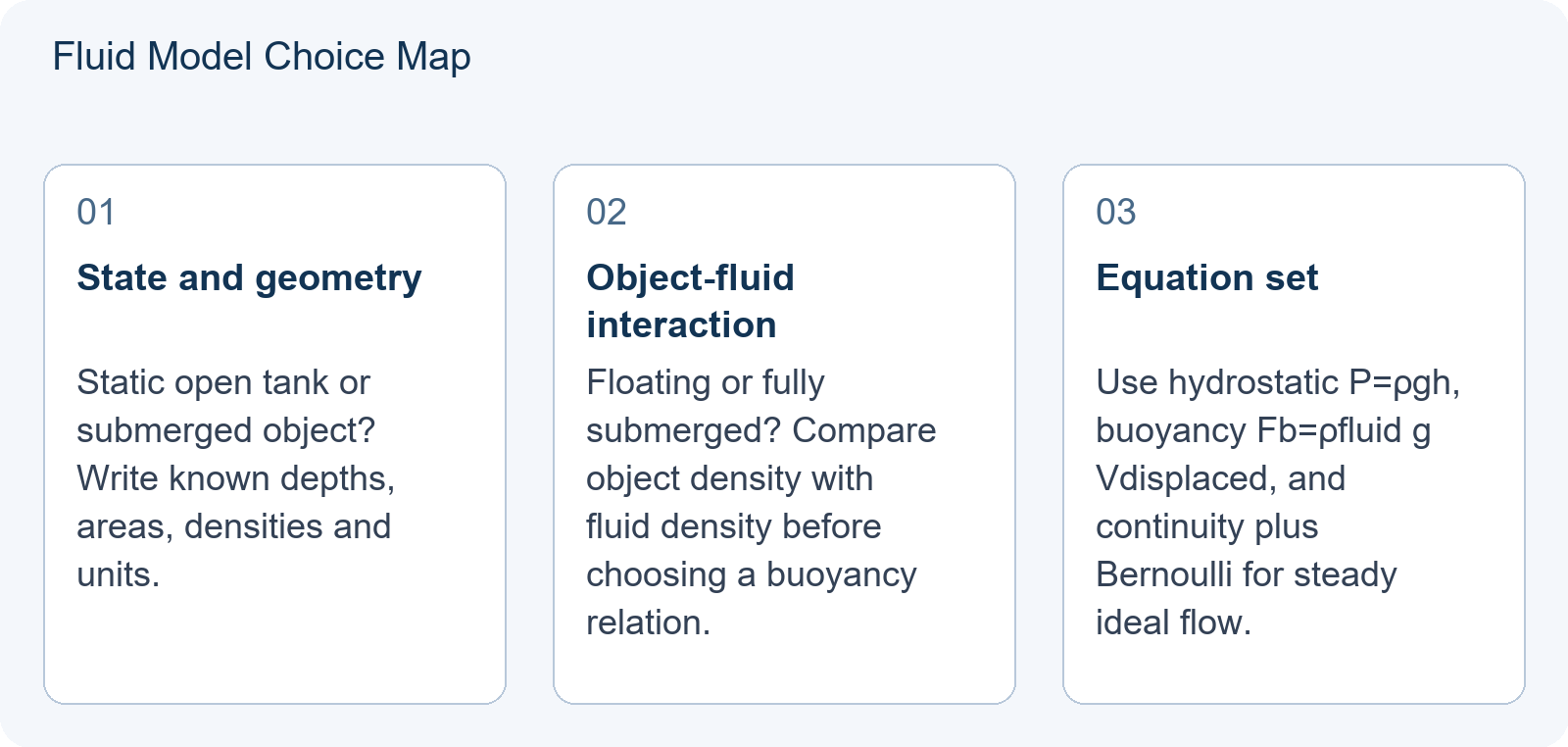
Pressure and Buoyancy: AP-Style Questions vs Contest-Style Wording
AP Physics 1 fluid questions often begin with a clear model: a tank of water, a submerged block, or a pipe with a known cross-section. The student selects a formula and calculates. A D1-style question may keep the same physics but change the decision point. Instead of asking only for a number, it may ask which quantity changes when a condition changes, or it may combine buoyancy with a spring, a scale, or circular motion.
A safe way to train is to use fully specified teaching illustrations, not guessed contest problems. Teaching illustration 1: a cube of side length L is fully submerged in water. The buoyant force is F_b = ρ_water g L cubed, where ρ_water is water density and g is gravitational field strength. If L = 0.10 m, ρ_water = 1000 kg/m³, and g = 9.8 m/s², then the cube volume is 0.001 m³ and F_b = 1000 × 9.8 × 0.001 = 9.8 N. This is direct AP-style work.
Teaching illustration 2: the same cube has density 600 kg/m³ and floats in water. The fraction submerged is ρ_object / ρ_fluid = 600 / 1000 = 0.60, so 60% of the cube’s volume is below the water line. If the cube is pushed fully under, the displaced volume increases to the full cube volume, so the buoyant force becomes 9.8 N while the cube’s weight is 600 × 9.8 × 0.001 = 5.88 N. These numbers are checkable and show the kind of model shift D1 practice should make automatic.
Pressure questions require the same care. Gauge pressure at depth h in a static fluid is P_gauge = ρ g h. At h = 2.0 m in water, P_gauge = 1000 × 9.8 × 2.0 = 19,600 Pa. Absolute pressure adds atmospheric pressure: about 101,325 + 19,600 = 120,925 Pa. D1 prep should make clear whether the question wants gauge or absolute pressure.
Bernoulli and Flow: What to Know Without Overbuilding
Bernoulli’s equation is now part of AP Physics 1 fluids, but D1 preparation should stay controlled. For steady, incompressible, non-viscous flow, the relation P + ½ρv² + ρgy = constant is useful. Continuity, A₁v₁ = A₂v₂, handles speed changes in a pipe. A useful contest-style idea is qualitative: where a horizontal pipe narrows, speed increases and pressure decreases.
Teaching illustration 3: water flows through a horizontal pipe whose radius narrows from 2.0 cm to 1.0 cm. The area ratio is (2.0/1.0)² = 4, so if the wider section has speed 0.50 m/s, the narrow section has speed 2.0 m/s. Using Bernoulli with no height change, P₂ − P₁ = ½ρ(v₁² − v₂²) = ½ × 1000 × (0.25 − 4.0) = −1875 Pa. The pressure falls by 1875 Pa, or 1.875 kPa. This is the level of calculation worth practising: one continuity step, one Bernoulli step, and clean unit handling.
Do not overbuild turbulent flow, viscous losses, or nonlinear pipe networks for D1. If the problem says ideal fluid, use ideal-fluid tools. If the problem involves a tank draining slowly, Torricelli’s law or energy conservation may be the intended shortcut. If the fluid is static, Bernoulli is unnecessary; use hydrostatic pressure. Physics Bowl High-Frequency Topics and New Question Trends Explained can help you see how fluid ideas sit beside the rest of the mechanics scope.
Practice Diagnostic: Sort Fluid Errors by Concept, Units, and Model Choice
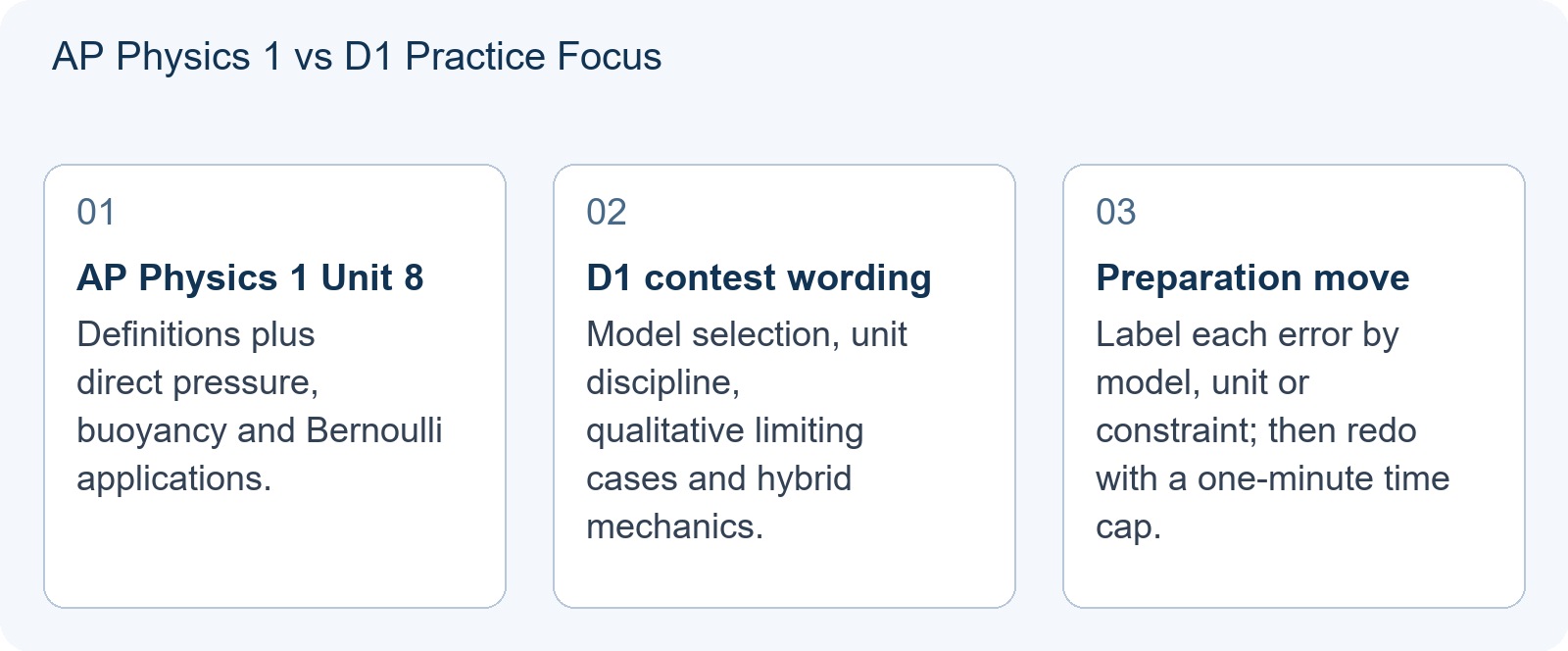
An effective fluids diagnostic does not simply count wrong answers. It labels why each error happened. Three labels are enough for most D1 preparation: model choice, units, and constraints.
Model choice errors mean you used the wrong physical picture. You applied Bernoulli to a static tank, or you used hydrostatic pressure when the question depended on flow speed. Unit errors often involve density. 1 g/cm³ equals 1000 kg/m³. So 0.80 g/cm³ becomes 800 kg/m³, and a floating object with that density in water has submerged fraction 800/1000 = 0.80. Constraint errors mean you ignored a stated condition such as incompressible flow, steady flow, or a sealed versus open container.
After labelling an error, redo the problem under a one-minute cap. If the corrected solution still takes three minutes, the issue is not knowledge but recognition speed. For D1, recognition speed is part of the skill. The supplied preparation note lists 2020–2026 Physics Bowl past papers, answers, and solutions as available resource material; if you use such papers, select fluid-related questions and sort them with this three-label system rather than solving randomly.
AP Physics 2 Students: Gaps Created by the Move
Students in AP Physics 2 face the clearest gap. If fluids are no longer in AP Physics 2, then a student who takes that course may not receive a fresh classroom treatment of pressure, buoyancy, and Bernoulli. The topic may have appeared years earlier in AP Physics 1, or it may not have appeared at all if the student entered through a different sequence. The contest knowledge list still expects D1 candidates to handle fluid mechanics, so waiting for AP Physics 2 to cover it is not a reliable plan.
The fix is not to relearn an entire university fluids chapter. Review AP Physics 1 Unit 8 concepts, then practise contest-style model selection. Confirm that you can move among three statements: static fluid pressure, buoyant force from displaced fluid, and steady-flow Bernoulli. If you are also considering D2 later, the supplied notes describe D2 as wider and deeper than D1, so check the division guide before assuming any D1 topic can be postponed. Physics Bowl Division I or Division II: Which One Your Course History Actually Puts You In is the relevant guide for checking division fit before you commit your practice time.
Short Preparation Plan for Fluids Before the Contest Window
The supplied source note lists the 2027 Physics Bowl time as March 2027, with the exact date pending official confirmation. Use that as a planning window, not as a fixed deadline. A workable fluids plan has four moves.
First, audit the AP Physics 1 Unit 8 topics from the revised framework: pressure, buoyancy, Bernoulli, and basic flow. Make a one-page sheet with definitions and units. Second, solve a small set of fluid-related past or practice questions each week. Five well-reviewed questions are more useful than twenty rushed ones. Third, after each set, label every miss as model choice, unit, or constraint. Fourth, create hybrid drills: buoyancy with a spring scale, pressure with a moving elevator, or flow through a pipe with a height change. These combinations are where classroom fluency becomes contest flexibility.
The central takeaway is simple. Physics Bowl Fluids are no longer an AP Physics 2-only concern. They are now part of AP Physics 1 Unit 8, and they were already listed inside D1 mechanics. D1 candidates should treat fluids as a core mechanics topic: learn the models, control the units, and practise the wording shifts that separate a textbook problem from a timed contest decision.
Frequently Asked Questions
Does the new AP Physics 1 fluids unit cover everything needed for Physics Bowl D1?
It covers the core concepts such as pressure, buoyancy and Bernoulli’s principle, and D1 is described as using basic algebra and trigonometry rather than deep calculus derivations. However, Physics Bowl questions may use trickier wording or combine fluids with other mechanics topics, so contest-specific model-selection practice remains necessary.
I am taking AP Physics 2. Will I be disadvantaged in fluids for the Physics Bowl?
Potentially, because the supplied curriculum note says fluids are no longer part of AP Physics 2. You should review AP Physics 1 Unit 8 concepts or an equivalent fluids unit, since D1 knowledge points still include fluid mechanics within mechanics.
How much time should I dedicate to fluids compared to other D1 topics?
The supplied notes do not publish an official topic weighting. Treat fluids as one listed mechanics topic among several, track your error rate by model choice, units and constraints, and adjust practice time based on how quickly you recognise static, buoyancy and flow situations.