 PhysicsBowl
When a Physics Bowl question shows a potential-energy-versus-position graph, the slope at any point gives the negative of the force. Students who treat the graph as a picture of the path, or who read curvature instead of slope, lose time and points. This article shows how to extract force, equilibrium positions, and motion predictions directly from the graph, with every step verified and a contrasting case where a similar-looking graph leads to a different conclusion.
Why the Slope Equals Negative Force
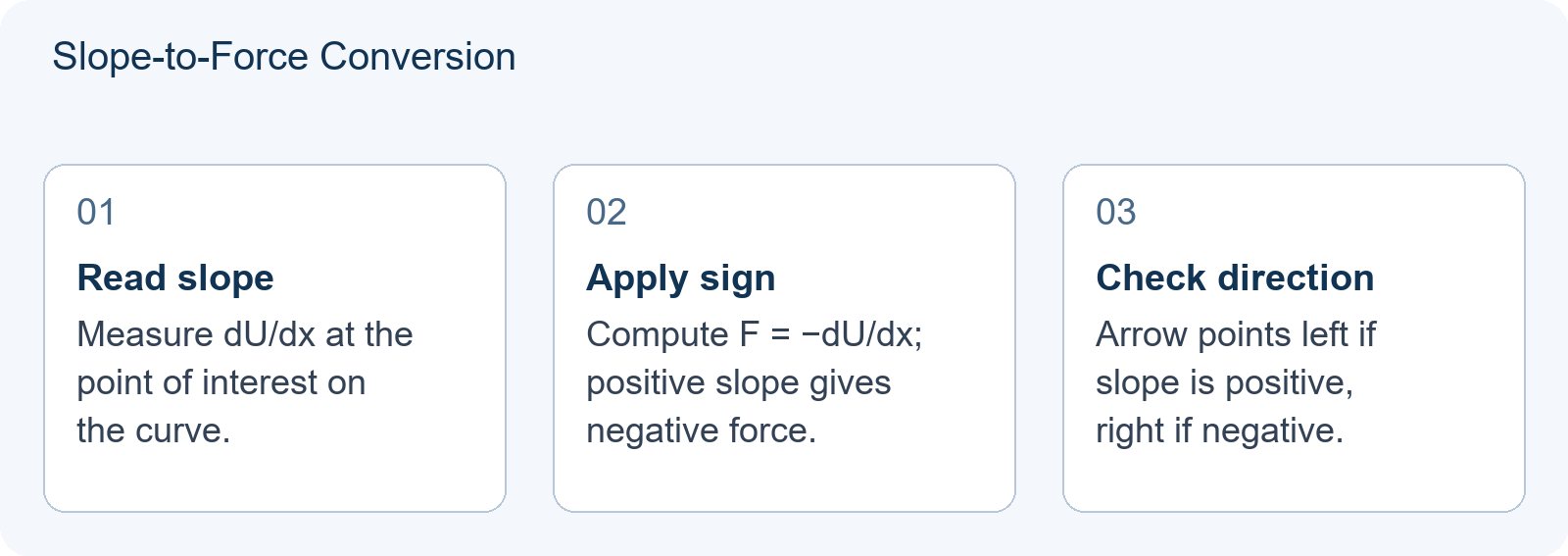
The defining relationship for a conservative force is F = −dU/dx. This assumes only this conservative force acts; other forces would modify the analysis. On a U(x) graph:
- Where the slope is positive, the force points in the negative x-direction.
- Where the slope is negative, the force points in the positive x-direction.
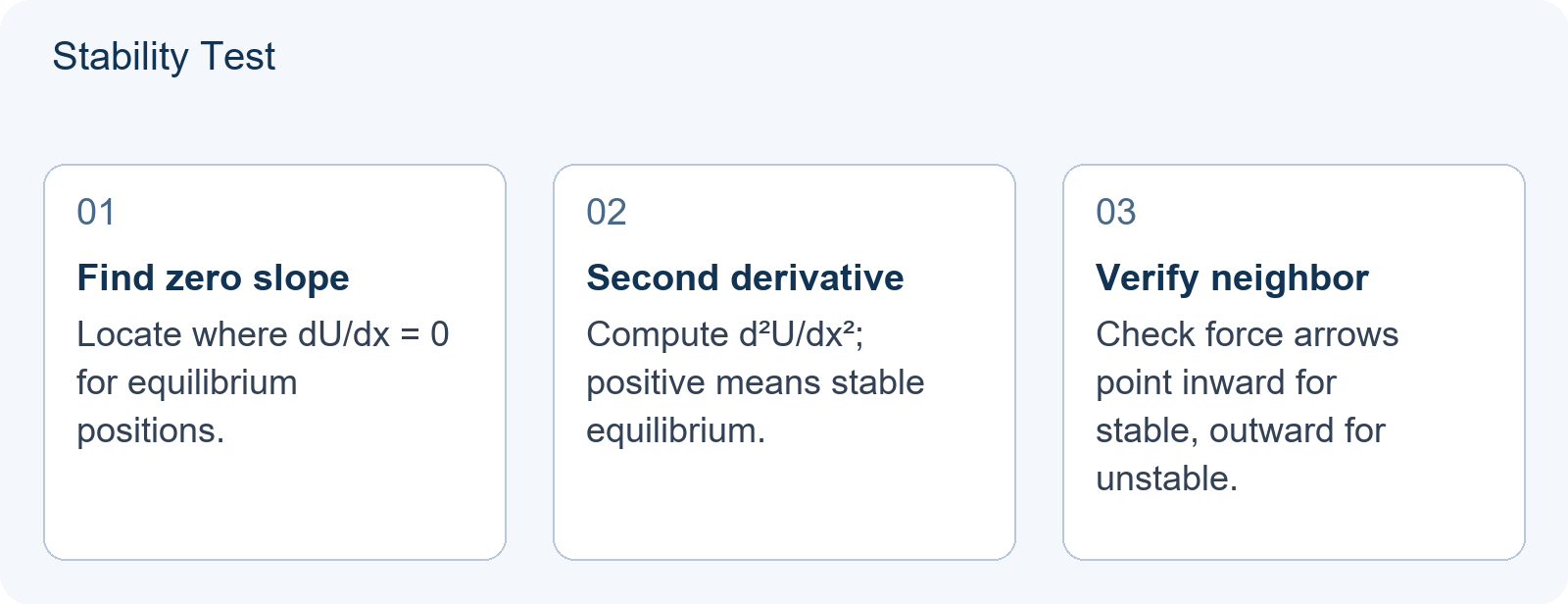
- Where the slope is zero, the net force is zero—an equilibrium position. Note that a zero-force equilibrium position does not mean the particle is necessarily at rest; it may be passing through with non-zero velocity.
This follows from the work-energy theorem for conservative forces. The sign convention matters: a student who forgets the negative sign will reverse the force direction on every slope-reading question. Physics Bowl problems frequently exploit this with graphs where slope changes abruptly, testing whether the sign flip is applied correctly at each segment.
Worked Teaching Case: Particle in a Cubic Potential
Consider a potential energy function U(x) = αx(x − 2a)², where α > 0 and a > 0, defined for all real x. This is a teaching illustration, not a contest problem.
Step 1: Expand and differentiate.
U(x) = αx(x² − 4ax + 4a²) = α(x³ − 4ax² + 4a²x)
dU/dx = α(3x² − 8ax + 4a²)
Step 2: Find equilibrium points.
Set dU/dx = 0: 3x² − 8ax + 4a² = 0
Using the quadratic formula: x = [8a ± √(64a² − 48a²)] / 6 = [8a ± √(16a²)] / 6 = [8a ± 4a] / 6
So x = 2a or x = 2a/3. These are the equilibrium positions.
Step 3: Determine stability.
d²U/dx² = α(6x − 8a)
At x = 2a/3: d²U/dx² = α(4a − 8a) = −4αa < 0. Negative second derivative means unstable equilibrium (local maximum).
At x = 2a: d²U/dx² = α(12a − 8a) = 4αa > 0. Positive second derivative means stable equilibrium (local minimum).
Step 4: Evaluate key potential values.
U(0) = 0
U(2a/3) = α·(2a/3)·(−4a/3)² = α·(2a/3)·(16a²/9) = 32αa³/27 (barrier height)
U(2a) = α·2a·0 = 0 (local minimum)
Step 5: Analyze motion for different energies.
For 0 < E < 32αa³/27: The particle can be bounded in the right well only if it starts in the right component (x > 2a/3). The left region (x < 2a/3) is unbounded—if the particle starts there with E > 0, it escapes to x → −∞ since U → −∞.
For E > 32αa³/27: The particle cannot escape to +∞ because U → +∞ as x → +∞. It has a finite right turning point and eventually escapes to the left (x → −∞) because U → −∞ as x → −∞. It is not trapped on the left.
Verification: The barrier height calculation: (2/3)×(16/9) = 32/27. Confirmed. The particle is pushed away from x = 2a/3 (unstable) and toward x = 2a (stable).
Contrasting Case: Different Barrier Placement
Now consider U(x) = αx²(x − 3a) for α, a > 0, defined for all real x. At first glance, this also yields a cubic with two turning points.
Expansion: U(x) = α(x³ − 3ax²)
dU/dx = α(3x² − 6ax) = 3αx(x − 2a)
Equilibria at x = 0 and x = 2a.
Second derivative: d²U/dx² = α(6x − 6a)
At x = 0: d²U/dx² = −6αa < 0 → unstable (local maximum)
At x = 2a: d²U/dx² = 6αa > 0 → stable (local minimum)
Comparison: Both potentials have the same stability order: unstable at smaller x, stable at larger x. The difference lies in the barrier height and the behavior at large |x|. For the first potential, U → +∞ as x → +∞ and U → −∞ as x → −∞. For the second, the same limits hold, but the specific barrier heights and turning point locations differ. A student must check slope signs explicitly at each region boundary rather than memorizing patterns.
From Graph to Motion: Energy Conservation and Turning Points
Given total mechanical energy E, the particle’s motion is restricted to regions where U(x) ≤ E. The turning points satisfy U(x) = E. Kinetic energy K = E − U(x) is read as the vertical gap between the E line and the U(x) curve.
For the first potential with E chosen between 0 and 32αa³/27, a particle starting in the right component oscillates between two turning points bracketing x = 2a. The speed at any point follows from v = √[2(E − U)/m]. Maximum speed occurs at minimum U, not maximum curvature. Students who confuse curvature (d²U/dx²) with the force (related to slope) will predict the wrong position for maximum acceleration, which occurs where the slope is steepest, not where the curve bends most.
Diagnostic Application: Piecewise Potential with a Corner
Consider a potential energy function defined for all real x:
U(x) = 8 − 2x (in Joules) for x ≤ 2 m
U(x) = 4 + (2/3)(x − 2)² (in Joules) for x ≥ 2 m
A particle has total energy E = 10 J.
Question 1: Find the turning points.
Answer: For x ≤ 2: U(x) = 10 → 8 − 2x = 10 → x = −1 m. Verified: U(−1) = 8 + 2 = 10 J.
For x ≥ 2: U(x) = 10 → 4 + (2/3)(x − 2)² = 10 → (x − 2)² = 9 → x − 2 = 3 (taking positive root for x > 2) → x = 5 m. Verified: U(5) = 4 + (2/3)(9) = 4 + 6 = 10 J.
The turning points are at x = −1 m and x = 5 m.
Question 2: Where is the particle’s speed greatest?
Answer: Speed is greatest where U is smallest. At x = 2 m, U(2) = 8 − 4 = 4 J from the left, and U(2) = 4 + 0 = 4 J from the right. The potential is continuous. Kmax = 10 − 4 = 6 J. Maximum speed is at x = 2 m.
Question 3: What is the force for x < 2 m and for x > 2 m?
Answer: For x < 2: F = −dU/dx = −(−2) = +2 N (constant, positive, pointing right).
For x > 2: F = −dU/dx = −(4/3)(x − 2) = −(4/3)x + 8/3. This is negative for x > 2, pointing left, and its magnitude increases with x.
Question 4: What happens at x = 2 m?
Answer: The corner at x = 2 m is NOT smooth. The left slope is −2, the right slope is 0. The force jumps from +2 N (left side) to 0 N (right side, at the point). For x just above 2, the force is negative. At the exact cusp, classical F is undefined; there is a one-sided jump. The velocity remains continuous across the corner, but acceleration jumps.
What This Diagnostic Reveals About Preparation
A student who answers Questions 1–2 correctly but stumbles on Question 3–4 understands energy conservation but has not internalized that forces can be discontinuous in idealized models. The next learning task is to practice problems with piecewise-defined potentials and to verify that energy conservation still holds across the discontinuity—E is constant, even when F jumps.
Useful feedback would include: checking whether the student confuses “smooth graph” with “smooth motion” (velocity is continuous, but force need not be); and practicing the explicit calculation F(2−) versus F(2+) to see the jump magnitude. This bridges to Physics Bowl Limiting Cases: Checking Whether a Formula Makes Physical Sense, where similar idealization questions arise.
Connecting to Broader Physics Bowl Preparation
Energy graph problems appear throughout Physics Bowl, with added complications in advanced problems: multiple particles, or the need to integrate F = −dU/dx to find work directly. The slope-reading skill developed here transfers directly to electric potential V(r), where E = −∇V is the analogous field relation.
For students building from this topic, Physics Bowl Circuit Symmetry: Spotting Equal Potentials Before Using Equations offers a complementary skill: recognizing when circuit nodes have equal potential without full calculation. The energy-graph approach and the symmetry approach share the feature of extracting answers from geometric properties before committing to algebra.
Those still deciding between competition levels should consult Physics Bowl Division I or Division II: Which One Your Course History Actually Puts You In. The energy graph analysis here assumes comfort with basic calculus; some Division 1 questions may present the same concepts with pre-calculated slopes or tabular data instead of continuous functions.
Preparing Your Next Practice Session
To apply this analysis, select past Physics Bowl problems that include potential energy graphs. For each problem:
- Identify every point where the slope is zero and classify stability using the second derivative or neighboring slope signs.
- Draw the force direction arrows below the graph for each region.
- Mark the turning points for a given total energy and verify that kinetic energy equals the vertical gap.
- Check limiting cases: as x → ±∞, does U(x) behave so that bound and unbounded motion are correctly predicted?
This structured approach prevents the common error of treating the potential energy graph as a physical landscape that the particle rolls over. The graph is not a hill; it is a rule for force. Internalizing that distinction converts energy graph problems from time-consuming calculations into rapid, reliable point sources.
Frequently Asked Questions
Why does the force equal negative slope and not negative curvature?
Force derives from the first derivative of potential energy, F = −dU/dx, because work is the integral of force and energy is the integral of work. Curvature (second derivative) determines stability at equilibrium but does not give the force itself. A graph with high curvature but zero slope has zero force at that point.
Can a particle ever be at a position where U(x) > E?
No. In classical mechanics, kinetic energy K = E − U must be non-negative. Where U(x) > E, the particle cannot enter that region. These are classically forbidden regions, and the boundary points where U(x) = E are turning points where the particle momentarily stops and reverses.
How do I handle a graph with a sharp corner where the slope is undefined?
At a sharp corner, the left and right slopes differ. Compute F from the left slope for x just below the corner, and from the right slope for x just above. The force is discontinuous, but energy conservation still holds because the potential is continuous. The particle’s velocity does not change instantaneously, but its acceleration jumps. At the exact cusp, classical F is undefined; there is a one-sided jump.