 PhysicsBowl
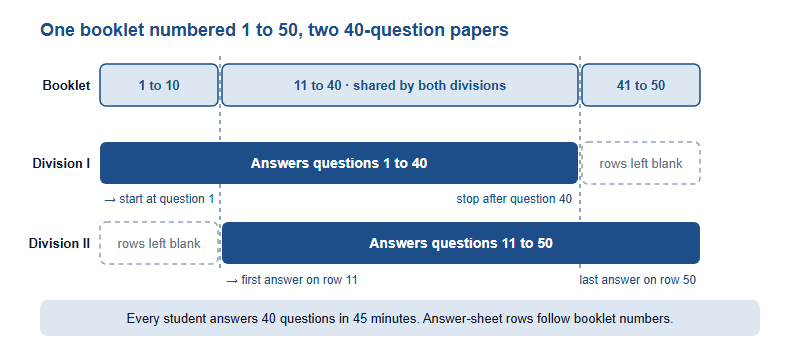
The PhysicsBowl booklet is numbered from 1 to 50, but no student answers more than 40 questions. Division I answers questions 1 to 40 and leaves 41 to 50 blank; Division II starts at question 11, leaves 1 to 10 blank and finishes at 50, so questions 11 to 40 are common to both. Four identity fields on the answer sheet then decide whether the score counts at all.
How is the PhysicsBowl booklet numbered?
The instruction page of both the 2025 and the 2026 paper sets it out plainly. The test is made up of 50 questions, each student answers 40 of them, and each division is told which rows of the answer sheet to use. Inside the booklet the instruction returns as a pair of signposts. The first sits where question 11 begins: Division I is told to carry on through question 40, and Division II is told to start there. The second sits where question 41 begins: Division I is told to stop, and Division II to continue to question 50. The Division II signpost also spells out the detail that matters most on the day. Rows 1 to 10 of the answer sheet stay empty, and, in the paper's own words, “Your first answer should be for #11.”
None of this changes the contest itself. AAPT describes a timed test of 40 multiple-choice questions in 45 minutes, sat under the supervision of the student's own school, and every student gets the same clock and the same count. What the numbering decides is where each division's 40 questions sit inside one shared booklet — and therefore which rows of the answer sheet each student fills.
| Booklet questions | How many | Division I | Division II | What it means |
|---|---|---|---|---|
| 1 to 10 | 10 | Answers them (its first ten) | Leaves rows 1 to 10 blank | Division I only |
| 11 to 40 | 30 | Answers them (its 11th to 40th) | Answers them (its 1st to 30th) | The same thirty questions for both divisions |
| 41 to 50 | 10 | Leaves rows 41 to 50 blank | Answers them (its 31st to 40th) | Division II only |
| Answered | — | 40 | 40 | Same count, same 45 minutes |
One practical consequence: AAPT's own statistics use booklet numbers rather than each division's count. Its 2026 results letter names question 40 as the hardest item in Division I and question 47 as the hardest in Division II — a question no Division I student ever sees. Whenever you read an analysis of a past paper, including ours, check which numbering it uses before you compare anything.
A correction to our own earlier guidance. Our Division I or II article treated this 1-to-40 and 11-to-50 layout as a claim circulating in Chinese-language descriptions of the contest, and told readers to plan against 40 questions instead. The layout is real: it is printed on the paper, and the two divisions differ by ten questions at each end. The part of that advice that still stands is the arithmetic. Nobody answers more than 40, so pacing is still built on 40 questions in 45 minutes.
The four answer-sheet fields that decide whether a score exists
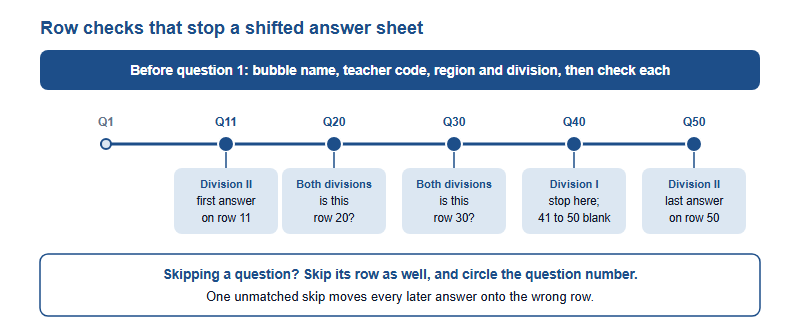
The printed answer sheet is machine graded, and the instruction page is blunt about identity. Four fields must be written and bubbled: your name, your teacher's AAPT teacher code, your region and your division. If they are not properly bubbled, the student is disqualified and the official score is zero. A school's CEEB code is optional, but the paper notes that it helps identify the school if a disqualification does happen. AAPT's FAQ explains missing results the same way. The most common causes it names are an improperly filled teacher code, region or division, and an improper division or region can lead the scoring software to set a student's score to zero.
| Field | Where the value comes from | The mistake to prevent |
|---|---|---|
| Name | You | Writing it but leaving the bubbles unfilled, or leaving stray marks across the grid |
| AAPT teacher code | Your teacher. A school uses exactly one code, which is its AAPT member number; AAPT provides a code to schools that are not members | Using a second teacher's number, or copying the code with two digits swapped |
| Region | Your teacher or entry route. AAPT groups China into five codes: 15 North, 16 South, 17 East, 18 Central and 19 West | Guessing from memory, or copying a friend who studies in another province |
| Division | 1 for students in a first physics course; 2 for a second course, or for anyone choosing the challenge | Bubbling 1 while answering questions 11 to 50, or 2 while answering 1 to 40 |
| CEEB code (optional) | Your teacher, if the school has one | Leaving it out when it exists; it helps identify your school if something else goes wrong |
Two notes for China-based candidates. First, AAPT's region list assigns each part of China to one of the five codes — Shanghai, Zhejiang and Jiangsu are Region 17, for example — but the code on your sheet should come from your teacher or entry route, not from a list you found yourself. Second, everything above describes AAPT's own printed answer sheet. How identity details are captured in a China-route sitting is set by that route: per the China organising channel, the 2026 reference sitting was online with a webcam, and for 2027 the channel says sittings will be in person only. Confirm at entry what you will be asked to fill in, and how. Our registration page explains which organisation handles which step.
Five numbering mistakes, and the check that catches each
All five come from the layout of the booklet rather than from physics, which is exactly why they are worth rehearsing. None takes more than a few seconds to prevent.
- Division II starting on row 1. The answer to question 11 goes on row 1, question 12 on row 2, and so on down the sheet. The graded rows fill with answers to other questions, and the last ten rows stay empty. The check is physical: before you write anything, put your pencil on row 11.
- Division I carrying on past question 40. The paper tells Division I students to stop at 40 and leave rows 41 to 50 blank. Those ten questions belong to the other division's paper, and every second spent reading them comes out of your own forty.
- Skipping a question but not its row. This is the classic one-row shift, in which every later answer lands a row early. When you skip, circle the question number in the booklet and move your pencil down a row deliberately. Then confirm that the row number matches the question number at 20, at 30 and at 40.
- Bubbling the wrong division. The division field has to match the paper you actually answered, and AAPT's FAQ says an improper division can be scored as zero. Check it against what your teacher recorded at entry, not against what the classmate beside you chose.
- Marking a practice paper against the wrong rows. A Division II student who marks rows 1 to 40 of a past booklet gets a score that is one quarter from a paper they will never sit, and that leaves out the ten questions that end their own. Mark 11 to 50 and nothing else.
What the instruction page allows on the desk
The same page answers the equipment questions students ask every season. A hand-held calculator may be used, provided its memory has been cleared of data and programs, and calculators may not be shared; AAPT's FAQ describes the same rule as calculators that are non-programmable or have had all programs removed. Only the formulas and constants provided with the contest may be used, and the question pages repeat that g is 10.0 m/s² for every question. For the printed answer sheet, the practical rules are a #2 pencil, bubbles filled completely and no stray marks.
Whether there is a printed answer sheet at all depends on how the exam is delivered. AAPT offers schools two formats through Educational Vistas (EdVistas): a web-based online exam that needs internet access but no extra software, or a printable PDF with a printable answer sheet, which the school scans and uploads afterwards. AAPT also notes that, unlike the exam inside EdVistas, the combined document places both divisions together — so an online candidate's screen need not look like the booklet you practise from. After the paper, AAPT asks proctors to collect all materials until the official solutions are released. The wider contest rules are summarised on our rules page; for a China-route sitting, confirm the permitted equipment with the channel that entered you.
Practising with the combined booklet
Past booklets use the same combined layout, which makes them the right place to build the habit. Sit each one the way you will sit the real paper: Division I from question 1 to question 40 with rows 41 to 50 left empty, and Division II from question 11 to question 50 with rows 1 to 10 left empty. Use a copy of an answer grid rather than the margins of the booklet, work in one 45-minute block, and mark only your own division's forty rows.
The shared block has a second use that schools rarely exploit, and this is our coaching suggestion rather than anything AAPT recommends. Questions 11 to 40 are identical for both divisions, so a school group preparing students for both papers can compare everyone on the same thirty questions. Two totals from two different papers cannot be compared honestly; a score out of 30 on a common block can. It also gives a first-year student weighing up Division II something concrete to look at: how they do on the thirty questions both papers share, before the ten that only Division II sits.
For material, our past-paper pack contains papers with their answers, and worked solutions for some years; exactly what you receive follows what our teachers send, and the past papers page explains how to ask for it. Whichever year you practise, read its instruction page first, because layout details are exactly the kind of thing that can change between seasons — and AAPT has not yet published anything for 2027.
Common questions
How many questions are on the PhysicsBowl paper?
The booklet is numbered to 50, but every student answers 40 in 45 minutes: Division I does 1 to 40 and Division II does 11 to 50.
Where does Division II start on the answer sheet?
At row 11. Rows 1 to 10 stay blank, the first Division II answer is question 11, and the last one is question 50.
What happens if the region or division is bubbled wrongly?
The paper says improperly bubbled identity fields mean disqualification and an official score of zero, so check them before question one.
Can you use a calculator in the PhysicsBowl?
Yes. The paper allows a hand-held calculator with its memory cleared of data and programs, and calculators may not be shared.
Contest details change from season to season; confirm current details on aapt.org before acting on anything here. Corrections are issued within 7 working days.