 PhysicsBowl
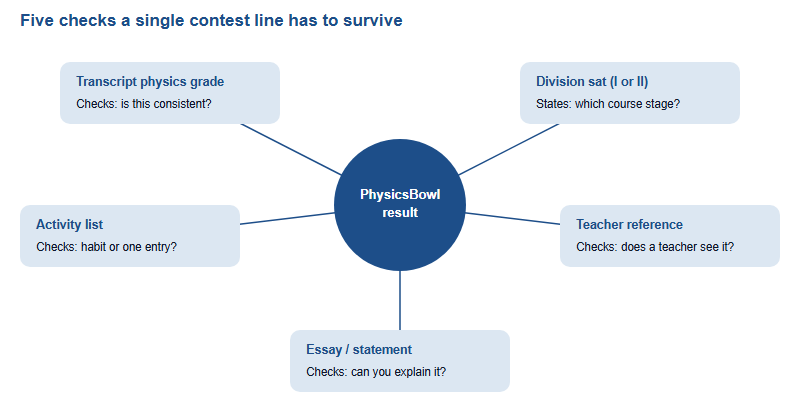
A PhysicsBowl award is not read as a standalone score. It is read as one line that a reader checks against the rest of your file: the division you sat tells them your course stage, your transcript tells them whether the result is consistent, and your activity list and essays tell them whether the physics is a real habit or a one-afternoon entry. Its value is corroboration. It is not, and cannot be, a guarantee of anything.
The line is read against your course stage, not on its own
The most useful thing to understand about PhysicsBowl in an application context is structural rather than competitive. AAPT defines Division I as being for first-year physics students and Division II for second-year physics students. That means the division on your result is a statement about where you were in your physics education when you sat the paper, before it is a statement about how well you did.
The consequence is that the same band means different things in different places. A strong Division I result from a student in their first year of formal physics says the ceiling is high and the trajectory is early. A comparable Division II result from a second-year student says something different again, because it is being set against a further year of coursework. Neither reading is “better”. They are answers to different questions, and a reader who knows the division structure is asking the right one automatically.
This is also why students who ask “which division looks more impressive?” have asked a question with no answer. You are placed by course history, which the rest of your transcript already discloses. Choosing the division that flatters you rather than the one your course history indicates does not create a stronger line; it creates an inconsistency between two documents in the same file, which is the single thing you least want. If you have not settled that question yet, the contest overview sets out the format and division definitions in full.
What corroborates a physics result — and what each piece actually proves
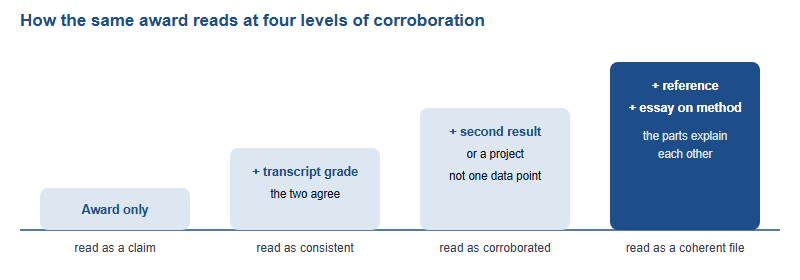
Cross-validation is a plain idea: a reader believes a file when its independent parts agree with each other. One line can be lucky, mistyped, generously described, or simply unexplained. Three lines that agree are hard to fake and easy to trust.
| Evidence | What it corroborates | What it does not establish |
|---|---|---|
| Physics grade on the transcript | That the contest result reflects sustained classroom performance, not one lucky morning | Speed under time pressure, or ability outside a taught syllabus |
| Division sat (I or II) | Where you were in your physics course when you sat the paper | Anything about rank — the division is placement, not a level of difficulty you chose |
| A second physics or maths result | That the first result was reproducible rather than a single data point | Depth. Two timed papers still both test the same short-format skill |
| A build, lab or research project | That the interest survives contact with open-ended work | Technical accuracy under exam conditions |
| The physics teacher’s reference | That someone who watched you work recognises the result as yours | Comparative standing outside your school |
| An essay that explains a method | How you think, which no score can express | Any objective measure of attainment |
What a single line cannot carry
There are four things a contest result cannot do on its own, and pretending otherwise wastes preparation time that could go somewhere useful.
- It cannot establish depth. Forty multiple-choice questions in 45 minutes measures fast, accurate handling of standard physics. That is a real skill and a hard one, but it is not the same as sustaining a question over months.
- It cannot establish independence. A score does not distinguish between a student who worked alone and a student who was coached intensively through past papers. Other parts of the file do that work.
- It cannot explain motivation. Why physics, and why this problem, is essay territory. A band cannot narrate itself.
- It cannot guarantee an outcome. No result does. Results vary, cohorts vary, and any presentation of a contest award as a route to a particular admissions outcome should be treated with suspicion, including when it comes from someone selling preparation.
The productive reframe is this: stop asking what the award is worth, and start asking what it corroborates. A result that confirms something else in your file is doing real work. A result floating on its own is a line an experienced reader will simply note and move past.
Where the bands actually sat: our own 2026 cohort record
One reason students misjudge what a result corroborates is that they only ever see the top of the distribution. Announcement posts feature the highest band; the shape underneath is invisible.
For calibration, here is our own record from the 2026 season, de-identified and reported in the China-region organiser’s award bands. These are our own figures rather than an official AAPT statistic, the bands belong to the China-region organiser rather than to AAPT, band structures can change between seasons, and individual results vary.
| Band (China-region organiser) | Our 2026 cohort | Share of our recorded awards |
|---|---|---|
| Super Gold | 39 | about 26% |
| Gold | 31 | about 21% |
| Silver | 42 | about 28% |
| Bronze | 37 | about 25% |
The useful observation is not the top row. It is that the four bands are of broadly similar size in what we recorded, which means the awards we recorded were spread across the four bands rather than concentrated at the ceiling. If your working assumption is that only the top band is worth reporting, that assumption is doing you damage twice: it makes a good outcome feel like a failure, and it removes a line that would have corroborated your transcript perfectly well.
Two composite files, one award
The following two profiles are illustrative composites, not real students, and no institution is named. They carry the same contest line and read completely differently.
| Element | File A | File B |
|---|---|---|
| Contest line | Division I, middle band | Division I, middle band |
| Physics grade | Consistently strong across the year | Mid-range, with one weak term |
| Other evidence | A maths contest result the same year; a small measurement project written up | Nothing else quantitative in the file |
| Reference | Physics teacher describes a specific problem the student would not drop | General praise, no physics detail |
| Essay | Explains a method the student got wrong first, then fixed | States a long-standing love of physics |
| How the award reads | Confirms a pattern already visible three other ways | Unexplained, and slightly at odds with the transcript |
File B is not a disaster; it is simply a file where the contest line is doing all its work alone. The repair is never “get a higher band next time”. It is to add the corroborating pieces, most of which cost time rather than talent: a written-up project, a teacher who has seen you persist on something specific, an essay that shows a method rather than an affection.
What this changes about this autumn
Three practical consequences, all of them cheap.
Enter at the stage your course history actually indicates. The division is placement, and a placement that matches your transcript is worth more than a placement that flatters it. If you are still working out where you sit, the same logic applies when you look at how registration works and file your entry details.
Plan the second piece of evidence before you sit the first. The corroborating item — a project, a second contest, something written up — usually takes months, so deciding on it in the same week you register costs nothing and saves a year. The award will arrive with a companion instead of alone.
Tell your physics teacher what you are attempting and why. Not to secure a favourable reference, but because a reference that mentions a specific problem you would not drop is the piece of the file that no score, band or certificate can substitute for. Teachers write what they have observed. Give them something to observe.
Frequently asked questions
Does a PhysicsBowl award improve admission chances?
No result guarantees an outcome. An award is read as corroboration next to your transcript, course stage and the rest of your file.
Which division looks better to a reader?
Neither. Division I is for first-year physics students and Division II for second-year, so the division states your stage rather than your rank.
Is a middle band worth reporting?
Yes, when the rest of the file agrees with it. A middle band that matches a strong physics grade still corroborates; a lone line does less.
Where do your cohort figures come from?
From our own de-identified records for the 2026 season, in the China-region organiser’s bands. They are not an official AAPT statistic.
Written for China-based international-school students. Confirm current details on aapt.org. Corrections issued within 7 working days.