 PhysicsBowl
You cannot build a PhysicsBowl plan on a calendar, because AAPT has not published dates for the next season. You can build one on milestones. Autumn is for closing physics gaps, the winter window is for the school-side entry, and the final weeks are for converting knowledge into speed on a 40-question, 45-minute paper. Here is that plan, stage by stage.
Anchor the plan to milestones, not to dates
Every September a version of the same message arrives: a student has found a Chinese-language post listing next year's contest date, wants to build a countdown around it, and is annoyed that this site will not confirm it. The reason is simple. AAPT has not published dates for the next season, and this site does not publish a date before AAPT does. What is safe to say is the shape a season has taken: in the 2026 season, registration closed in late February and the contest ran across a window of dates in the second half of March into early April. Treat that as a shape, not a promise — every element of it can move, and you must confirm current details on aapt.org and with the registration route that serves your region.
That sounds like a limitation. In practice it is liberating, because none of the work in the first two-thirds of a plan is date-sensitive. Learning rotational dynamics properly is worth the same amount whether the paper falls in mid-March or early April. Only the last stage — timed work under contest conditions — needs to be positioned relative to a known day, and by the time you reach it the date will exist. So the plan below runs on four milestones instead of dates.
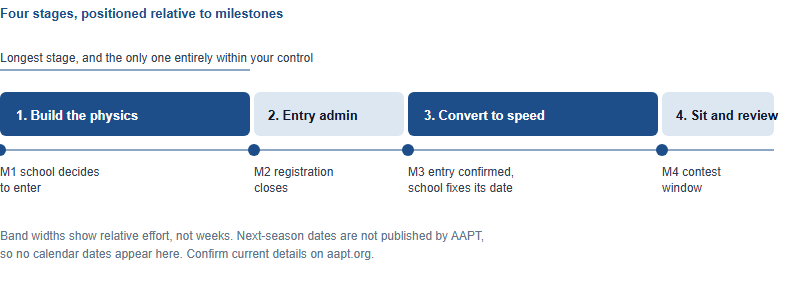
Stage 1, autumn: build the physics you do not yet have
This is the longest stage and the only one entirely within your control, which is why it is also the one students under-use. September to roughly the New Year is content time. The goal is not contest practice. It is to arrive at the winter with no cluster of ordinary school physics that you have simply never been taught.
Start by naming your gaps rather than guessing at them. Ask your physics teacher which topics your class will have finished before the spring, and which it will not: on most course paths there are two or three clusters that the timetable will not deliver in time, and those are your autumn syllabus. Then do the unglamorous thing and learn them the way you would learn school content — theory, worked examples, then untimed problems. A topic you have never met cannot be fixed by doing past papers at it.
Three habits make this stage work, and all three run against instinct:
- Untimed first, deliberately. Timing yourself on material you do not yet understand teaches you that you are slow, which you already knew. Speed is stage 3's job. Autumn is for correctness at any speed.
- Two or three gaps, not eight. A gap that is one lesson wide and a gap that is a term wide are not the same purchase. Closing two properly beats skimming six.
- Keep it small and weekly. Two to three focused hours a week for a term closes more than a heroic fortnight in February, and it survives mock exams, which a heroic fortnight does not.
If you have not yet checked what the paper actually is — its length, its format, the two divisions — do that before you plan the term, because it changes what “prepared” means. The contest overview is the shortest route to those facts.
Stage 2, the entry window: the admin stage students forget
Here is the structural fact that catches families out: entry is not an individual sign-up. Entries are made by a school or a centre, and for schools in Asia and the Middle East they go through ASEEDER rather than to AAPT directly. That means the deciding action in this stage is not something you revise for — it is a conversation with a teacher, and it has a deadline attached.
Two consequences follow. First, this stage is short in effort but hard in dependency: it needs someone at your school to own the entry, and if nobody does, the strongest revision plan in the year produces nothing. Second, it is also the stage to confirm your division with your school, since entrants are sorted by how many years of physics they have studied — Division I for first-year physics students, Division II for second-year. That follows your course history rather than your topic knowledge; confirm the exact division rules through your entry route. The mechanics of the route are set out in how registration works; the thing to protect in your own plan is simply that it happens before the deadline rather than during it.
Practical version: put a reminder in your own calendar roughly two months before you expect entries to close, and use it to ask your teacher one question — is our school entering this year, and who is handling it? If the answer is no, you have time to ask whether it could. If you ask in February, you do not.
Stage 3, the final six to eight weeks: convert knowledge into speed
Only now does the clock matter. The paper is 40 multiple-choice questions in 45 minutes, sat under your school's supervision, and a student who knows the physics but has never worked at that density will not show what they know. This stage changes the unit of practice from the topic to the set.
The weekly loop below is what we run with students, and its point is the third box. Most students do the first two and skip the review, then repeat the same errors for six weeks.
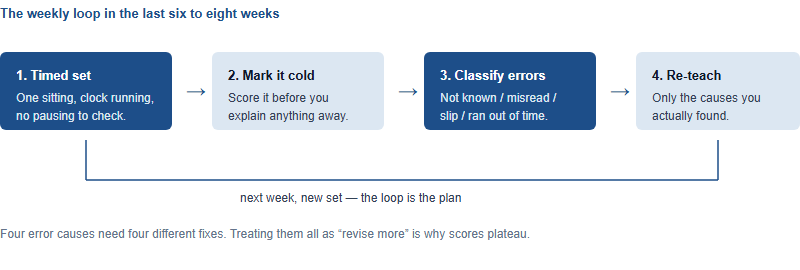
The classification matters more than the score. A question you got wrong because you never learned the topic sends you back to stage-1 work for that cluster. A question you got wrong because you misread “doubled” as “halved” needs no physics at all — it needs a reading habit. A question you never reached is a pacing problem, not a knowledge problem. Students who log the cause improve on all four fronts; students who only log the score keep revising the topics they already know, because those are the comfortable ones.
One caution about volume. Roughly one timed set a week, thoroughly reviewed, beats three sets skimmed. The review takes longer than the set, and if your week cannot hold both, do fewer sets rather than shorter reviews.
What a stage actually looks like, week by week
| Stage | Position | Main goal | Typical weekly time | What “done” looks like | What wastes the stage |
|---|---|---|---|---|---|
| 1. Build the physics | From September to around the New Year | Close the two or three clusters your course will not reach in time | 2 to 3 focused hours | You can solve untimed problems in every cluster without notes | Timed papers on topics you have not learned yet |
| 2. Entry admin | Around the registration window | Make sure a teacher owns the entry before it closes | Under an hour, once | Your school has entered you and you have confirmed your division | Assuming someone else has asked |
| 3. Convert to speed | Final six to eight weeks | Work accurately at contest density | One timed set plus a longer review | Error causes are shrinking, not just scores rising | More sets, less review |
| 4. Sit and review | The contest window and after | Sit under your school's arrangements, then learn from it | The session itself | You know which cause cost you most, for next year | Treating the result as the end of the project |
Stage 4, the window and what comes after
In the 2026 season the contest ran across a window of dates rather than a single fixed day, so the specific date a school uses within the window is a school-level arrangement rather than something you choose individually — ask your school, and confirm the current window on aapt.org. Your part of stage 4 is small and mostly logistical: know which day your school has set, know where you are sitting, and protect the 45 minutes.
The part students skip is what happens afterwards. If you are a first-year entrant, there is a strong chance you will enter again next year with a further year of physics behind you, which makes this year's error log unusually valuable. Write down, within a week, which of the four error causes cost you most. That single note is a better starting point for next September than any general advice, including this article.
And a boundary worth stating plainly: a plan like this improves how much of what you know actually reaches the answer sheet. It does not guarantee an award, and no preparation can. What it does reliably prevent is the most common outcome we see — a capable student who never closed two known gaps, entered in a rush, and met the clock for the first time on the day.
When should I start preparing for PhysicsBowl?
Autumn is content time. Start with the two or three topic clusters your school course will not reach before the contest, while there is no rush.
Do I need next season's date to build a plan?
No. Only the final timed stage depends on the date, and AAPT has not published one yet. Anchor the rest to milestones instead.
How many timed papers should I do in the last weeks?
Around one per week, fully reviewed. The review takes longer than the paper, and doing fewer sets properly beats rushing through more.
Can I register myself if my school is not entering?
Entry is not an individual sign-up: entries come from a school or a centre, and in Asia they go through ASEEDER rather than AAPT directly. Ask your teacher early, and put edge cases to the entry route.
Editorial note: an independent PhysicsBowl guide operated by Hanlin Education for China-based international-school students. Stage positions here are relative because AAPT has not published next-season dates; confirm current dates, deadlines and format on aapt.org. Corrections are issued within 7 working days.