 PhysicsBowl
AAPT does not publish a topic syllabus for PhysicsBowl. What it publishes is a division rule — Division I for first-year physics students, Division II for second-year — and a paper of 40 multiple-choice questions in 45 minutes. So the useful question is not what is on the syllabus. It is which parts of a first- and second-year physics course your own programme has not reached yet.
Why there is no syllabus to revise from
Students arriving from IGCSE, A-Level, IB or AP are used to a specification: a numbered document telling you exactly which sub-topics can be examined. PhysicsBowl does not work that way, and hunting for that document is the first hour most students waste. What AAPT does state is the shape of the paper, the basis of the two divisions, and that exam questions are based on topics and concepts covered in a typical high school physics course. Entrants are sorted by how many years of physics they have studied, with Division I for first-year physics students and Division II for second-year. A contest that classifies people that way is built around what a normal school physics course contains, not around an olympiad specification with its own separate body of theory.
That is a genuinely different mental model, and it changes the revision question. You are not hunting for exotic material. You are auditing an ordinary two-year physics course and finding the parts your own timetable has not delivered yet. If you want the format facts in one place before planning anything, start with the contest overview and come back to this map.
Two things this article deliberately does not do. It does not tell you how many questions come from each topic area: no topic weighting is published, and inventing one would send you revising in the wrong proportions — confirm current details on aapt.org. It also does not tell you your division, because that follows your course history rather than your topic knowledge, and is a separate rule-based question. What follows is our own reading of where course paths and a normal physics course diverge, built from teaching students on all four paths.
The course-to-contest map
Before the table, one caveat that matters more than it looks. Exam boards differ, and syllabus versions move. IB restructured its physics guide for recent cohorts. AP has shifted topics between its first and second courses across revisions, so two students who both say “I did AP Physics 1” may have met different content depending on the year they sat it. A-Level content splits between the first and second year differently by board, and some boards carry optional units that others do not. Treat the columns below as the typical case and check your own specification before concluding you have a gap — or before concluding you do not.
| Topic area | IGCSE | A-Level | IB | AP | Where the gap usually sits |
|---|---|---|---|---|---|
| Kinematics, 1D and 2D, projectiles | Core, mainly 1D | Core, first year | Core | Core | Two-dimensional projectile algebra for IGCSE-only students |
| Newton's laws, friction, free-body diagrams | Core, light | Core, first year | Core | Core | Formal free-body practice rather than the laws themselves |
| Work, energy, power | Core, light | Core, first year | Core | Core | Rarely a knowledge gap; more often a speed problem |
| Momentum and collisions | Partial | Core | Core | Core | Elastic versus inelastic algebra under time pressure |
| Circular motion and gravitation | Rarely | Second year | Core | Core | A standard hole for students who have only finished AS |
| Rotational dynamics, torque, moment of inertia | Rarely | Moments yes, rotation rarely | Higher-level extension | Core in mechanics courses | The widest single mismatch on UK-track paths |
| Simple harmonic motion and oscillations | Rarely | Second year | Core | Core in mechanics courses | Missing entirely for many first-year entrants |
| Waves, sound, interference | Core, light | Core | Core | Varies by course version | Two-source interference algebra, not the concepts |
| Geometrical optics, mirrors and lenses | Core | Rarely revisited | Varies | Usually the second course | A-Level students often have not used a lens relation since Year 11 |
| Thermal physics and gas laws | Core, light | Second year | Core | Usually the second course | Kinetic theory and gas-law algebra |
| Electrostatics and fields | Rarely | Second year | Core | Usually the second course | Field and potential treated quantitatively |
| DC circuits | Core | Core, first year | Core | Version dependent | Multi-loop reasoning done quickly |
| Magnetism and electromagnetic induction | Partial, qualitative | Second year | Core | Usually the second course | Induction handled with numbers rather than in words |
| Modern physics: photoelectric, atomic, nuclear | Partial, radioactivity | Board dependent | Core | Usually the second course | Photon and energy-level calculations |
Where each course path usually leaves a hole
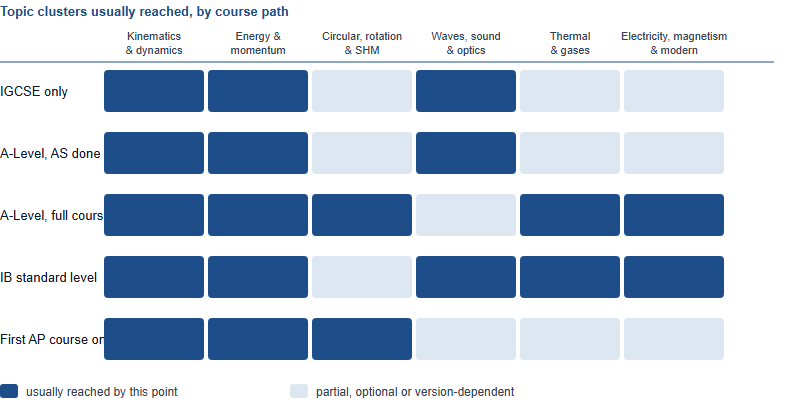
From coaching students on all four paths, our teaching team sees the same four patterns often enough to name them. These are our observations of where students stumble, not statements from AAPT.
- IGCSE-only students, entering in their first physics year. The conceptual coverage is broader than people assume — IGCSE touches optics, circuits, waves and radioactivity, which some older students have half-forgotten. What is genuinely thin is quantitative work in two dimensions: projectiles resolved into components, vectors added fluently, momentum in collisions. The fix is narrow and cheap, which is why this group often improves fastest.
- A-Level students who have finished AS but not the second year. This is the most predictable gap set in the whole table, because the second year is usually where circular motion, gravitation, simple harmonic motion, fields, capacitance and induction live. An AS student is strong on kinematics, forces and DC circuits, and simply has not been taught several clusters yet. Knowing that in advance turns panic into a reading list.
- A-Level students who have finished the whole course. A different problem. Content coverage is good, but two habits get in the way. Geometrical optics has often not been touched since IGCSE, so lens and mirror relationships feel unfamiliar even though they were once easy. And rotational dynamics — torque with moment of inertia, angular acceleration — is not standard A-Level material at all, while it is ordinary content in a US-style course. That is the widest single mismatch we see on UK-track paths.
- IB and AP students. Broad coverage, so the gaps are narrower and more specific: rigid-body rotation for standard-level IB, and, for students who have completed only a first AP course, whichever of circuits, waves or thermal physics their course version placed in the second course. This is exactly the case where you must check your own course description rather than trust a general table, because that boundary moved between revisions.
Notice what this list is not saying. None of these gaps means a course path is weak, and none of them predicts a result. They are timetable facts: a topic you have not been taught yet is not a weakness, it is a scheduling accident — and it is the cheapest kind of gap to close.
Turning the map into a revision order
A list of gaps is not a plan. The mistake we see most often is a student who identifies eight gaps in September and tries to close all eight at equal depth, which usually means none of them closes properly. Rank instead on two axes: how central the topic is to an ordinary physics course, and how far it sits from what your course has actually taught you.
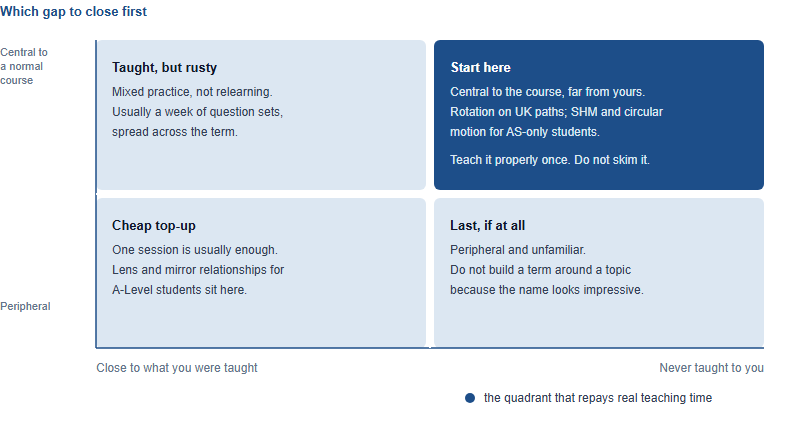
One more rule from the same experience: separate a gap that is one lesson wide from one that is a term wide. Lens relationships are a single session for someone who once knew them. Rotational dynamics taught from nothing is a genuine sequence of lessons, because torque only makes sense once moment of inertia does. Budgeting the two as if they were the same size is how an autumn term disappears.
What to confirm before you build a plan on this
Three things sit outside anything an article can settle for you.
- Your own specification. Board, syllabus version and option choices all move the boundaries in the table. Ask your physics teacher which of these clusters your class will have finished before the contest window, and which it will not. That single conversation is worth more than the table.
- Your division. It follows how many years of physics you have studied, not which topics you have met, so a well-read first-year student is normally still a first-year entrant; confirm the exact division rules on aapt.org. Ask your school to confirm how this is recorded when it enters you, andhow registration works is the place to check that step.
- Anything with a date on it. AAPT has not published dates for the next season, and this site will not publish one before AAPT does. Nothing in your revision order depends on the exact date, which is precisely why the content work can start now and the calendar can arrive later. Confirm current details on aapt.org.
The honest summary is that PhysicsBowl rewards a complete ordinary physics course rather than a specialised one. If your course has already delivered that, your work is fluency and speed. If it has not yet — and for most students in September it has not — then you are not behind. You have a reading list, and you now know which two items on it deserve real time.
Does AAPT publish a PhysicsBowl syllabus?
No topic syllabus is published, but AAPT states that questions are based on a typical high school physics course, with divisions for first- and second-year physics students. Confirm current details on aapt.org.
I have only done IGCSE physics. Is this map any use to me?
Yes. It shows which clusters your course has not reached, so you close the central gaps first instead of trying to cover everything at once.
Are there topics I can safely ignore?
Nothing is officially ruled in or out. Rank by how central a topic is to a normal physics course, not by how advanced its name sounds.
Does this map tell me which division I am in?
No. Division follows how many years of physics you have studied, not which topics you have met. That is a separate, rule-based question.
Editorial note: an independent PhysicsBowl guide operated by Hanlin Education for China-based international-school students. Course coverage described here is our editorial reading of typical specifications, not an AAPT topic list; confirm current contest details on aapt.org. Corrections are issued within 7 working days.