 PhysicsBowl
 runs 22 contest regions, numbered 00 to 21, and awards are decided inside each region and each division rather than across the whole global entry. A school in mainland China sits in one of five China regions, codes 15 to 19. Your school team score is the sum of your top five students' scores only — which means a sixth entrant can raise that total, but can never lower it.
Those two facts settle most of the planning questions a physics department actually has in January. The first tells you who you are being compared against, which is a far smaller field than most teachers assume. The second tells you how many students to enter, and it points in a direction that surprises people: because the rule sums a top five rather than averaging a cohort, adding a marginal student is a free option. This article works both through concretely. The full region reference table lives on the competition rules page; what follows is how to plan against it.
Your region, not the world, is the field you are ranked in
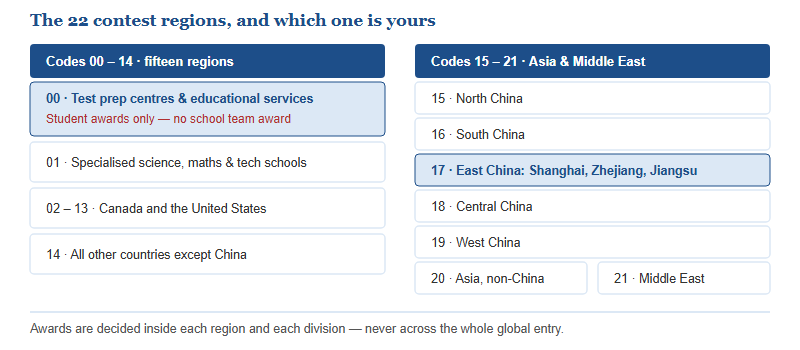
AAPT states that each Division has 15 regions established across the country, and that it has additionally established seven regions specifically for countries in Asia and the Middle East — covering China, Vietnam, Thailand, Indonesia, Malaysia, Singapore, Mongolia, Kazakhstan, Japan, Korea, India, Pakistan, Dubai, Saudi Arabia and Qatar — which are regions 15 through 21. Seven Asian and Middle Eastern regions numbered 15 to 21 means the other fifteen occupy codes 00 to 14, giving 22 regions in total.
Read that phrase “across the country” carefully, because taken literally it misleads. Codes 00 to 14 are not fifteen American regions. Two of them are categories rather than places, code 02 is Canada, and code 14 ends with a catch-all covering all other countries except China. So a school in Europe, Africa, South America or Australia is not in a region of its own at all — it shares code 14 with a dozen American states. A school in Shanghai, by contrast, has its own regional field made up of Chinese schools.
This is the most under-appreciated fact about the contest for a China-based international school. Awards are given per region and per division, so the pool you must finish near the top of is other schools in your own China region sitting the same paper — not the tens of thousands of students entered worldwide.
Region 00 is the one that can quietly cost you the team award
Two of the 22 regions are defined by what an institution is rather than where it sits. Code 01 is for specialised schools of science, mathematics and technology, which compete against one another rather than against ordinary high schools in their state. Code 00 is for test preparation centres and educational services — and AAPT is explicit about the consequence: they compete in their own region, and are eligible for the student award categories only.
Read that as a planning fact rather than a footnote. If a student sits the paper under a training centre's identity rather than their school's, two things change at once. They leave their China regional field and join a pool of centre-entered students, and the school team award disappears entirely, because Region 00 does not have one. A school that has carefully assembled five strong physicists can find their scores add up to nothing at all, simply because the entry was filed under the wrong kind of institution.
The arrangement that keeps you in your own region is the ordinary one: students sit the paper at their own school, and the school supervises it. AAPT requires that the exam be proctored, and states that parents, relatives, or close friends and acquaintances of students are not acceptable proctors. We help schools file entries through the official channel, but we are not a test centre, we do not host or invigilate sittings, and no student sits with us — that is precisely the arrangement that would move a student into Region 00.
The top-five rule, worked through
AAPT's rule is one sentence: school team scores are determined by the sum of the scores of the top five students competing. Almost every intuition teachers bring to this comes from average-based team scoring, where a weak entrant drags the group down and the sensible move is to enter only your best. Summing a top five inverts that logic completely.
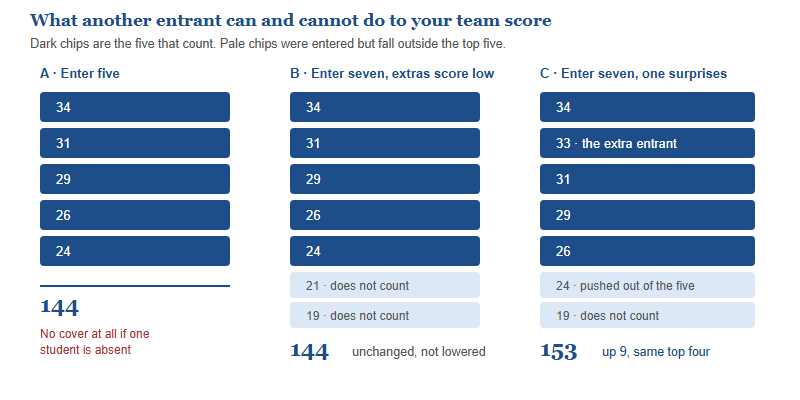
Consider a school whose five strongest students score 34, 31, 29, 26 and 24 out of 40. The table below holds those five fixed and changes only what happens around them.
| Scenario | Scores achieved | Which five count | Team score |
|---|---|---|---|
| A. Enter exactly five | 34, 31, 29, 26, 24 | All five | 144 |
| B. Enter seven; the two extras score below the fifth | 34, 31, 29, 26, 24, 21, 19 | 34, 31, 29, 26, 24 | 144 — unchanged |
| C. Enter seven; one extra outperforms expectation | 34, 33, 31, 29, 26, 24, 19 | 34, 33, 31, 29, 26 | 153 — up 9 |
| D. Enter exactly five; one is ill on the day | 34, 31, 29, 26 | Only four scores exist | 120 — a short team |
Scenarios A and B are the important pair. The two additional students in B contributed nothing whatsoever to the team total, and cost the team nothing either. That is not a coincidence of the numbers chosen; it is guaranteed by the rule. A newly added student either scores below your current fifth, in which case the top five is untouched, or scores above it, in which case they displace a lower score with a higher one and the sum necessarily rises. There is no third case. The team score is arithmetically incapable of falling when you add an entrant.
Scenario C is what that free option is worth in practice. The student who scored 33 was, by assumption, not among the five the department would have chosen. PhysicsBowl is 40 multiple-choice questions in 45 minutes, a format that rewards speed of decision as much as depth of physics — and departments are reliably imperfect at predicting which of their students that format suits. Every additional entrant is another ticket in that particular lottery.
Scenario D is the risk that thin entries actually run. Five entrants is the number that produces a five-score team, so a school entering exactly five has no tolerance for a fever, a clashing mock exam, or a family trip. The downside of entering the bare minimum is not a lower score; it is not having a complete team at all.
How many entrants all this argues for is a question the arithmetic shapes but your budget settles. Five is the floor, and it is a floor that assumes perfect attendance. Somewhere between seven and nine is where most schools stop gaining much: you have covered the realistic risk of one or two absences, and you have bought several tickets in the who-suits-this-format lottery.
The binding constraint is cost, not risk. AAPT's published fee for the United States route is US$10 per student paid to AAPT. Schools in regions 15 to 21 register through ASEEDER instead, and AAPT does not publish that route's fee — so confirm it before you size your entry, either on the registration page or with ASEEDER directly. Whatever it turns out to be, adding a seventh student is a small and knowable cost set against an upside the table above quantifies.
Which students to add is the easier question, because the rule makes it nearly costless to be generous. The candidates worth adding are the ones departments are systematically bad at predicting: strong mathematicians who are quick under time pressure, students who are excellent at multiple-choice elimination without being your best at extended written physics, and students a year into the course who have quietly done a lot of reading on their own. None of them can hurt the total. One of them might be your 33.
Two divisions are two separate fields — and the door opens one way
Because awards are given per region and per division, a school entering both divisions is competing in two distinct fields against two distinct sets of rivals, and needs a top five in each to have two team scores. AAPT states that Division I is for first-year physics students and Division II is for second-year physics students, and it is explicit that Division II is additionally open to anyone wanting a challenge.
That asymmetry is a real planning lever with a real price. A first-year student may move up into Division II to help complete a second-year team; a second-year student may not move down to bolster Division I. So a school with nine first-years and only four second-years can complete its Division II team by moving a first-year up — but each student sits one paper only, so the Division I team loses that score in exchange. You are not gaining a student, you are relocating one, and the one to relocate is whichever student's score matters least where they currently sit. The Division I or Division II self-check is the place to work that through student by student rather than in the abstract.
Award categories themselves vary from season to season, but the pattern in recent years has been recognition for the leading students and the leading schools within each region and division. That structure is what makes the region question worth answering properly: finishing near the top of East China is a materially different task from finishing near the top of a worldwide list, and it is the former you are actually being asked to do.
What to confirm before you commit numbers
Three things should be settled before a department fixes its entry list. First, your region code. AAPT publishes the mapping, and East China — Shanghai, Zhejiang and Jiangsu — is Region 17. Confirm the code actually recorded against your school at registration rather than assuming it, because that code determines the entire field you are ranked in.
Second, the calendar. For the 2026 season the registration deadline was 23 February 2026, extended to 25 February at 11:59pm EST, and the exam was given between 18 March and 3 April 2026. AAPT has not published dates for 2027; as of late August 2026 its PhysicsBowl page still describes the 2026 contest. Do not plan against an estimated date — watch aapt.org, and for the Asia route, ASEEDER.
Third, who is entering you. Entry is made by a school or centre and never by a student directly, and as Region 00 shows, the identity on that entry decides which awards exist for you at all. If your students sit at their own school under their school's supervision, you keep both your regional field and your team award — and the top-five rule then rewards you for entering more of them, not fewer.
Frequently asked questions
Which PhysicsBowl region is my school in?
China has five regions, codes 15 to 19. East China (Shanghai, Zhejiang, Jiangsu) is Region 17. Confirm your code when you register.
Does entering a sixth student lower our team score?
No. The team score sums your top five scores only, so a sixth student can raise the total or leave it unchanged, never reduce it.
Can a training centre enter us as a school team?
No. Test prep centres compete in Region 00 and are eligible for student awards only. Sit at your own school to be eligible for team awards.
When is the 2027 PhysicsBowl?
AAPT has not published 2027 dates. The 2026 exam ran between 18 March and 3 April 2026. Check aapt.org for the new season.
This is an independent guide operated by Hanlin Education for China-based international-school students. Confirm all current details — regions, dates, fees, eligibility and awards — on aapt.org before acting on anything here. Errors reported to us are corrected within 7 working days.