 PhysicsBowl
The Physics Bowl, organized by the American Association of Physics Teachers (AAPT), is a globally influential high school physics academic challenge. For students aiming for STEM fields, it is not only a highly prestigious credential for top universities but also an excellent opportunity to strengthen physics foundations and enhance academic profiles.
I. Why Is the Physics Bowl Worth Participating In? Three Core Values
1. High International Recognition
Physics Bowl results are highly regarded by top universities worldwide. In STEM applications to prestigious institutions such as MIT, Stanford, Caltech, Oxford, and Cambridge, Physics Bowl awards serve as highly compelling academic evidence. AAPT publishes a Global Top Scores list each year, and award certificates record what a student achieved against an externally set standard. AAPT does not publish data on where awardees go on to study, and neither does this site.
2. High Award Rate
Compared to the more demanding BPhO (British Physics Olympiad), the Physics Bowl has a lower entry barrier and offers a wide range of awards. Its global award rate is approximately 35%–40%, with even higher rates in the China region. For students with a solid physics foundation, diligent preparation offers a very high return on investment for winning an award.
3. Ideal Stepping Stone to Advanced Competitions
The Physics Bowl’s difficulty lies between school-level physics and the Olympiad level, making it a perfect transition to more advanced competitions such as BPhO and PUPC (Princeton University Physics Competition). Preparing for the Physics Bowl not only broadens your understanding of physical models but also lays a solid foundation for future top-tier Olympiad challenges.
II. Physics Bowl Full Award System & Certificate Uses
Physics Bowl awards are divided based on global rankings. With diligent preparation, most students can achieve corresponding honours:
- Global Top 100: The highest honour of the competition, with顶尖 prestige and extremely high recognition from top universities.
- Super Gold: Top 5% globally. A top-tier award, demonstrating能力 far beyond the average participant.
- Gold: Top 10% globally. A top-tier award with strong competitive advantage for university applications.
- Silver: Top 25% globally. A mainstream优质 award, suitable for enhancing the profiles of most top university applicants.
- Bronze: Top 45% globally. A foundational优质 award, achievable even with preparation from a beginner level.
- Participation Certificate: Available to all participating students.
Certificate Benefits & Uses: Results can be checked after the exam. Both paper and electronic certificates are issued, verifiable on the official website, and valid indefinitely. These certificates can be used for school comprehensive evaluations, enriching application portfolios, and serving as powerful加分 materials demonstrating STEM abilities.
III. 2026 Season Physics Bowl Registration Guide & Exam Format
Registration & Exam Dates: Registration closes in March each year, and the exam is held in late March (specific dates subject to official announcements).
Registration Method: Individual registration is not supported in mainland China; registration must be completed through official partner test centers.
Exam Format: For the 2026 season, only offline paper-based closed-book exams are available domestically (online options were previously supported). The competition is an individual event, with no experimental component, and the entire exam is in English.
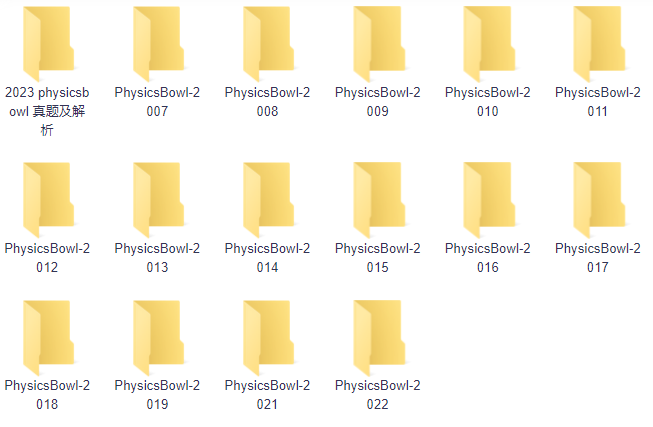
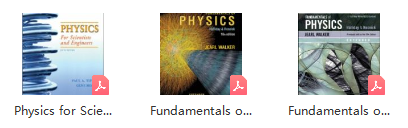
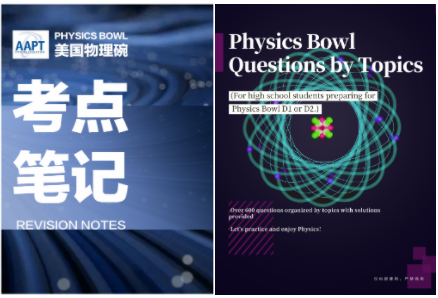
IV. Our Preparation Strategy & Course System
Although the Physics Bowl covers a wide range of topics, the difficulty of individual questions is not extremely high. The real challenge lies in being “fast and accurate”—completing 40 multiple-choice questions in 45 minutes, which gives you only about 1 minute per question on average. Therefore, the core of preparation is not blindly practicing difficult problems, but building a solid foundation, clarifying concepts, and improving problem-solving speed.
Based on this core logic, our Physics Bowl training courses are divided into two stages, precisely aligned with students’ different foundations:
Stage 1: Foundation Class (Suitable for students just beginning systematic physics study)
- Core Goal: Pursue deep understanding rather than blindly chasing difficulty.
- Course Content: Focus on building a solid foundation in the two largest sections—Mechanics and Electromagnetism—while systematically reviewing core concepts in Thermodynamics, Optics, and Modern Physics to ensure no gaps in the knowledge system.
Stage 2: Sprint Class (Suitable for students with some foundation aiming for high scores)
- Core Goal: Achieve stable performance and optimise exam strategy.
- Course Content: Focus on intensive practice with past papers and full-length timed mock exams, identifying and填补 individual weak areas. Emphasis is placed on training problem-solving strategies and time allocation, cultivating the exam rhythm of “easy first, difficult later, and decisive取舍.”
Both stages have different focuses, but both revolve around the same ultimate goal: enabling students to perform stably at their true level on exam day and achieve their desired awards.
V. Reference Constants
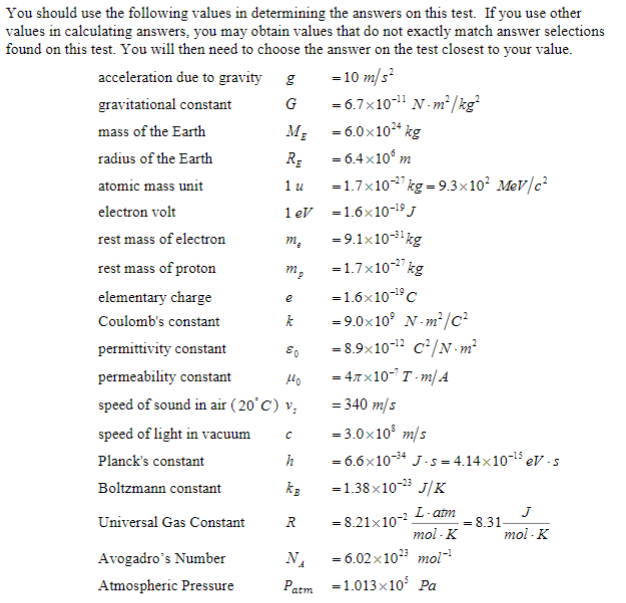
The following table lists common physical constants that may be useful for preparation and reference.
| Quantity | Symbol | Value |
|---|---|---|
| Acceleration due to gravity | g | = 10 m/s² |
| Gravitational constant | G | = 6.7 × 10⁻¹¹ N·m²/kg² |
| Mass of the Earth | Mₑ | = 6.0 × 10²⁴ kg |
| Radius of the Earth | Rₑ | = 6.4 × 10⁶ m |
| Atomic mass unit | 1 u | = 1.7 × 10⁻²⁷ kg = 9.3 × 10² MeV/c² |
| Electron volt | 1 eV | = 1.6 × 10⁻¹⁹ J |
| Rest mass of electron | mₑ | = 9.1 × 10⁻³¹ kg |
| Rest mass of proton | mₚ | = 1.7 × 10⁻²⁷ kg |
| Elementary charge | e | = 1.6 × 10⁻¹⁹ C |
| Coulomb’s constant | k | = 9.0 × 10⁹ N·m²/C² |
| Permittivity constant | ε₀ | = 8.9 × 10⁻¹² C²/(N·m²) |
| Permeability constant | μ₀ | = 4.7 × 10⁻⁷ T·m/A |
| Speed of sound in air (20°C) | vₛ | = 340 m/s |
| Speed of light in vacuum | c | = 3.0 × 10⁸ m/s |
| Planck’s constant | h | = 6.6 × 10⁻³⁴ J·s = 4.14 × 10⁻¹⁵ eV·s |
| Boltzmann constant | k_B | = 1.38 × 10⁻²³ J/K |
| Universal Gas Constant | R | = 8.21 × 10⁻² L·atm/(mol·K) = 8.31 J/(mol·K) |
| Avogadro’s Number | N_A | = 6.02 × 10²³ mol⁻¹ |
| Atmospheric Pressure | P_atm | = 1.013 × 10⁵ Pa |