 PhysicsBowl
The Physics Bowl, organized by the American Association of Physics Teachers (AAPT), is a global high school physics competition known for its extreme time pressure and broad coverage of topics. Although the competition is intense, systematic preparation makes winning an award an achievable goal.
I. Physics Bowl Award Levels and Difficulty
| Award Level | Award Ratio | 2025 Reference Cutoff (out of 40) | Difficulty Interpretation |
|---|---|---|---|
| Global Top 100 | ≈ 0.1% | D1: ≥ 34 / D2: ≥ 35 | Ivy League / G5 applications; no more than 6 incorrect answers allowed |
| National Super Gold | Top 5% | D1: ≥ 29 / D2: ≥ 32 | Proof of top-tier ability |
| National Gold | Top 10% | D1: ≥ 23 / D2: ≥ 28 | A recognised, externally scored physics credential |
| National Bronze | Top 35% | D1: ≥ 17 / D2: ≥ 21 | Basic profile enhancement |
To win an award, you must keep the number of incorrect answers to 6 or fewer — the margin for error is extremely tight.
II. Why Is It So Hard to Win a Physics Bowl Award? Four Core Challenges
Challenge 1: Extreme Time Pressure
You have 45 minutes to complete 40 multiple-choice questions, giving you an average of only 67 seconds per question — including reading, thinking, calculating, and selecting an answer. Many test-takers report that “they knew how to solve some questions, but ran out of time to even read them.”
Challenge 2: Broad Coverage of Topics
The exam covers mechanics, electromagnetism, optics, thermodynamics, wave motion, modern physics, and more. In recent years, the difficulty has been increasing, with integrated problems placing greater demands on students’ abilities.
Challenge 3: Language Barrier of the All-English Exam
A large number of physics-specific terms and relatively long problem statements pose a significant challenge to English reading proficiency and vocabulary. The language barrier further increases the difficulty of winning an award.
Challenge 4: Flexible Questions with Hidden Traps
Memorizing formulas alone will not earn you points. Most test-takers find that even though they know most of the concepts, they still cannot achieve a high score. The core reason is that the questions are very flexible, with multiple traps embedded in a single problem. A slight lapse in attention can lead to lost marks.

III. How Does the Physics Bowl Compare to the Chinese Physics Curriculum?
Division 1 (D1) ≈ Chinese Grade 10–11 Physics Level
- Target Audience: IB Year 10, A-Level G2, and outstanding G1 students.
- Topics Covered: Mechanics, electromagnetism, thermodynamics, optics, wave motion, and modern physics — six major modules that closely align with the compulsory and elective topics of the Chinese Gaokao physics curriculum.
- Difficulty Comparison: The first 30 questions are similar to intermediate-level Gaokao physics problems; the last 10 questions touch on Gaokao final problems and introductory physics competition difficulty.
- Core Difference: Completing 40 multiple-choice questions in 45 minutes demands a speed far beyond that of domestic exams.
Division 2 (D2) ≈ Chinese Grade 12 to First-Year University Physics Level
- Target Audience: IB Years 11–12 and A-Level students.
- Topics Covered: Includes first-year university topics such as rigid body mechanics, electromagnetic field theory, thermodynamic cycles, and frontiers of modern physics.
- Difficulty Comparison: Questions 11–30 are equivalent to the semifinal round of the Chinese Physics Olympiad (CPhO); questions 31–50 touch on CPhO provincial selection and introductory IPhO level.
- Core Challenge: Extremely high demands on the application of calculus and physical modelling skills.
Key Conclusion: For Physics Bowl Division 2, scoring full marks on the Gaokao is only the starting point. Without systematic competition-level thinking training, it is very difficult to achieve a high score in D2.
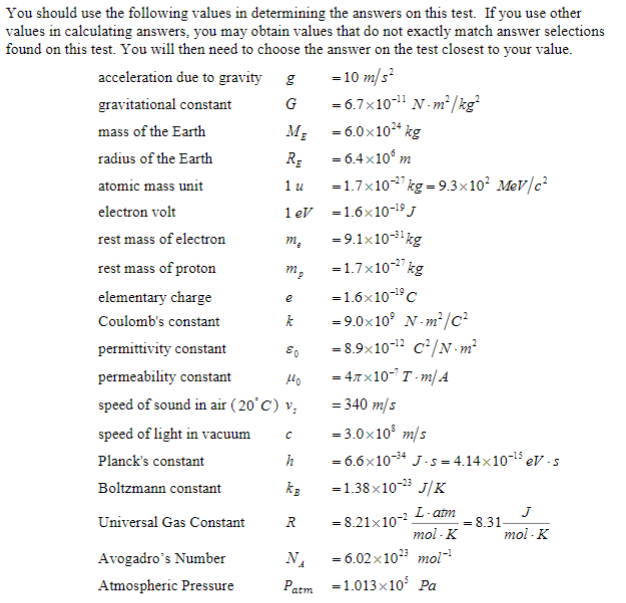
IV. Reference Constants
The following table lists common physical constants that may be useful for preparation and reference.
| Quantity | Symbol | Value |
|---|---|---|
| Acceleration due to gravity | g | = 10 m/s² |
| Gravitational constant | G | = 6.7 × 10⁻¹¹ N·m²/kg² |
| Mass of the Earth | Mₑ | = 6.0 × 10²⁴ kg |
| Radius of the Earth | Rₑ | = 6.4 × 10⁶ m |
| Atomic mass unit | 1 u | = 1.7 × 10⁻²⁷ kg = 9.3 × 10² MeV/c² |
| Electron volt | 1 eV | = 1.6 × 10⁻¹⁹ J |
| Rest mass of electron | mₑ | = 9.1 × 10⁻³¹ kg |
| Rest mass of proton | mₚ | = 1.7 × 10⁻²⁷ kg |
| Elementary charge | e | = 1.6 × 10⁻¹⁹ C |
| Coulomb’s constant | k | = 9.0 × 10⁹ N·m²/C² |
| Permittivity constant | ε₀ | = 8.9 × 10⁻¹² C²/(N·m²) |
| Permeability constant | μ₀ | = 4.7 × 10⁻⁷ T·m/A |
| Speed of sound in air (20°C) | vₛ | = 340 m/s |
| Speed of light in vacuum | c | = 3.0 × 10⁸ m/s |
| Planck’s constant | h | = 6.6 × 10⁻³⁴ J·s = 4.14 × 10⁻¹⁵ eV·s |
| Boltzmann constant | k_B | = 1.38 × 10⁻²³ J/K |
| Universal Gas Constant | R | = 8.21 × 10⁻² L·atm/(mol·K) = 8.31 J/(mol·K) |
| Avogadro’s Number | N_A | = 6.02 × 10²³ mol⁻¹ |
| Atmospheric Pressure | P_atm | = 1.013 × 10⁵ Pa |