 PhysicsBowl
AAPT describes PhysicsBowl as a 40-question, 45-minute, timed multiple-choice test. That is about 67 seconds per question, which changes what preparation is for: the binding constraint is not how much physics you know but how fast you can retrieve the right relation. The audit below sorts everything you have learned into three tiers — automatic, rebuildable, and not worth carrying — and gives you a way to test which is which.
The constraint is retrieval speed, not coverage
Do the arithmetic once and then stop thinking about it. Forty-five minutes is 2,700 seconds. Divided by 40 questions, that is 67.5 seconds each, and that average has to absorb reading the stem, deciding what the question is about, choosing a relation, doing the arithmetic, and marking an answer. Our teaching team’s working figure is that recognising the physics and selecting the relation should take under ten seconds, or the rest of the question has nowhere to live.
That is why “I knew that one, I just needed longer” is such a common and such an expensive post-mortem. Under those conditions there are effectively two kinds of physics in your head. There is physics you can produce — the relation appears, correctly, without effort. And there is physics you can recognise — you would confirm it instantly if someone showed it to you, but you cannot summon it cold. Recognition feels almost identical to knowledge while you revise, and behaves nothing like it in a timed room. The whole point of an audit is to tell the two apart before the paper does it for you.
If you have not yet mapped how the timing distributes across a paper of this shape, the contest overview sets out the format the audit is built around.
The materials question, answered honestly
Students always ask first whether anything is supplied in the room. Our own rules page records that an equation sheet is provided with the paper and that it is not exhaustive, so plan on having one without planning around it. Beyond that, materials and permitted equipment are governed by AAPT’s rules and by the arrangements for your particular sitting, so this is a question to settle on aapt.org and with whoever files your entry — not one to settle from a forum post or a Chinese-language summary of unknown vintage. Confirm it at entry, and confirm it again with the teacher supervising the room.
Then prepare as though you must recall everything. That is not a scare tactic; it is the only assumption that cannot hurt you. If something is supplied, a student who prepared for full recall simply finds the paper easier. If nothing is supplied, a student who planned around a sheet has built their preparation on a variable they never controlled. Asymmetric risk, obvious decision.
Three tiers: automatic, rebuildable, leave behind
The classification below is our own teaching-team framework, applied to the kind of first-year and second-year physics course the two divisions describe — AAPT defines Division I for first-year physics students and Division II for second-year. The content specification is AAPT’s, so confirm scope on the official site; what follows is a method for organising whatever scope applies to you.
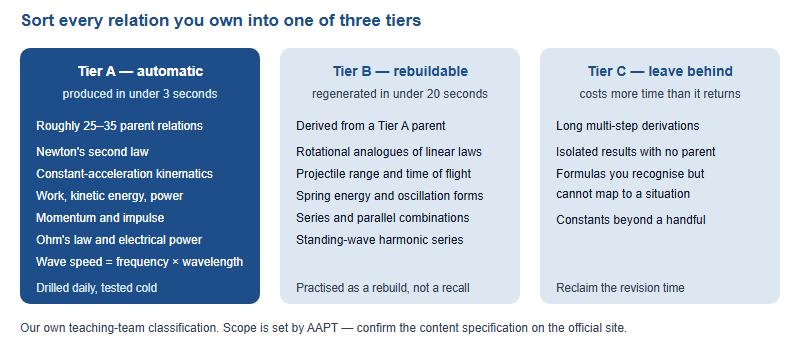
Notice what the tiers imply. Tier A should be short. Students who try to make everything automatic end up with a long list they half-hold, and half-held relations fail exactly when the clock is running. A compact Tier A that is genuinely instant, plus a Tier B you can rebuild reliably, beats a long list you can nearly produce.
Tier C is the tier students resist, because demoting something feels like giving up on it. Read it the other way round. A relation you have carried for two months without ever producing it cold is not an asset you are protecting; it is revision time you keep spending at a nil return. Two honest tests decide the question. First, can you say what kind of situation triggers it — not what it says, but when you would reach for it? A relation you can quote but cannot trigger will never be selected under time, because selection is the step that is actually failing. Second, if you met a question that needed it, would the rest of the paper have been a better use of those 67 seconds? For most students the answer is yes, and a short Tier C list is the price of a Tier A that holds.
Parent relations and the chains they carry
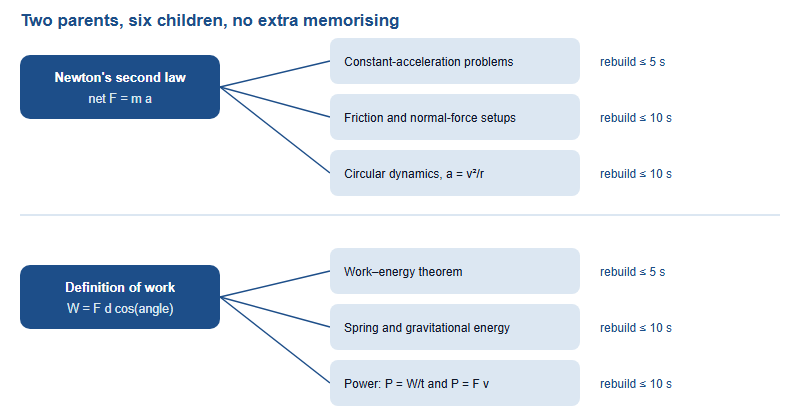
The reason Tier B works is that most of a physics course is not independent facts. It is a small number of parent relations plus their consequences. If the parent is automatic and you have practised the rebuild, the children cost you seconds rather than memory.
| Parent relation (Tier A) | What it regenerates (Tier B) | Why it is worth carrying |
|---|---|---|
| Net force = mass × acceleration | Inclines, pulleys, friction, lift and elevator problems, circular dynamics | One relation plus a free-body sketch covers most mechanics stems |
| Definition of work | Work–energy theorem, spring energy, gravitational energy near Earth, power | Turns force questions into energy questions when the force route is slow |
| Impulse = change in momentum | Elastic and inelastic collisions, recoil, average force over a contact time | Collision stems are common and the shortcut is always momentum first |
| The linear-to-rotational mapping | Every rotational kinematic and dynamic relation, from its linear twin | Halves the rotational content instead of doubling the memorising |
| Ohm's law with the definition of power | Power dissipated in a resistor, series and parallel behaviour | Circuit stems reward speed on combinations more than clever analysis |
| Wave speed = frequency × wavelength | Standing-wave harmonics, boundary-condition patterns | Boundary conditions generate the whole harmonic series in seconds |
Work through that fourth row once and you will see why the parent method is worth the discipline. If you hold the mapping — displacement to angle, velocity to angular velocity, acceleration to angular acceleration, mass to moment of inertia, force to torque, momentum to angular momentum — then every rotational relation you were told to memorise separately is the linear one you already own, with the labels exchanged. A student carrying the mapping holds one extra idea. A student memorising the rotational set holds a second copy of mechanics, and under time pressure the second copy is the one that fails first, because it was learned as a list rather than as a structure.
Two cautions keep this honest. The mapping regenerates the form of a relation, not the standard results that go with it, so a small number of items — the moments of inertia of common shapes, for instance — still have to be held directly or read off whatever your sitting permits. And a rebuild is only Tier B if you have practised it as a rebuild. Knowing in principle that something is derivable is not the same as having derived it under a stopwatch, which is precisely the gap the audit below is designed to expose.
How to run the audit in one afternoon
The audit is not revision. It is a measurement, and it works only if you run it cold — not immediately after studying the topic, which is the single most common way students flatter themselves.
- Pick one topic block. Mechanics, circuits, waves, thermal, optics. One block per sitting.
- Blank page, six minutes, no notes. Write every relation from that block you can produce. Do not tidy. Do not check anything.
- Mark honestly. Three marks only: produced instantly, produced slowly, not produced at all.
- Time the slow ones. Second pass with a stopwatch, one relation at a time. Under 3 seconds is Tier A. Rebuilt from a parent in under 20 seconds is Tier B. Everything else is a Tier C candidate.
- Compress to one page. Parents in bold, children indented beneath them. If your page needs a second sheet, you are memorising children.
- Re-test cold at expanding intervals. Day 3, day 10, day 24, always on a day you have not revised that block. Anything that fails twice gets promoted to daily drilling or demoted to a rebuild.
Two rules make the audit honest. The first is that a relation you produce with a hint does not count as produced; multiple choice will show you a set of plausible-looking options, and the moment you need one of them to remind you of the physics, you are choosing rather than solving. The second is that the paper is timed from the first question, so any relation whose retrieval you have only ever tested at your own pace has not really been tested.
Four failure modes, and what the audit is worth in minutes
Memorising children instead of parents. The list grows, retention falls, and the student ends up with forty half-held relations rather than thirty solid ones. The fix is structural: every time you meet a new relation, ask which parent it comes from before you write it on a card.
Mistaking recognition for recall. Reading notes produces a strong feeling of knowing that a blank page immediately disproves. This is why step two of the audit is blank-page production and not a checklist you tick.
Testing warm. Auditing a topic ten minutes after revising it measures your short-term memory, which is not the faculty you will be using in the room.
Planning around materials you have not confirmed. Settle the materials question through the official channel and your entry — how registration works covers who to ask — and prepare for full recall regardless.
Finally, the conversion that makes the audit worth an afternoon. Suppose twelve questions on the paper each cost you an extra 25 seconds because a relation had to be reconstructed rather than retrieved. That is 300 seconds — five minutes, or roughly four and a half questions’ worth of time at the 67.5-second average. No new physics was required to recover it. The relations were already in your head; they were simply filed in the wrong tier.
Frequently asked questions
Is a formula sheet provided?
Our own rules page records that an equation sheet is provided with the paper and that it is not exhaustive. Confirm what applies to your sitting on aapt.org, and prepare as though you must recall everything.
How long is each question worth?
Forty questions in 45 minutes is about 67 seconds each, so retrieval must be near-instant and derivation is a luxury you rarely afford.
How many relations should be automatic?
Fewer than students expect. Carry a small parent set you can rebuild from, rather than a long list you recognise but cannot produce.
How do I test recall honestly?
Blank page, one topic block, six minutes, no notes, and never straight after revising it. What you cannot produce cold is not yet available.
Written for China-based international-school students. Confirm current details on aapt.org. Corrections issued within 7 working days.