 PhysicsBowl
 is sat at your own school, under your school's supervision. A proctor is mandatory, and AAPT's rule bars a parent, a relative or a close friend from doing that job. For a small school entering for the first time, that one sentence decides more than any revision plan — because it determines whether there is anybody available to run the session at all.
The model: your room, your school's supervision
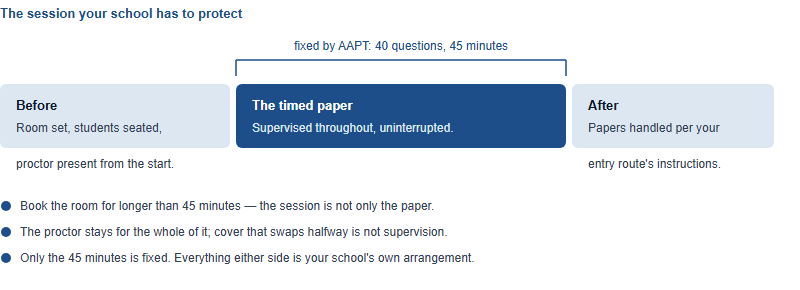
Two facts define the exam day. The paper is a 40-question, 45-minute timed, multiple-choice test, and it is taken under the school's supervision. That is a materially different arrangement from contests that gather everyone into a hired hall, and it shifts a set of responsibilities onto the school that nobody mentions at the point of signing up.
It also explains our own position, which is worth stating plainly because families ask about it every season. We arrange entries through the official channel for schools that want help with the paperwork. We are not a test centre and we do not proctor: students sit the paper at their own school, supervised by their own school, and there is no arrangement in which a student comes to us to take it. AAPT's own rules give a structural reason for that model as well — test prep centres and educational services compete in their own region and are eligible only for the student award categories. Entering through your school keeps you in your school's region, competing as your school.
What that leaves you with is a practical question, not a philosophical one: which adult at your school will supervise the session, and is that person permitted to? If you have not yet checked what your school is committing to, the contest overview sets out the format the session has to accommodate.
The proctor rule, and the cases people get wrong
The rule itself is short: a proctor is mandatory, and may not be a parent, a relative or a close friend. The logic is ordinary exam-integrity logic — the person supervising must not have a personal stake in the outcome. What makes it worth an article is that it collides with how small international schools actually staff themselves, where the physics teacher may be a family friend, where a parent volunteer is the default solution for everything, and where the entire science department is three people.
| Candidate | Usually workable? | The point to check |
|---|---|---|
| A physics teacher at the school, unrelated to the entrants | Yes, the standard case | Only that they are free for the whole session, not teaching elsewhere |
| A teacher of another subject, or a senior staff member | Usually yes | The rule is about relationship, not subject expertise |
| An exams officer or invigilator the school already uses | Usually yes | Often the cleanest answer at schools that run public exams |
| A parent volunteer | No | The rule names parents explicitly; do not improvise around it |
| An older sibling, cousin or other family member | No | Covered by “relative”, whatever their qualifications |
| A family friend who happens to teach at the school | Depends, and it is not your call | “Close friend” is a judgement; put the specific case to your entry route |
| A private tutor who coaches an entrant | Treat as ineligible unless told otherwise | Direct stake in the result; confirm rather than assume |
| Us, or any outside provider | No | We do not proctor; the session is supervised by your school |
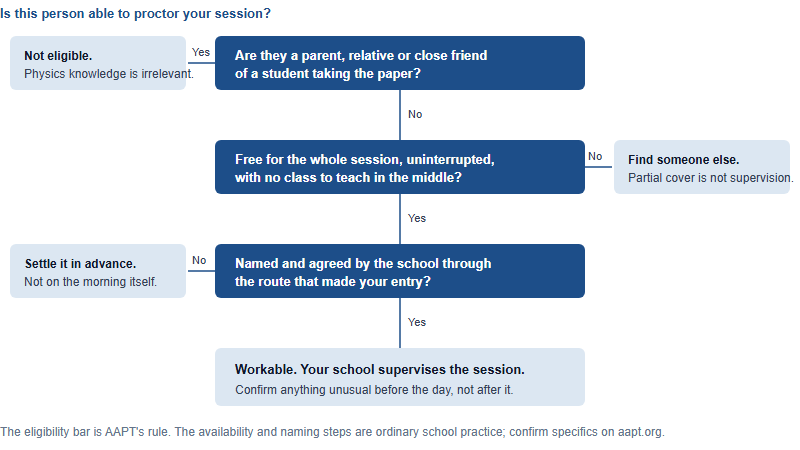
One edge case deserves naming because it comes up at genuinely small schools: what if the only physics teacher is a relative of one of the entrants? The answer is not to reinterpret the rule. It is to supervise with a different member of staff — the proctor does not need to teach physics — and, if anything about the arrangement is unusual, to raise it through the route that handled the entry rather than to decide locally and hope. A judgement made in advance costs an email. A judgement made wrongly can affect whether a result stands.
What a first-time host school has to settle
Schools that already run public examinations tend to absorb this without noticing, because they have rooms, invigilators and a culture of protected sessions. Schools entering a small group for the first time have to make the same decisions from scratch, usually in the middle of a normal teaching week.
- Who owns the entry. One named member of staff, not “the science department”. Almost every problem below traces back to this one being left vague.
- A room and an uninterrupted block. The paper runs 45 minutes and the session needs to be longer than the paper, since students have to be seated and settled first. A room that is booked for a lesson twenty minutes later is not a room.
- The timetable clash. Contest sessions land inside a school day. Which lesson your entrants miss, and whether their teachers know, is a conversation that costs nothing in November and a great deal in March.
- Two divisions, one school. Entrants are split into Division I for first-year physics students and Division II for second-year. Whether the two divisions can be seated in the same supervised session, or need separate arrangements, is a logistics question to put to your entry route rather than to assume.
- How many students to enter. A school team score is the sum of a school's top five students, and how that is applied to a school entering fewer than five is not spelled out publicly — put it to your entry route. If team recognition matters to your school, that number is a decision, not an accident.
- What students may bring. Do not guess. Materials and equipment policy is exactly the sort of detail that changes and that varies by contest — confirm it on aapt.org and through your entry route before the day, and tell students in writing.
The failure modes we actually see
These are our observations from helping schools with entries, not rules from AAPT. They repeat often enough to be worth predicting.
- The entry with nobody named to run it. A department agrees enthusiastically in November and discovers in March that no individual ever took ownership of the room, the proctor or the date. This is the single most common failure and the easiest to prevent.
- The proctor decided in the final week. Left late, the obvious volunteer is often a parent — precisely the category the rule excludes. Deciding early costs nothing; deciding late narrows the field to the people you cannot use.
- The block that is not really uninterrupted. A teacher who has to leave for a lesson partway through, or a room that doubles as a thoroughfare, breaks supervision even when everyone means well.
- Entering four students and hoping for a team result. The team score is defined as the sum of the top five, and how smaller entries are treated is not spelled out publicly. If team recognition is part of why your school is entering, the entry list has to reflect that.
- Assuming the equipment policy. Students turning up with the wrong assumption about what they may use is avoidable with one confirmed sentence sent to families in advance.
The short checklist to send your school
If you are a student or parent trying to move this forward, do not send your school an article. Send five questions, which a teacher can answer in a few minutes:
- Is our school entering PhysicsBowl this season, and who is the named owner of the entry?
- Which member of staff will proctor, and are they clear of the parent, relative and close-friend bar?
- Which room, and is it free for longer than the 45-minute paper?
- Are we entering enough students for a team score to be possible, if that matters to us?
- What have we confirmed with our entry route about equipment, seating both divisions, and the date within the contest window?
Everything on that list is a school-side decision, and the last one has an external dependency: for schools in Asia and the Middle East, entries go through ASEEDER rather than to AAPT directly, so that is where school-specific arrangements get confirmed. The mechanics of that route are set out in how registration works. Dates, deadlines and equipment rules all change between seasons, and AAPT has not published dates for the next one — so treat the current season's official pages as the authority and confirm current details on aapt.org before you commit anything to a school calendar.
None of this is difficult. It is simply administrative work that has to happen in a specific order, and it fails when it is left to the week of the contest. A school that settles the proctor, the room and the entry list in the autumn has removed almost every way this can go wrong — and the students get to spend their attention on the physics, which is the only part of the day they can actually influence.
Who is allowed to proctor a PhysicsBowl session?
A supervising adult at the school who is not a parent, relative or close friend of an entrant. They do not need to teach physics.
Can a parent invigilate if no teacher is free?
No. AAPT's rule names parents explicitly. Use another member of staff, and raise unusual cases through your entry route in advance.
Can students sit the paper at an outside centre instead of school?
Students sit at their own school under its supervision. We arrange entries but do not proctor and are not a test centre.
Does the proctor need to be a physics teacher?
No. The rule is about relationship to the entrants, not subject expertise, so an exams officer or another subject teacher usually works.
Editorial note: an independent PhysicsBowl guide operated by Hanlin Education for China-based international-school students. Supervision rules quoted here are AAPT's; the practical readings and failure modes are our own editorial observations. Confirm current rules, dates and equipment policy on aapt.org. Corrections are issued within 7 working days.