 PhysicsBowl
Every PhysicsBowl student sits the same shape of paper. AAPT describes it as “a 40-question, 45-minute timed, multiple-choice test under their school's supervision” — 2,700 seconds for 40 questions, or 67.5 seconds each. Most students who run out of time did not run out of physics. They spent the budget on three or four questions that were never going to fall, and never saw the last ones.
The arithmetic, and why 67.5 seconds is a budget rather than a rule
Forty-five minutes is 2,700 seconds. Divided across 40 questions that is 67.5 seconds apiece, and it is worth doing that division once before your first timed set. But no question on the paper is priced at 67.5 seconds. Some are 20-second items — a definition, a graph you can read straight off, a ratio that falls out of one substitution. Some will take you four minutes. The average is a budget across the whole paper, and every second you go over on one question is borrowed from another one you have not seen yet.
That borrowing is the whole story. A question that takes 240 seconds does not cost you 240 seconds; it costs you the 172.5 seconds that were not yours to spend — about two and a half other questions. Do that twice and roughly five questions at the back of the paper get nothing at all. They are not questions you got wrong. They are questions you never read.
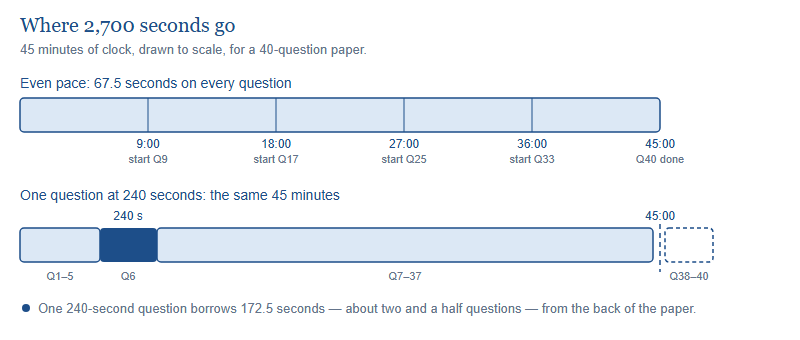
The practical version is a set of checkpoints. Note the time your proctor starts the paper — and agree in advance how time will be called, since that varies by room — then hold yourself to the marks below. The important column is the last one: falling four questions behind costs you 7.5 seconds per remaining question at the nine-minute mark, and 22.5 seconds per remaining question at the thirty-six-minute mark. A deficit gets more expensive the longer you carry it.
| Clock | On budget, you are starting | Questions left | If you are 4 questions behind | What that means |
|---|---|---|---|---|
| 9:00 | Q9 | 32 | 60 s per question | Cheap to fix. Drop one long item and you are level. |
| 18:00 | Q17 | 24 | 57.9 s per question | Still recoverable, but stop starting long routes. |
| 27:00 | Q25 | 20 | 54 s per question | Skim-and-mark only; no new derivations from scratch. |
| 36:00 | Q33 | 12 | 45 s per question | Answer what is readable, then protect the last five minutes. |
| 45:00 | — | 0 | — | Every bubble filled, every answer on its own line. |
No partial credit changes what a half-finished question is worth
The paper is entirely multiple choice, and there is no partial credit; your individual result is a mark out of 40. Nothing you write on the question paper is seen by anyone. There is no working to award, no method mark, no examiner who notices that your free-body diagram was right and your arithmetic slipped in the last line.
Two consequences follow, and they point in the same direction. First, a derivation that is ninety percent complete when time is called is worth exactly what an untouched question is worth: nothing. Second — and this is the part students resist — an answer reached in 25 seconds by eliminating the options with the wrong units scores exactly the same as one reached by four minutes of honest algebra. Elimination is not a lesser method on this paper. It is the same mark at a much better price.
One thing we cannot tell you: whether an incorrect answer is treated differently from a blank is not spelled out in AAPT's public description of the contest, and it is not on the rules summary here either. Settle it on aapt.org before exam day, and ask your teacher or proctor to confirm. What is certain is that an unanswered question scores nothing; if it is confirmed that nothing is deducted for a wrong answer, then leaving a blank is strictly worse than guessing, and your last minute has an obvious job.
Pacing is not only a personal matter, either. AAPT states that “School Team scores are determined by the sum of the scores of the top five students competing.” A strong student who mismanages the clock does not just lose their own marks; they lower one of the five numbers their school is judged on.
The equation sheet, g = 10, and the answer choices
Per the published rules, an equation sheet is supplied with the paper. It carries many basic relations, but not every one a question might need. Treat it as a safety net rather than a substitute for recall: the relations you own by heart are the ones you retrieve in two seconds, while anything you have to hunt for on the sheet costs ten or fifteen seconds of a 67.5-second budget. Knowing what is on the sheet is itself preparation, because the worst outcome is searching it for something that was never there.
Per the same published rules, gravity questions are set with g = 10 meters per second squared. This sounds like a footnote and is not. A student who has practiced an entire year at 9.8 does slower arithmetic under pressure, and then lands on a value that sits near a listed option without matching it — and spends forty seconds deciding whether the discrepancy is their mistake or the option's. Practice with 10 so that the mental arithmetic and the answer choices agree.
The options themselves are the cheapest tool on the paper, and using them is a timing decision rather than a trick. Units, order of magnitude, sign, and limiting behavior — what the expression must do as an angle goes to zero, or as a mass becomes very large — will often kill most of the options before you compute anything. Two cautions. Some questions are built with options that are all dimensionally consistent, so the technique fails exactly where you most want it. And reading every option carefully before you decide whether a question is cheap is itself a cost; decide first, then read.
A triage pass that fits inside 45 minutes
The rule that saves the most time is a decision rule, not a physics rule. Work the paper in three passes, with the clock, not the question order, telling you where you are.
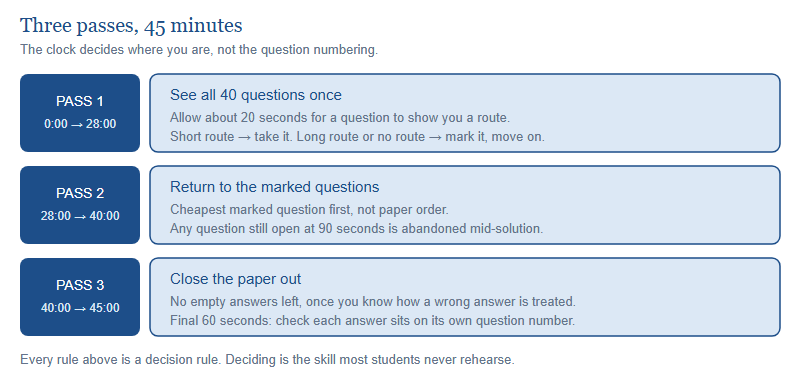
Pass 1 is about coverage: by twenty-eight minutes you should have looked at all forty questions and answered the ones that came cheaply. Give a question roughly twenty seconds to show you a route. If the route is short, take it. If it is long, or if there is no route, mark it and go — do not “just try something,” because trying something is how ninety seconds disappear without a decision ever being made. Use two marks, not one: a symbol for “I know how but it is long” and a different symbol for “I have no idea.” Pass 2 then knows where to start.
The ninety-second ceiling is the hardest habit to build, because at eighty seconds you feel close. The sunk cost is the enemy here: those eighty seconds are gone whether you continue or not, and the only live question is what the next ninety seconds buy. Almost always they buy more elsewhere. Pass 3 is administrative and should never be skipped — a row of answers shifted by one question is the most expensive clerical error available on a multiple-choice sheet, and sixty seconds of checking is cheaper than any physics you could do with the same minute.
Training the clock, not just the physics
Timed sets only teach you something if you record the right thing. Sit a full paper in one 45-minute block, ideally at the hour you will actually sit the exam, and keep a decision log rather than an error log: for each question, one letter — solved on the spot, marked, or skipped — plus the seconds it took. Then, when you mark it, look at two numbers.
The first is how many questions you never saw. The second, and the more diagnostic one, is how many of your questions over 120 seconds you got wrong. If most of your long questions came out wrong, your problem is selection rather than speed: you are choosing to fight the questions you are least likely to win, and no amount of faster algebra fixes that. If most of your long questions came out right, you have a different and more comfortable problem — you are a slow, accurate solver who needs to bank time on the cheap items rather than abandon the hard ones.
Half-length sets — twenty questions in twenty-two and a half minutes, twice a week — train the checkpoint instinct more cheaply than a full paper, and they are easier to fit around school. The past-paper archive here runs from 2007 to 2025, with answers, and worked solutions for many of the years. Read the solution even for questions you got right: if the intended route took forty seconds and yours took three minutes, that is a pacing finding, and it is exactly the kind that never shows up in a score. One caution — do not calibrate a target score from a single practice year. Papers vary in difficulty from year to year, and so do the thresholds that go with them; a timed set tells you about your process, not about where you would land.
Practice under the conditions you will actually sit
The exam must be proctored, and AAPT is explicit that “Parents, relatives, or close friends and acquaintances of students are not acceptable proctors.” Per the published rules the proctor needs at least a two-year degree, which does not have to be in physics, and a student's own school is the expected and preferred venue. That is the situation the whole method above assumes: your desk, your school, your school's clock.
This has a consequence worth stating plainly, because it is not obvious. AAPT places test prep centres and educational services in their own region, eligible for the student award categories only. A student entered under a test-prep-centre identity is therefore competing in a different region from their classmates and gives up the school team award — the one built from a school's top five scores. We are an independent guide; we are not a test centre, we do not host or proctor a sitting, and nothing here should be read as an invitation to sit anywhere other than your own school. Entry is made by a school or centre and never by a student directly; schools in China and elsewhere in Asia and the Middle East register through ASEEDER, and helping schools arrange that through the official channel is part of what we do — the mechanics are set out on the registration page.
Division I is for first-year physics students and Division II is for second-year physics students. Both sit forty questions in forty-five minutes, so the pacing method is identical across divisions even though the content is not; what changes with the harder paper is how many questions you should expect to mark in Pass 1, which is precisely what your own timed sets are for.
On dates: in the 2026 season the registration deadline was 23 February 2026, extended to 25 February at 11:59pm EST, and the exam was given between 18 March and 3 April 2026. AAPT has published nothing for 2027 as of this writing, so do not build a revision plan around a date that does not exist yet. Build it around the shape of the season — a registration deadline in late winter, then a sitting window in which your school picks a day — and confirm the real dates on aapt.org, and your own sitting date with your teacher, as soon as they are announced.
Common questions
How long do you get per question in the PhysicsBowl?
Forty questions in forty-five minutes works out to 67.5 seconds each on average. It is a budget across the paper, not a limit on any one item.
Is there partial credit on the PhysicsBowl?
No. The paper is multiple choice and nothing you write is marked, so a half-finished derivation scores the same as a blank: zero.
What value of g does the PhysicsBowl use?
Per the published rules, gravity questions are set with g = 10 meters per second squared, and the equation sheet supplied is not exhaustive.
Should I guess on questions I cannot finish?
An unanswered question scores nothing for certain. Check on aapt.org how a wrong answer is treated before you decide to leave anything blank.
This is an independent guide operated by Hanlin Education for China-based international-school students. Contest details change from season to season; confirm current rules, dates and registration arrangements on aapt.org before acting on anything here. Corrections are issued within 7 working days of notification.