 PhysicsBowl
Written during the 2026 cycle
That cycle has closed. The 2026 exam ran between 18 March and 3 April 2026, and registration closed on 23 February 2026 (extended to 25 February). As of 25 August 2026 AAPT had not announced the 2027 dates. For what is current, see registration and the competition rules.
The 2026 Physics Bowl score reports have sounded an alarm for all prospective international students: high scores are no longer scarce, and the selection logic of competitions is undergoing a dramatic change. In the past, 36-37 points were enough to stand out, but this year, achieving 38 points might place you outside the global top 100. This phenomenon of “score inflation” has not only reshaped the award thresholds but has also directly altered how top university admissions officers evaluate such scores.
I. Redefining Competitiveness: 39-40 Points is the “New Entry Ticket”
With the surge in the number of high-scoring students, the weight of Physics Bowl scores in application materials has undergone a structural stratification:
38 points and below: This has gradually become a “participation certificate” this year. Due to the clustering of high scores, it is difficult for this score range to create a significant differentiating advantage on a resume.
39-40 points: Only by approaching a perfect score can you truly have the “background enhancement value” to apply for physics or engineering programs at G5 universities or US Ivy League schools.
Combination Strategy: A single Physics Bowl score is no longer sufficient to prove academic depth. Future applicants must pair it with more difficult, derivation-focused competitions like the BPhO (British Physics Olympiad) to form a complementary proof of “breadth + depth.”
II. The “Pure Score-Chasing” Path is Obsolete, and the Rise of China’s Dominance Raises Concerns
Nearly half of this year’s perfect-scoring Physics Bowl participants came from the China region, a phenomenon that has been clearly recognized by both official bodies and overseas admissions officers. The logic of “scoring miracles through extensive practice” is being overturned. The logic of background enhancement must be upgraded from “high score = strong competitiveness” to a three-pronged model:
Extremely High Score: Maintaining a hard threshold of over 39 points.
Deep Thinking: The ability to handle non-template, interdisciplinary physics scenarios.
Project Evidence: Linking competition results to research projects or related practical experience.
Official Barometer: The AAPT has explicitly stated that it will adjust future question papers to emphasize fundamental principles over shortcuts, reducing the “points that can be gamed through extensive past-paper practice.”
III. A Lingering Uncertainty: The Longest “Quiet Period” in Physics Bowl History
Looking back at the 2026 timeline, the entire competition circle was shrouded in an unprecedented atmosphere of caution:
March 17: Global simultaneous examination.
April 16: Score query opened.
Early May: Cutoff score announcements were repeatedly postponed.
Recently: The official website announced the cancellation of the “Global Top 100” list.
Nearly two months after the exam, the core award system has yet to be finalized, which is extremely rare in Physics Bowl history. The “Global Top 100,” as the pinnacle of individual awards, is the most recognizable achievement in the eyes of admissions officers. The cancellation of this list indicates that the entire award system is facing a restructuring. The official body has yet to clarify whether global individual awards will be completely eliminated. This cautious approach suggests that award criteria may be uniformly adjusted this year, or only scores may be published without mandatory ranking.
IV. Returning to the Essence: Why is the Physics Bowl Still the Top Choice for “Average Students”?
Despite the intense competition in the high-scoring brackets, the Physics Bowl remains extremely welcoming to most physics enthusiasts. Its original design is not meant to “torture” but to “cultivate”:
1. A Reasonably Graded and “Accessible” Competition: The Physics Bowl is divided into Division 1 (ninth grade and below) and Division 2 (tenth grade and above). Most questions are reasonable extensions of school physics knowledge, rather than the obscure and difficult style of Olympiads. As long as preparation is systematic, average students can still achieve satisfactory scores.
2. High Alignment with School Curriculum: The exam topics (mechanics, electromagnetism, thermodynamics, etc.) overlap heavily with mainstream international curricula such as A-Level, IB, and AP. The process of preparing for the Physics Bowl is essentially a systematic review and elevation of school knowledge, which can effectively boost your school GPA.
3. An Incentive System with High Coverage: The Physics Bowl offers awards in multiple dimensions. For non-top-tier “prodigy” participants, as long as they prepare diligently, obtaining a certificate that demonstrates academic enthusiasm is not difficult. This experience remains a very reliable advantage in STEM applications.
V. 2027 Preparation Reminder: The Battle of Speed and Blind Spots
If you plan to participate in the next Physics Bowl, be sure to adjust your strategy based on this year’s trends:
Extreme Time-Constrained Training: Complete 40 multiple-choice questions in 45 minutes, averaging only 67.5 seconds per question. With a lower error tolerance due to easier questions, the balance between speed and accuracy will be crucial.
Eliminate Knowledge Gaps: The Physics Bowl covers a very wide range. Beyond regular mechanics and electromagnetism, topics like thermodynamics, optics, and modern physics, which are often marginal in school, are often key to pulling ahead. Systematically reviewing all topics and avoiding blind spots is the way to thrive in the “high-score era.”
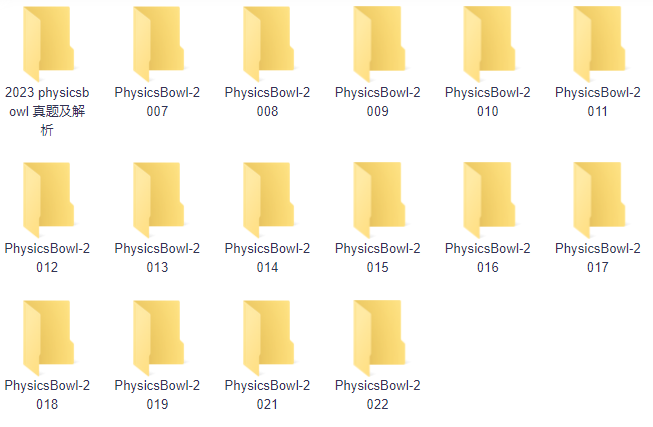
〖Scan to Get for Free〗 Physics Bowl 2007-2026 Past Papers + High-Frequency Formulas + Categorized Question Banks + Mock Assessments!
Competition Past Papers | Common Formula Sheets | Physics Bowl Prep Books | Key Concept Notes + Categorized Bank | Online Customer Service | WeChat Inquiries